Artificial Tree Trunk Materials Compared: FRP, Steel-Core & PU Bark
In an artificial tree the trunk is the structural part; the canopy and leaves are cosmetic on top of it. This guide explains the four trunk constructions we use, where each one belongs, and how to specify the right trunk so the finished tree stands straight, lasts outdoors and survives contact in busy spaces.
September 27, 2026 · Materials & Specifications · 6 min read
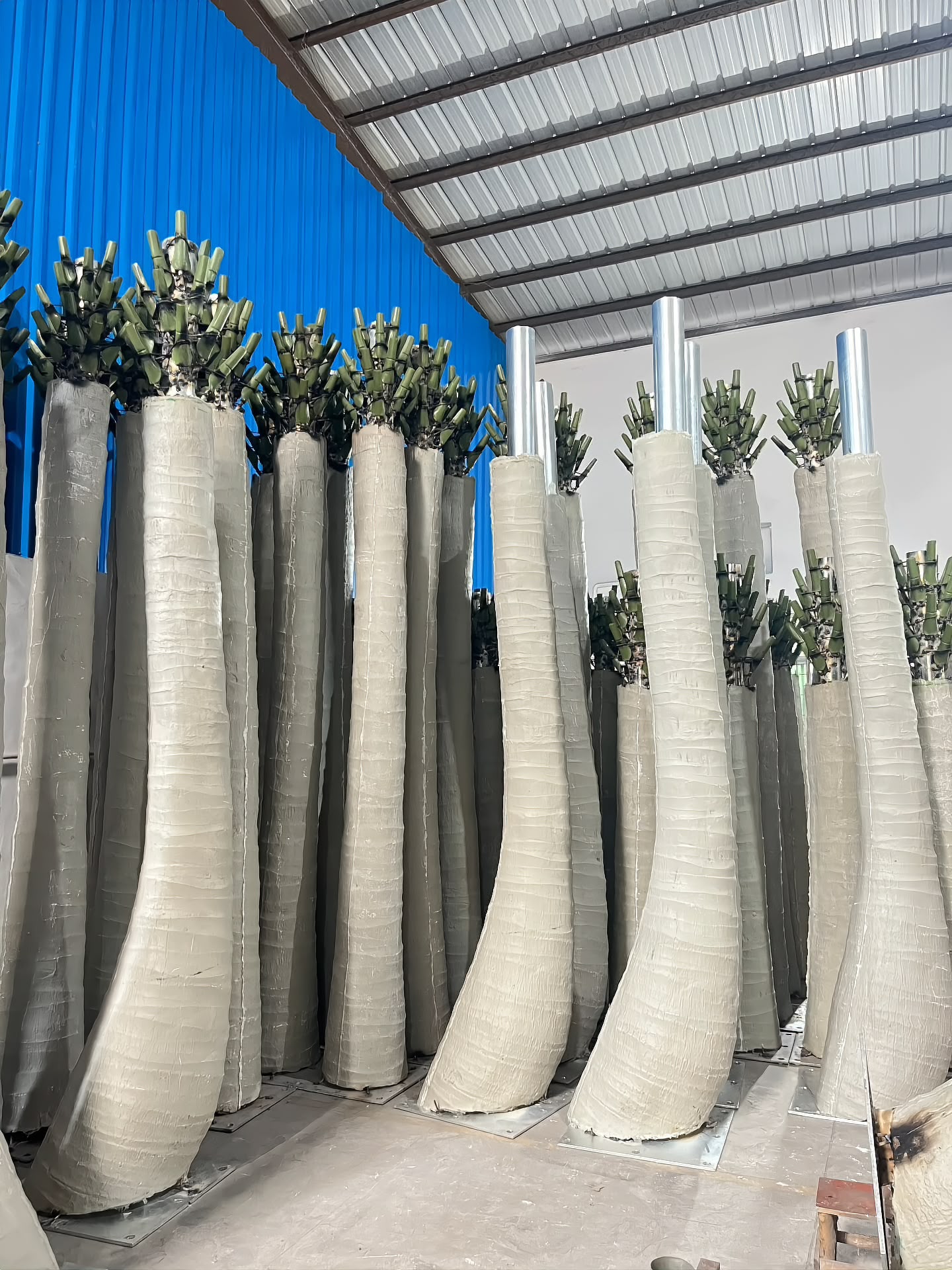
- The trunk is the structural part of an artificial tree; leaves and canopy are built on top of it.
- Glass-fibre (FRP) trunks are light and weather-stable — the default for most indoor and sheltered-outdoor trees.
- Large trees (roughly above 3 m) use a steel-core skeleton so they stand straight and resist wind and crowd contact.
- Moulded PU trunks give the finest bark texture for smaller decorative trees but are limited in size.
- Specify trunk material together with height, location and wind exposure, not as an afterthought.
Why the trunk decides everything else
In an artificial tree the trunk is the load-bearing member. Canopies and foliage are mounted on top of it. Whether a tree from 1 to 15 metres tall stands straight, resists wind, and survives being brushed by crowds comes almost entirely from the trunk's internal construction. Foliage material — typically ABS or PU — decides how the tree looks and how it weathers, but what carries the weight is always the trunk.
This is why the trunk question should be settled at the quotation stage, with height and installation environment stated up front. Changing the trunk later is not a quick swap; it is a different tree.
Glass-fibre reinforced (FRP) trunks
FRP is fibreglass cloth saturated in resin and cured into shape. The advantages are low weight, no rot, good weather stability, and the ability to mould natural bends and branches. Most indoor trees and sheltered-outdoor trees (covered, low-wind locations) use FRP as the default. A realistic bark or smooth finish can be applied to the surface in the same step.
The limitation is rigidity at scale. In a pure-FRP trunk above roughly 3 metres, or anywhere exposed to strong wind, the material alone is not enough to keep the tree perfectly straight over time.
Steel-core skeleton with moulded bark
Large-spec trees — generally 3 metres and above, and any outdoor, coastal or fall-risk location — hide a steel tube skeleton inside the FRP or PU bark shell. The steel core keeps the trunk vertical, carries cantilevered branches, and resists pushing. The exterior is finished with moulded bark that can be very realistic.
This is the standard for hotel atriums, shopping-mall voids and outdoor plaza trees. The trade-off is weight and shipping volume: very large trees are often built in sections and assembled on site. When you specify one, tell us the wind exposure and any load limits — the skeleton and base are engineered to that, not guessed.
Moulded PU trunks
Injection-moulded PU trunks are formed in a single mould, giving the finest, most consistent bark texture. They suit smaller decorative trees — tabletops, corners, feature pieces — where detail matters more than scale. Cost per unit is usually lower than a steel-core build, but the mould caps the maximum size and makes very large natural bends hard to achieve.
If your project needs many small-to-mid trees with priority on texture and budget, moulded PU is often the best value.
How to specify by location
- Indoor, under 3 m, low traffic: FRP or moulded PU — choose by texture and budget.
- Indoor atrium or lobby, over 3 m: FRP shell over a steel-core skeleton.
- Outdoor, sheltered: FRP + steel core, with foliage confirmed as UV-treated.
- Outdoor open, coastal, windy: steel core + weighted base, outdoor-grade UV foliage (3–5 year colour-fastness), and fire rating to the local standard (NFPA 701 / BS 5867 / EN 13501-1) where required.
- Near walkways, easy to touch: prefer steel core for push resistance.
Frequently asked questions
Is the trunk hollow?
How does an outdoor tree resist wind?
Can trunk colour be customised?
What are sampling and lead times?
Related pages
Planning a project?
Send dimensions, drawings or reference images and we will reply with a priced quotation and a production drawing — normally within 24 hours on business days.