Green Wall Panels vs Hedges: Which to Specify for Your Project
Green walls and artificial hedges solve the same problem — greenery without irrigation — but they install, maintain and read completely differently. This guide helps specifiers choose between modular wall panels and freestanding hedges before the drawings are locked.
September 27, 2026 · Buying Guide · 6 min read
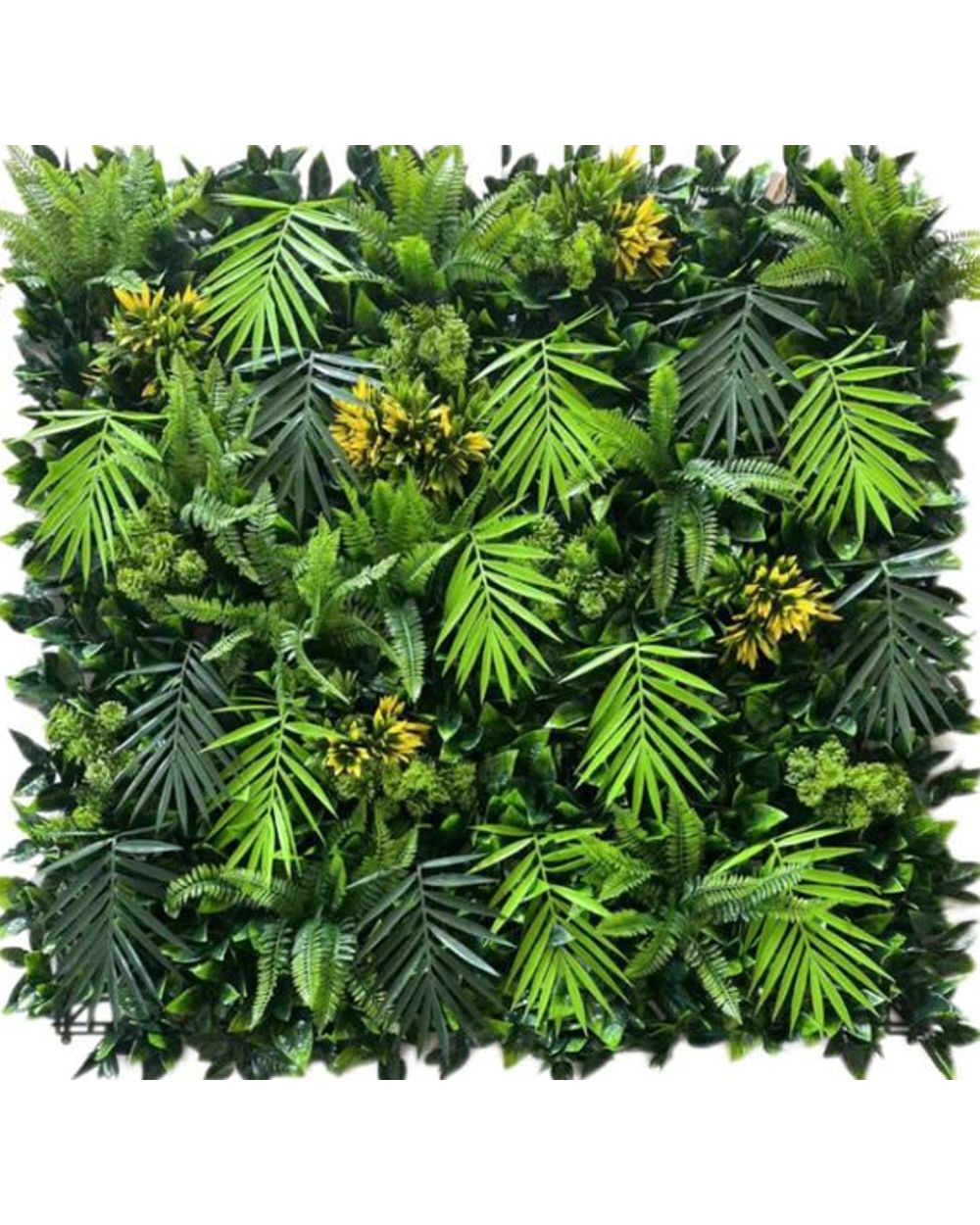
- Panels mount on a wall; hedges stand on the floor — the first question is whether you have a wall or floor space.
- Panels give a flat, seamless planted surface; hedges give depth, screening and a softer edge.
- Both are fire-rateable; panels need a suitable substrate and fixing method, hedges need a stable planter base.
- Maintenance is dusting either way — no irrigation, no seasonal replacement.
- Budget by surface area for panels and by linear or cubic volume for hedges; neither is priced like real planting.
Start with the surface you have
The cleanest way to choose is physical. A green wall panel needs a wall — interior drywall, a building facade, a booth backwall. An artificial hedge needs floor or planter space and stands on its own. If you have a bare wall and no floor room, panels win. If you need to screen a walkway or soften a plaza edge, a hedge or planter box is the natural fit.
What modular panels do best
Panels turn a flat surface into a continuous planted plane. In a lobby, restaurant or exhibition stand they deliver a high-end "designed" look with zero depth requirement. Because every panel of a style is made to the same construction, colour and density are consistent, which also makes per-order fire documentation straightforward.
The catch is the wall. Panels need a suitable substrate and a fixing method matched to it, and they suit mostly vertical, flat runs. We supply installation guidance with the order so the backing and fixings are specified, not improvised.
What hedges do best
Freestanding hedges and topiary in planter boxes give depth, screening and a softer silhouette than a flat wall. They define paths, hide utility boxes, and frame entrances without touching architecture. For outdoor landscapes, a hedge line often reads more natural than a wall panel mounted on a fence.
The trade-off is footprint and weight: a hedge needs a stable planter base, and large screens ship as bulky units. Indoors, planters also occupy floor area that panels would not.
Fire, UV and maintenance
Both can be supplied fire-retardant — NFPA 701 (US), BS 5867 (UK) or EN 13501-1 (EU) — with documentation issued per order referencing the exact specification. For outdoor use, specify UV-stable foliage: outdoor grade carries about a 3-year colour-fastness warranty, premium outdoor grade up to 5 years.
Maintenance is the same either way: no irrigation, no seasonal replanting, just occasional dust-down for high-visibility interiors and a rinse for outdoor installs. There is no soil, no pests, no watering schedule to fail.
How to budget (without inventing numbers)
We do not publish list prices because every project differs in size, foliage mix and fire/UV spec. The honest way to budget: panels are scoped by surface area (square metres of wall), hedges by linear or cubic volume (metres of screen or planter fill). Send the wall dimensions or the run length and we return a priced quotation with the trunk structure, foliage grade, fire and UV options itemised — so you can compare like for like.
Frequently asked questions
Can I mix panels and hedges in one project?
Do panels work on curved walls?
What is the minimum order?
Will the colour fade outdoors?
Related pages
- Green Walls & Hedges — Modular Panels
- Compliance: Fire & UV Documentation
- Hotel Lobbies & Atriums — Application Guide
Planning a project?
Send dimensions, drawings or reference images and we will reply with a priced quotation and a production drawing — normally within 24 hours on business days.