Which Artificial Plants Suit a Windowless Office Reception?
For artificial plants in an office reception with no light, build the scheme from three formats: a mixed-foliage green wall behind the desk (1×1 m panels, 90–120 stems per panel, 4–6 kg/m²), potted monstera from 0.65 m and dracaena fragrans from 1.2 m at the corners. Samples ship from 1 piece, stock SKUs deliver in 5–12 days and produced SKUs in 15–25; fire documents to NFPA 701, BS 5867 or EN 13501-1 are available per order.
October 30, 2026 · Buying & Sourcing · 8 min read · By Everflorae Editorial Team
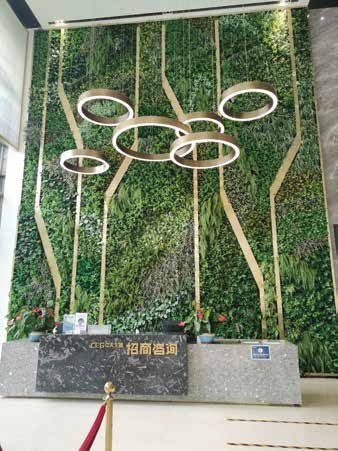
- A windowless reception removes the one variable that kills live planting — light — and with it sun-fade and glare, so the specification becomes a colour-under-lamps exercise.
- Three formats cover the whole scheme: 1×1 m mixed-foliage panels (90–120 stems per panel, 4–6 kg/m²) behind the desk, compact potted plants on the counter, and monstera or dracaena at 0.65–1.8 m in the corners.
- Shade-plant species read most convincingly without daylight: big, matte leaves that plausibly live without sun. Sun-loving silhouettes look wrong deep inside a floor plate.
- MOQ is per SKU in carton quantity, mixed SKUs are accepted, and sampling starts from 1 piece at unit price. Stock SKUs run 5–12 days, produced 15–25, custom 20–45.
Why a windowless reception rules out live planting
A reception desk is usually the position furthest from the facade, deep in the floor plate. Live foliage placed there survives on whatever the building’s lighting circuit provides, and office lighting — even a bright, modern LED grid — is not photosynthetically useful light. Within weeks the plants etiolate, drop leaves and end up on a replacement schedule that quietly becomes a line item in the facilities budget.
Artificial planting removes the biology from the equation: no light requirement, no irrigation line beside the visitor book, no replacement cycle. But “no light” does not make the specification easier — the light that does exist comes entirely from lamps, at fixed colour temperatures and fixed angles. Everything the visitor sees, they see by downlight. That shifts the buying checklist from horticulture to optics, and the rest of this guide follows that shift.
What “no light” actually changes in the specification
Four consequences matter when you specify foliage for a position that daylight never reaches:
- Species plausibility becomes a design decision. With sun through a window, almost any plant can justify itself. Under lamps only, the species has to plausibly be a shade plant — visitors’ eyes accept what their experience tells them.
- Colour is set by the lamps, not the leaves. Warm 3000 K downlights pull foliage toward olive; neutral 4000 K reads closest to daylight. Matte finishes hold their colour; glossy ones catch hot spots from narrow beams.
- Dust replaces weather as the enemy. No rain, no UV bleaching — but also no natural cleaning, so leaf surfaces and panel density must survive a damp-cloth dusting cycle.
- The compliance file does not change. A lobby without daylight is still a public commercial interior, and decorative foliage is still expected to demonstrate flame-propagation performance with documents.
Those four points convert directly into product choices — and into the three-format structure below.
The three formats that cover the whole scheme
Windowless receptions work best when the planting is structured like stage design: one backdrop, one counter layer, one set of corner statements.
- The backdrop: mixed-foliage green wall. Standard 1×1 m panels planted at 90–120 stems per square metre, weighing 4–6 kg/m², mounted behind the desk. The mixed-leaf construction is what makes it work without daylight: ferns, philodendron and trailing vines at different leaf sizes create the shadow depth a single-species wall loses under flat lamp light.
- The counter layer: compact potted plants. Anything from 10 to 50 cm — small ferns, pothos, succulents — in weighted pots that cleaning crews can lift and wipe around, kept below the sight line between a seated receptionist and a standing visitor.
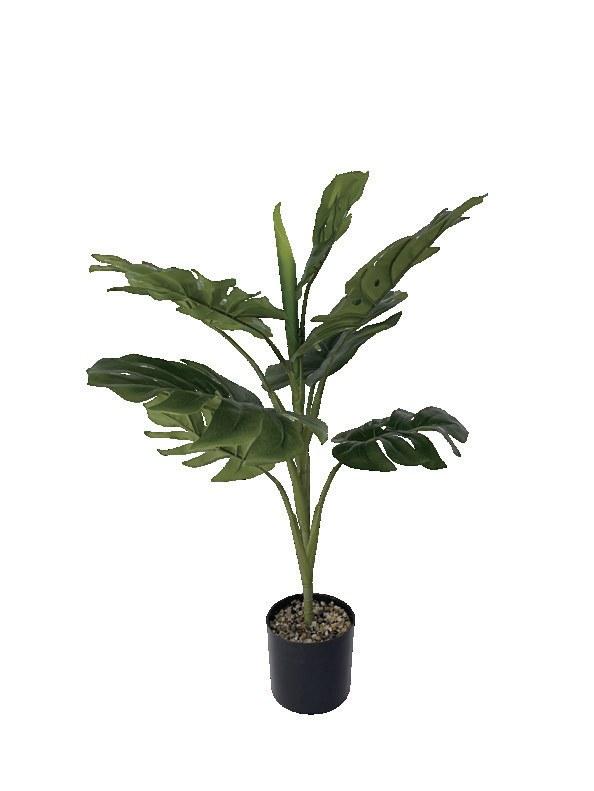
- The corner statements: monstera and dracaena. Potted monstera deliciosa starts at 0.65 m, dracaena fragrans runs 1.2–1.4 m in standard builds, and the taller produced series reaches 2.5–2.6 m for double-height positions. Both are classic office-plant silhouettes — which is exactly why they belong here.
The potted monstera and dracaena programme sits on the potted monstera & dracaena page, and the wider potted-plant range — bamboo, ficus, fiddle-leaf fig, bird of paradise and more — is on the artificial plants & foliage page.
Species that read convincingly without daylight
Visitors judge a plant twice: once for what it is, once for whether it could really live there. In a windowless room the second judgement is the unforgiving one, and it favours understory species — plants whose real equivalents evolved on forest floors:
- Monstera deliciosa — big split leaves, matte surface, made to catch scattered light. The most credible large foliage for lamp-lit interiors.
- Dracaena fragrans — upright cane with arching strappy leaves; a genuine low-light survivor in its live form, so nobody questions it.
- Ferns and pothos — the classic desk and shelf layer, and the filler species inside mixed green wall panels.
By contrast, sun-loving silhouettes — olive trees, eucalyptus, silver-leaf varieties — quietly contradict the room. A visitor may never articulate why, but a sun-loving plant thriving in a lightless corner reads as fake at a distance the reception cannot afford. Save those species for the entrance zone, where glazing exists to justify them.
Design for the downlights, not the sun
Because lamps are the only light source, the finish of the foliage matters as much as the species. Three practical rules:
- Matte over gloss. Narrow-beam downlights turn glossy ABS leaves into a row of specular highlights. Matte or semi-matte PU and fabric leaves absorb the beam and keep their colour.
- Mixed leaf layers over single-species walls. Flat, even lighting flattens a single-species wall into wallpaper; a panel that mixes leaf sizes and green tones rebuilds the shadow contrast the room no longer provides.
- Colour temperature in 3000–4000 K. Below 3000 K foliage goes olive and tired; above 4000 K it can look clinical. Sample both under the actual fittings before locking the specification.
One more lighting note: a narrow uplight at the base of a tall dracaena or monstera reproduces the canopy shading a real plant would cast on itself — the cheapest way to keep lamp-lit foliage looking dimensional after hours, when the reception is photographed most.
The sample checklist under your own lighting
Every claim in this guide can be verified on a physical sample — but only under the reception’s own lamps, not the supplier’s showroom spots. Before approving the batch, check:
- Leaf finish under your downlights. Rotate the sample through the angles visitors will actually see. Hot spots on glossy leaves show up immediately.
- Density from below and from the side. Green wall panels look dense straight-on and thin at grazing angles. Ask to see the panel edge and the backing.
- Underside tone. Real leaves are lighter on the underside; good artificial foliage reproduces this. A uniformly dark leaf reads flat under lamps.
- Weighted bases. Lift the pot. Counter plants get knocked; the weight is the fixture.
Samples ship from 1 piece at unit price, and the approved sample becomes the reference the production batch is checked against — which is how colour drift between sample and delivery gets prevented. The same sampling logic applies to the wider reception sourcing decisions covered in our office reception supplier guide.
Ordering, MOQ and lead times
Potted foliage is quoted per SKU, and the MOQ is measured in carton quantity rather than per order. Mixed SKUs are accepted on one purchase, so a typical windowless-reception programme combines green wall panels by the square metre with two or three potted formats — monstera at 0.65–0.75 m for the counter ends, dracaena fragrans at 1.2–1.4 m for the corners.
Lead time follows the specification. Stock SKUs run 5–12 days from order to ex-factory; produced SKUs, where the foliage is made to the season’s colour standard, run 15–25 days; custom work — dye-matched brand colours, bespoke pot finishes, private-label packaging — runs 20–45 days, because the colour must be matched, sampled and approved before the run starts. Colour consistency across a multi-SKU order is held by retained colour swatches per batch, so this quarter’s monstera matches last quarter’s dracaena.
Fire documentation for a commercial reception
Fire behaviour is the specification line that decides whether the programme survives a building inspection, and a windowless lobby changes nothing about it. Decorative foliage in public commercial interiors is expected to demonstrate flame-propagation performance, and the three documents that matter in practice are NFPA 701 (the US test for flame propagation of textiles and films), BS 5867-2 (the British flammability specification for non-domestic curtain and drape fabrics) and EN 13501-1 (the European reaction-to-fire classification).
Fire-retardant treatment is a per-order option, not a factory default. If the building’s fire officer requires documentation, request it with the quotation and keep the test papers in the project file — the test applies to the production batch and cannot be retrofitted after delivery. The three standards are summarised on our compliance page.
Frequently asked questions
What are the best artificial plants for an office reception with no light?
Do artificial plants need any light in a windowless reception?
What is the MOQ, and can one order mix formats?
How long is the lead time for a windowless-reception planting programme?
Sources & attributed quotations
Named sources behind this guide; quotations are verbatim from the issuing bodies, with links to the official pages.
“This standard establishes test methods to assess the propagation of flame of various textiles and films under specified fire test conditions.”
— NFPA (National Fire Protection Association), NFPA 701, Standard Methods of Fire Tests for Flame Propagation of Textiles and Films (2023 edition), official source
“This document provides the reaction to fire classification procedure for all construction products, including products incorporated within building elements with the exception of power, control and communication cables which are covered by EN 13501-6.”
— CEN (European Committee for Standardization), EN 13501-1, Fire classification of construction products and building elements — Part 1: Classification using data from reaction to fire tests, official source
- NFPA — NFPA 701, flame propagation tests for textiles and films
- CEN — EN 13501-1, reaction-to-fire classification of construction products
- Everflorae — Artificial Plants & Foliage: potted monstera, dracaena and mixed foliage programmes, specifications and lead times
Related pages
Related project cases
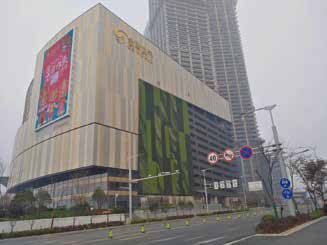
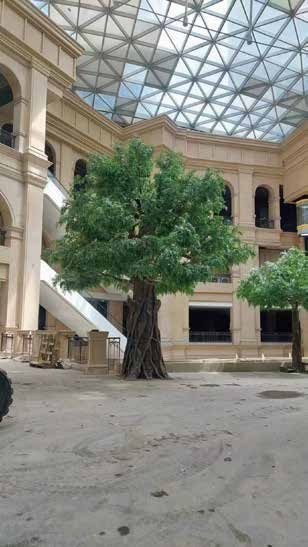
Real installations in this kind of setting — on-site photographs, no mock-ups.
Specifying planting for a windowless reception?
Send us the floor plan, the lighting colour temperature and the fire requirements. We will come back with a panel-and-pot layout, sampling terms and a lead time — normally within 24 hours on business days.
Sister brand · GardenStone
Pair it with landscaping stone (GardenStone)
From the same supplier group — GardenStone supplies decorative pebbles, gravel and landscape stone that complete the same hotels, resorts, malls and Japanese gardens. One source for the whole landscape.
Explore GardenStone →