How Is an Artificial Topiary Spiral Priced?
An artificial topiary spiral is priced per piece, and five build variables set that price: overall height (0.5–5 m), the steel gauge of the welded armature, how many foliage stems are tied per metre of spiral, the leaf grade — indoor or UV-stabilised outdoor — and the base. Made-to-order spirals run 20–45 days including drawing approval, and sampling starts at one piece.
November 1, 2026 · Buying & Sourcing · 8 min read · By Everflorae Editorial Team
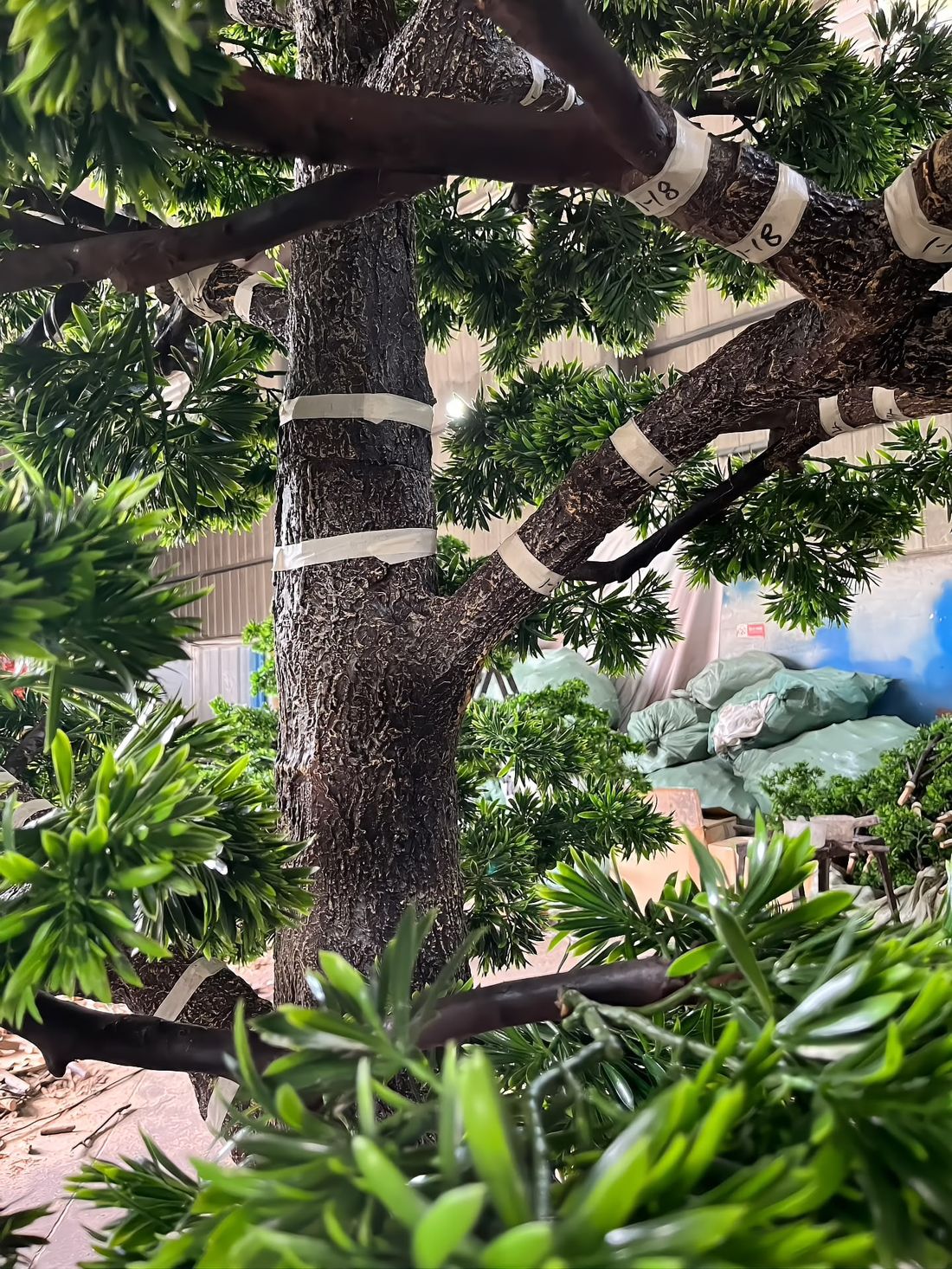
- Five variables set the price: height (0.5–5 m), armature gauge, stems per metre, leaf grade and base.
- Hand-tying dominates the cost; two spirals at the same height can differ by a factor of two.
- Freight follows cubic metres, not kilos — a tall, narrow form is priced by the crate its spread demands.
- Sampling starts at 1 piece, and made-to-order work runs 20–45 days including drawing approval.
What actually sits inside an artificial topiary spiral price?
A spiral is not a plant with a price tag. It is a small fabrication job that ends up looking like a plant: an armature welded to a drawn form, a core, foliage tied on stem by stem, a base, a paint finish, and a crate. Once you can see those parts, a quotation stops being one number and becomes a list you can check.
- The armature. Galvanised steel welded to the approved form. Gauge and bracing set both the material cost and whether the form still reads straight after two seasons outdoors.
- The core. A formed trunk running through the centre of the spiral, carrying the weight of the foliage and, at larger sizes, the wind load as well.
- The foliage. UV-stabilised ABS or PU boxwood, or a mixed foliage, moulded and cut to the form. Outdoor grade is a separate batch with its own material cost.
- Hand labour. Every stem is placed, twisted and trimmed against the drawing. This is the line that separates a sculpture from a green cone.
- Trunk work. Carving, texturing and painting where the brief calls for a visible trunk rather than a hidden core.
- The base. Weighted planter, bolted steel plate, or none at all if the piece drops into the client’s own planter.
- Finish. Natural, gloss or matte, matched to a retained colour standard so a repeat order reads the same.
- Packing and paperwork. A 3 m form ships in a crate, not a carton, and the drawing, 3D render and any fire papers travel with it.
On this line the material is a minority of the number. Two spirals of identical height can carry the same kilos of leaf and still sit far apart in price, because one took forty hours of tying and the other ninety. “Price per metre” is a convenient shorthand in a brochure; it is not a measurement you can hold a supplier to.

Which specifications move an artificial topiary spiral price the most?
Five variables explain most of the spread between one quote and the next. Ask for each of them as a number, because a specification you cannot measure is a specification you cannot compare.
| Build variable | What it does to the price | Number to put in the RFQ |
|---|---|---|
| Height and spread | Rises faster than height alone: a taller form needs a heavier armature, more stems and a bigger crate. | Overall height and maximum spread in metres, shown on the drawing. |
| Spiral pitch and stem count | Tying hours track stem count almost one to one; a tight dense spiral can double the labour of an open one. | Stems per metre of spiral, or leaf coverage per viewing face. |
| Leaf grade | Indoor grade and UV-stabilised outdoor grade are separate batches; outdoor material carries 3–5 years of colour performance. | Polymer (ABS or PU), UV stabilisation, and whether the position is permanent exterior. |
| Base and fixing | A weighted planter adds volume and kilos; a bolted plate ships cheaper but needs a fixing point on site. | Base type, footprint, bolt pattern and weight. |
| Packing | Knock-down forms use less cubic metre but need assembly on site; one-piece crates cost more to build and to move. | Crate dimensions, gross weight and CBM per piece. |
Read the table from the bottom up if freight is your constraint. Volume usually decides the freight bill on a tall, narrow form: the spiral occupies the crate its spread demands, so a 4 m piece with a 1.2 m spread can cost more to move than a 2 m piece that is twice as heavy.
Why do two factories quote different prices for the same 2 m spiral?
Because height is the only thing the two quotes agree on. Under the same “2 m” there can be a 16 mm or a 22 mm tube, 60 or 120 stems, a carved trunk or a straight pole, numbered quality tags on every limb or none, a 3D render before welding or a photograph after it. Each of those is real money, and none of them appears in the line item “2 m spiral”.
The failure mode is predictable. A sparse spiral photographs beautifully against a white workshop wall, then reads thin at one metre in a hotel lobby, and reads worse after a summer outdoors once a light frame has taken the load of a heavy canopy. Buying from the photograph is how a project ends up replacing a set in year two.
There is also the question of what a quote leaves out. Drawing approval, the render, crating, fire testing and the second quality check before packing are all optional in this industry. A quote that skips three of them is not cheaper; it is shorter.
What should an artificial topiary spiral supplier put in the quotation?
A usable quotation answers six lines. A supplier who cannot answer them in writing has not priced your spiral, only a height.
- Price basis. Per piece, ex-works, by height and spread, with the currency and the Incoterm named.
- Material specification. Tube gauge, galvanising, trunk construction, leaf polymer and UV grade.
- Stem density. Stems per metre or per viewing face, and whether that number is contractual or indicative.
- Base and fixing. Type, weight, footprint and bolt pattern — or an explicit “no base supplied”.
- Packing. Crate dimensions, gross weight and CBM per piece, and whether the form ships assembled.
- Calendar. Drawing, render approval, production, QC and packing, with the 20–45 day window given as a date rather than a range.
Ask for the fire option in the same message. NFPA 701, BS 5867-2 and EN 13501-1 testing applies to the production batch and cannot be added after the fact, so it belongs in the first quotation rather than in a later email. A complete enquiry — height, spread, quantity, setting and fire requirement — normally comes back priced within 24 hours on business days.
How do you compare two spiral quotations without being misled?
Put both quotes on one specification sheet before you look at the totals. Four things have to match, or you are comparing two different products:
- Height and spread. A 2 m × 0.6 m spiral and a 2 m × 1 m spiral are not the same object, and the second needs roughly three times the foliage.
- Grade. Indoor against UV-stabilised outdoor is a material change, not a discount.
- Incoterm. Ex-works against CIF hides freight inside the unit price and makes the cheaper line look expensive.
- Packing. One quote in a built crate and one knock-down is a different installation job with a different labour cost at destination.
Then ask each supplier for the drawing or 3D render that belongs to the price. The render is the cheapest part of the order and the last place where a misunderstanding is still free to fix — once the armature is welded, a change of pitch or spread is a new form.
What does landed cost include beyond the ex-works price?
Six items sit between the factory gate and a fixed spiral in a lobby, and only one of them is negotiable with the factory:
- Crating and export packing, usually quoted as a separate line on tall forms.
- Freight by volume. Spirals are volumetric cargo; a 3 m sculpted form is typically 60–120 kg of steel and foliage inside a crate sized for its spread.
- Insurance, duty and destination port charges.
- Inland haulage, including a vehicle that takes the crate length.
- Lifting and fixing. Two people and equipment for anything above head height, plus the fixing point the base assumes.
- Spares. A working 5% allowance is normal on high-traffic installations, ordered in the same batch so the colour matches the set.
Budget the spares line rather than discovering it. A replacement spiral ordered eighteen months later is a different colour batch, and on a matched pair the difference is visible from the door.
Where can cost come down without changing what the client sees?
Five cuts are honest, because they remove work that nobody in the finished space can detect:
- Choose height by viewing distance. A spiral read from six metres across a lobby needs less stem density than one beside the entrance door.
- Standard bases, local planters. Shipping a weighted planter across an ocean costs more than buying the planter at destination, where the project already has a supplier.
- Indoor grade in sheltered positions. Under a canopy, in a mall concourse or behind glass, indoor grade is the correct specification rather than a compromise.
- One run, several forms. A pair, or a set of four heights for one atrium, shares setup, colour batch and crate space.
- Simplify what is hidden. Trunk carving behind a planter, or above a ceiling line, is money no visitor will ever see.
Four things are not worth cutting: tube gauge on anything outdoors, stem density on a form viewed from inside two metres, UV grade for permanent exterior positions, and the fire documentation. Each of those failures shows up as a visible defect within a season, and the replacement costs more than the saving.
Frequently asked questions
How much does an artificial topiary spiral cost?
Why is a 3 m spiral more than three times the price of a 1 m spiral?
How long does production take once the drawing is approved?
Is a cheaper spiral suitable for a permanent outdoor position?
Sources & attributed quotations
Named sources behind the material and fire context used in this guide. Quotations are verbatim from the issuing bodies, with outbound links to the official pages.
“This document specifies methods for exposing plastic specimens to fluorescent UV lamp radiation, heat and water in apparatus designed to simulate the weathering effects that occur when plastic materials are exposed in actual end-use environments to global solar radiation, or to window-glass filtered solar radiation.”
— ISO (International Organization for Standardization), ISO 4892-3:2024, Plastics — Methods of exposure to laboratory light sources — Part 3: Fluorescent UV lamps, official source
“This standard establishes test methods to assess the propagation of flame of various textiles and films under specified fire test conditions.”
— NFPA (National Fire Protection Association), NFPA 701, Standard Methods of Fire Tests for Flame Propagation of Textiles and Films, official source
- ISO — ISO 4892-3:2024, fluorescent UV lamp exposure of plastics
- NFPA — NFPA 701, Standard Methods of Fire Tests for Flame Propagation of Textiles and Films
- ASTM International — ASTM G154-23, operating fluorescent UV lamp apparatus for exposure of materials
- Everflorae — Topiary & Sculpted Forms, 0.5–5 m built to drawing
- Everflorae — fire, UV and compliance standards
Related pages
Related project cases
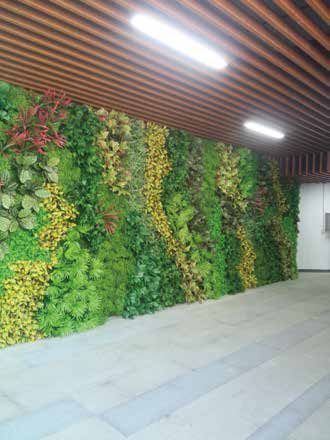
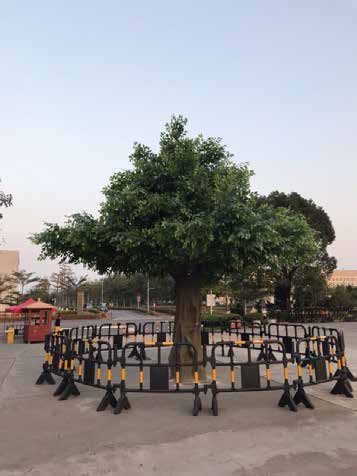
Two installations where the form, the frame and the crate were priced before the first stem was tied.
Pricing a spiral for a project?
Send the height, the maximum spread, the quantity, the setting and the fire requirement — and we will come back with the unit price, the crate volume, the drawing and a dated lead time, normally within 24 hours on business days.
Sister brand · GardenStone
Pair it with landscaping stone (GardenStone)
From the same supplier group — GardenStone supplies decorative pebbles, gravel and landscape stone that complete the same hotels, resorts, malls and Japanese gardens. One source for the whole landscape.
Explore GardenStone →