Artificial Plants vs Real Plants: The Total Cost of Ownership for Commercial Projects
Every fit-out debate about greenery eventually hits the same question: real or artificial? Most answers compare the invoice price, which is the least useful number on the page. This guide breaks down total cost of ownership — purchase, maintenance, replacement, compliance and downtime — the way a project buyer should actually compare them.
September 26, 2026 · Comparisons · 8 min read
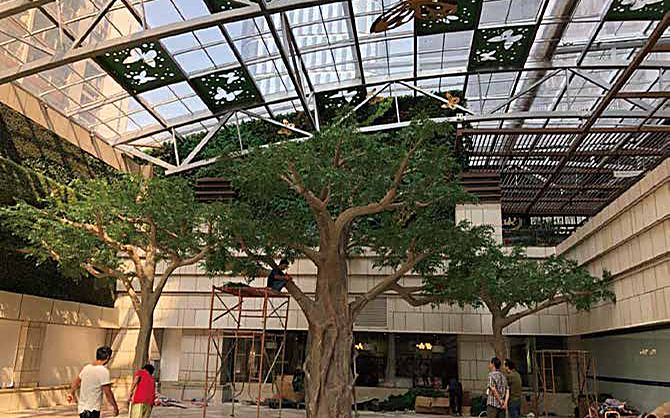
- Invoice price is the smallest line in commercial greenery; maintenance contracts, plant replacement cycles and compliance work dominate the 5-year cost of live planting.
- Real plants fail fastest exactly where projects need them most: low-light atriums, air-conditioned lobbies and poolside zones with heat and chlorine.
- Artificial greenery wins on TCO in interior hospitality, retail and poolside applications; real planting still wins where irrigation and natural light already exist outdoors.
- The artificial option only holds its cost advantage if you specify UV grade (3-year outdoor, up to 5-year premium) and per-order fire documents (NFPA 701, BS 5867, EN 13501-1).
- Compare suppliers on what happens after delivery: sample units at MOQ 1, production photos of your batch, and replacement availability years later.
Why do real plants keep failing in commercial interiors?
A live ficus in a shopping mall is not growing in a garden. It is growing under mixed daylight and 4000 K downlights, in conditioned air at 40% humidity, in a planter nobody wants to drain, and it is being brushed past by thousands of visitors a week. Commercial interiors are, for most species, a slow-motion failure environment.
The usual result is a maintenance contract that quietly becomes a replacement contract: plants decline, get swapped, decline again. The greenery looks perfect on opening day and noticeably tired by the second year — and the fit-out team that chose it has already moved on to the next project.
What does total cost of ownership actually include for greenery?
When project buyers compare "artificial vs real", the useful comparison has five cost lines, and only one of them appears on the quotation:
- The invoice is the smallest number. Over a typical commercial cycle, the recurring lines — maintenance, replacement, the labour of managing them — are where live planting quietly loses its head start.
- Location decides everything. The harsher the environment (low light, air-conditioning, chlorine, heat), the faster real plants consume the two recurring lines.
| Cost line | Real plants | Artificial plants |
|---|---|---|
| Purchase price | Lower per unit | Higher per unit — this is the only line where live planting wins |
| Maintenance | Ongoing contract: watering, pruning, pest control, feeding | Occasional dusting; no water, no soil, no pests |
| Replacement | Recurring — plants decline and are swapped on cycle | Essentially none indoors; outdoor foliage covered by 3–5 year UV warranty |
| Compliance | Soil, drainage and irrigation approvals in some fit-outs | Fire documents per order: NFPA 701, BS 5867, EN 13501-1 |
| Downtime & risk | Dropped leaves, water stains, pests near food zones | None — installation is one-time |
Where does artificial greenery win on lifetime cost?
Three settings come up again and again in our export orders, and they are exactly the settings where live planting struggles most:
- Hotel lobbies and atriums. Large statement trees (built from 1 m up to 15 m in our workshop) installed once, with no watering rotas near finishes and no leaf-drop into water features or HVAC grilles.
- Restaurants, cafés and food courts. Health codes and common sense both rule out soil, pests and standing water near food. Artificial greenery delivers the look with zero of those risks.
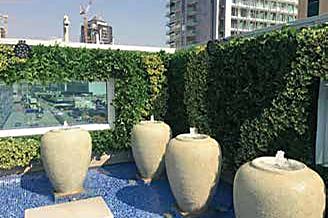
- Resorts, pools and water parks. Chlorine, salt spray, wind and hot deck surfaces kill live planting fastest here — and this is precisely where UV-graded artificial palms (2–12 m) and planters are specified instead.
When are real plants still the better choice?
We manufacture artificial greenery, and we will still tell you when not to buy it. Outdoor areas that already have irrigation, natural light and a gardening team — entrance landscapes, podium gardens, temperate-climate streetscapes — are often cheaper with real planting, because the two cost lines where artificial wins (maintenance, replacement) are already being paid for elsewhere in the building budget.
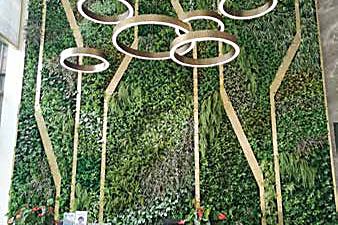
There is also a brand argument: some properties genuinely want the story of living walls and real trees, and are willing to fund the maintenance that keeps them alive. That is a legitimate choice — it is just one that should be priced honestly at design stage, not discovered in year two.
The honest summary: artificial greenery wins wherever the environment is hostile to living plants, and live planting wins wherever the environment would support it anyway.
How do you make sure the artificial option keeps its cost advantage?
The TCO argument for artificial greenery collapses if the product fades or is rejected at inspection, so the specification is where the money is protected. Three confirmations matter:
First, match the foliage grade to the environment: outdoor grade carries a 3-year colour-fastness warranty and premium outdoor grade up to 5 years — state the setting (direct sun, poolside, coastal) when you enquire. Second, if the project is a commercial fit-out, require fire test documents issued per order (NFPA 701, BS 5867 or EN 13501-1), not a generic catalogue certificate. Third, buy from a manufacturer that can prove production: sample units at MOQ 1 piece, production photos of your actual batch, and lead times you can plan around — 7–15 days for standard items, 20–45 days for custom builds, 30–60 days for large projects.
Frequently asked questions
Are artificial plants cheaper than real plants for a hotel or mall?
How long do commercial-grade artificial plants last?
Do artificial plants need any maintenance at all?
What should I put in the specification to protect the cost advantage?
Related pages
Planning a project?
Send dimensions, drawings or reference images and we will reply with a priced quotation and a production drawing — normally within 24 hours on business days.