What Is the Best Artificial Topiary Spiral for a Restaurant?
The best artificial topiary spiral for a restaurant is a fire-rated, wipe-clean sculpted form 1.2–2.4 m tall on a galvanised steel armature, with UV-stabilised ABS/PU foliage in a matte finish. Samples start at 1 piece, a standard finish ships in 7–15 days and a custom form takes 20–45 days including drawing approval.
November 10, 2026 · Specification & Selection · 8 min read · By Everflorae Editorial Team

- The restaurant band is 1.2–2.4 m: the form reads above seated guests without hitting downlights or the sightline to a sign. The sculpted range runs 0.5–5 m and the armature is welded to your drawing.
- Specify matte ABS/PU foliage. A grease film that is invisible on matte reads as haze on gloss under warm downlights, and a dining room cannot be closed for a re-finish.
- Fire documentation is issued per order against NFPA 701, BS 5867 or EN 13501-1 — the paper a landlord or insurer asks for before the greenery goes in.
- MOQ is 1 piece, standard finish 7–15 days, custom 20–45 days including the 3D render and drawing sign-off.
Why does a topiary spiral suit a restaurant?
Dining rooms are measured in covers per square metre, so floor area is the most expensive thing in the building. A spiral buys vertical interest for a footprint of roughly 0.5–0.8 m: the eye is pulled up the helix while the space under it still takes a chair. It also removes the service problem that live planting creates. There are no dropped leaves next to a plate, no soil, no watering trolley crossing the pass at eight o’clock, and no pollen in a room where guests sit for two hours at a time. In a space judged in the first thirty seconds, a sculpted spiral at the host stand does the job of a floral arrangement that would otherwise be replaced every week. The topiary and sculpted forms range covers the cones, spheres, cubes and helixes this brief usually needs.
Which height and footprint fit a dining room?
The sculpted range runs 0.5–5 m, but a restaurant uses a narrow slice of it. Most dining rooms sit between 2.7 m and 4 m to the ceiling, with downlights, pendants, sprinkler heads and ductwork already competing for the top 600 mm. That leaves 1.2–2.4 m as the working band: tall enough to be read from the door, low enough to stay clear of the light fittings and of any signage behind it. A 1.6–2 m form at a host stand is the most common single order; paired 1.4–1.8 m forms suit an entrance.
Footprint matters as much as height. The base — a steel plate, a concrete block or a planter — sets the diameter you have to keep clear, and it has to survive a chair being pushed into it fifty times a night. A 3 m form typically weighs 60–120 kg, so check the narrowest door and the lift on the delivery route before the order is placed, and plan two people plus a trolley for the install. Restaurants usually take delivery before service, so the schedule should name the window rather than the day.
Where do restaurants actually place a spiral?
Five positions account for most restaurant orders, and each one has a different height logic.
- Host stand or maître d’ station. 1.6–2.2 m, single form. It marks the queue point without a stanchion, and it gives the front-of-house team something to stand beside.
- Entrance vestibule. A pair at 1.4–1.8 m frames the door. In a wind lobby the base needs weight and a non-slip foot, because the floor is cleaned and the doors move air all evening.
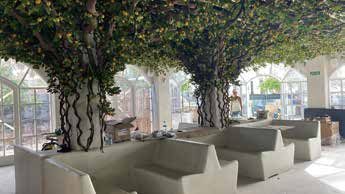
- End of a banquette run. 1.2–1.8 m, kept narrower than the seat back so it terminates the sightline instead of reading as a partition.
- Bar back or shelf top. 0.5–0.9 m miniature spirals and cones, above the reach of the pass but inside the light.
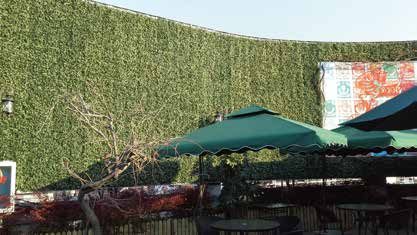
- Terrace or courtyard. Outdoor grade, 1.2–2.4 m, paired with a planter that can be drained. This is the one position where UV grade is not optional.
What foliage and finish work under restaurant lighting?
Warm downlights at close range are unforgiving. Gloss foliage picks up a specular highlight along every leaf edge and reads as plastic; matte foliage holds its colour and absorbs the light the way a real boxwood does. The topiary line offers natural, gloss and matte finishes, and for a dining room the answer is almost always matte. Foliage is UV-stabilised ABS or PU, which is what gives it the 3–5 year colour life outdoors, and the same grade is used indoors so a unit that sits near a window does not drift out of tone with its neighbour.
Colour consistency is the detail that separates a chain rollout from a one-off. Two spirals ordered six months apart will only match if the supplier holds a colour standard and a retained sample from the first batch. Ask for that in writing if the project has more than one site, and ask for it before the second purchase order rather than after.
What fire documentation will the landlord or insurer ask for?
Decorative foliage is tested as a textile or film for flame spread, so the report names the fabric and the standard, not the plant. The three documents that come up in restaurant projects are NFPA 701 in the United States, BS 5867-2 in the United Kingdom and EN 13501-1 in the European Union. Ask for the report issued against your order — product reference, quantity and date — rather than a generic brochure for the product family. A test report and a certificate are not the same document, and a landlord reviewing a fit-out will usually want the report that matches the goods on site.
Fire performance is a material choice, not a location choice: a spiral two metres from a kitchen pass and one in a lobby are tested the same way. What changes is the paperwork the building asks for before opening.
How do you keep a spiral clean in a working dining room?
Airborne cooking fat settles on everything in a restaurant, foliage included, and it is the main reason artificial planting looks tired after a year. A wipe every four to six weeks with lukewarm water and a neutral soap is enough, working from the top of the helix down so nothing drips onto cleaned leaves. Skip solvents and bleach — they dull the finish and can lift the colour coat. Dry with a cloth rather than leaving it wet, especially on matte surfaces where water marks show.
The same visit is the moment to check the armature: base fixings, any joint where a section was bolted together, and whether the form still stands vertical. Ten minutes twice a quarter is the whole maintenance programme, which is the point — the room has no horticulturist and no irrigation line, and the spiral still reads as designed greenery at every service.
Is the same spiral suitable for a shopping mall?
Yes, and the brief barely changes. For a shopping mall the working height moves up to 1.8–3 m because atrium ceilings are higher and the form has to read across a concourse rather than across a dining room. Everything else carries over: galvanised steel armature welded to the drawing, fire-rated foliage with a per-order report, MOQ 1 piece, 7–15 days standard and 20–45 days custom. Two practical differences are worth planning for. Cleaning access is usually a scissor lift rather than a step ladder, so the form should be specified in sections that can be re-assembled on site; and a mall fire file is reviewed once for many tenants, so the documentation has to be ready early. The hotel lobby version of this brief covers the atrium case in more detail.
How do you order a restaurant spiral, and how long does it take?
Send six things with the first enquiry: finished height (to the top of the form or including the base), the form and a reference photo, the quantity per site, the position and its lighting, the fire standard your landlord requires, and the base or fixing detail. A 3D render comes back before production so the form is approved before the armature is welded, and that approval sits inside the quoted window rather than in front of it.
MOQ is 1 piece. Standard finish ships in 7–15 days; a custom form including drawing approval runs 20–45 days, and quotations normally return within 24 hours on business days. Because the price is quoted per drawn unit rather than from a list, the comparison you should ask for is unit price at your quantity against one drawing, the render included, the written lead time, and the weight with carton volume. The vetting questions in how to choose a topiary spiral manufacturer and the schedule breakdown in how topiary spiral lead time works fill in the rest, and the restaurant and café application guide shows how the greenery line sits alongside tables, bars and terraces.

Frequently asked questions
What is the best height for a topiary spiral in a restaurant?
How much does a restaurant artificial topiary spiral cost?
How long does a custom restaurant topiary spiral take to deliver?
Is a topiary spiral suitable for a shopping mall as well?
Sources & attributed quotations
Named sources behind this guide; the quotations are verbatim from the issuing bodies, with links to the official pages.
“This document specifies methods for exposing plastic specimens to fluorescent UV lamp radiation, heat and water in apparatus designed to simulate the weathering effects that occur when plastic materials are exposed in actual end-use environments to global solar radiation, or to window-glass filtered solar radiation.”
— ISO (International Organization for Standardization), ISO 4892-3:2024, Plastics — Methods of exposure to laboratory light sources — Part 3: Fluorescent UV lamps, official source
“This standard establishes test methods to assess the propagation of flame of various textiles and films under specified fire test conditions.”
— NFPA (National Fire Protection Association), NFPA 701, Standard Methods of Fire Tests for Flame Propagation of Textiles and Films, official source
- ISO — ISO 4892-3:2024, methods of exposure to laboratory light sources, fluorescent UV lamps
- NFPA — NFPA 701, Standard Methods of Fire Tests for Flame Propagation of Textiles and Films
- ASTM International — ASTM G154-23, operating fluorescent UV lamp apparatus for exposure of materials
- Everflorae — Topiary & Sculpted Forms: size range, frame, foliage and finish specifications
Related pages
Related project cases
Real installations in this kind of setting — on-site photographs, no mock-ups.
Specifying a topiary spiral for a restaurant?
Send the height, the position, the quantity and the fire or UV grade your project requires. We will reply with a 3D render route, unit pricing at your quantity and lead time — normally within 24 hours on business days.