How to Source Artificial Olive Trees from a Chinese Manufacturer
Olive trees are the most requested artificial tree in hospitality design right now — and also one of the easiest to get wrong. This guide explains how a factory actually builds one, which details separate a convincing tree from a plastic-looking one, and what to confirm in writing before you commit to a bulk order.
September 25, 2026 · Sourcing Guides · 7 min read
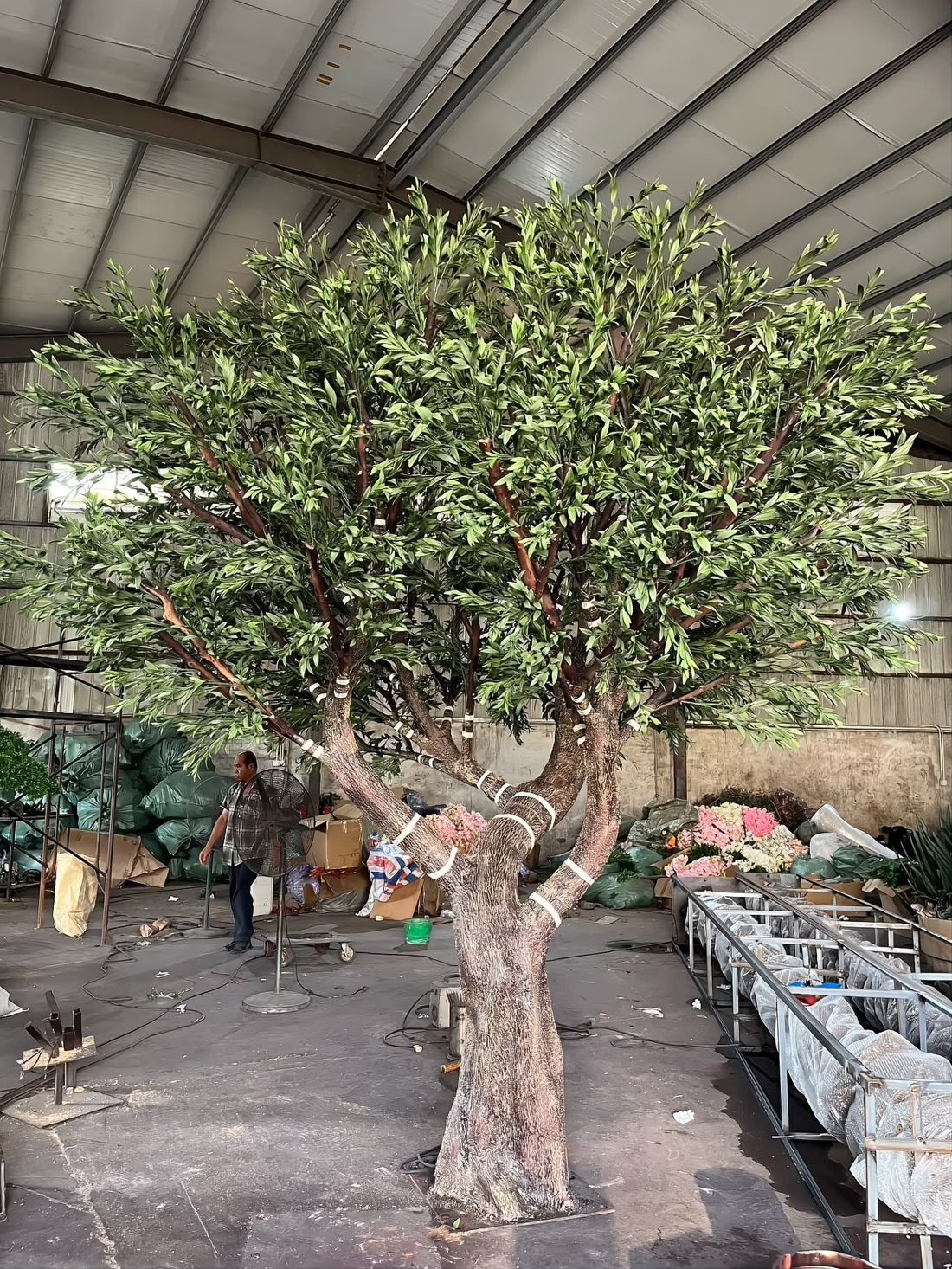
- A convincing faux olive tree is built on a real steel or fibreglass core with a hand-shaped trunk — not a plastic moulded pole.
- Ask for the trunk finish (real-bark texture, colour wash), fruit density and leaf colour variance in writing; these three details decide whether the tree reads as real.
- Confirm UV warranty (3 years outdoor grade, up to 5 years premium grade) and fire test documents (NFPA 701, BS 5867 or EN 13501-1) per order if the project needs them.
- Standard lead time is 7–15 days for catalogue trees and 20–45 days for custom builds; samples ship at MOQ 1 piece.
- Always request production photos of your actual batch — not catalogue images — before the container is sealed.
Why olive trees dominate commercial artificial planting schemes
Walk into any recently opened hotel lobby, restaurant group flagship or mall atrium and the odds are you will see an olive tree. Designers favour it because the silvery-green palette sits quietly behind almost any brand colour, the canopy can be pruned to any silhouette, and unlike a fiddle-leaf fig it never drops leaves in an air-conditioned atrium.
The commercial demand is real — which is why the market is flooded with two very different products sold under the same name: injection-moulded trees on a plastic pole, and hand-built trees on an engineered core. The price gap is large; the visual gap is larger.
How a factory-built olive tree is actually made
In our workshop every olive tree starts as a welded steel core — the trunk skeleton and branch sockets are cut and welded to the specified height and canopy spread, then measured against the production drawing before anything else happens.
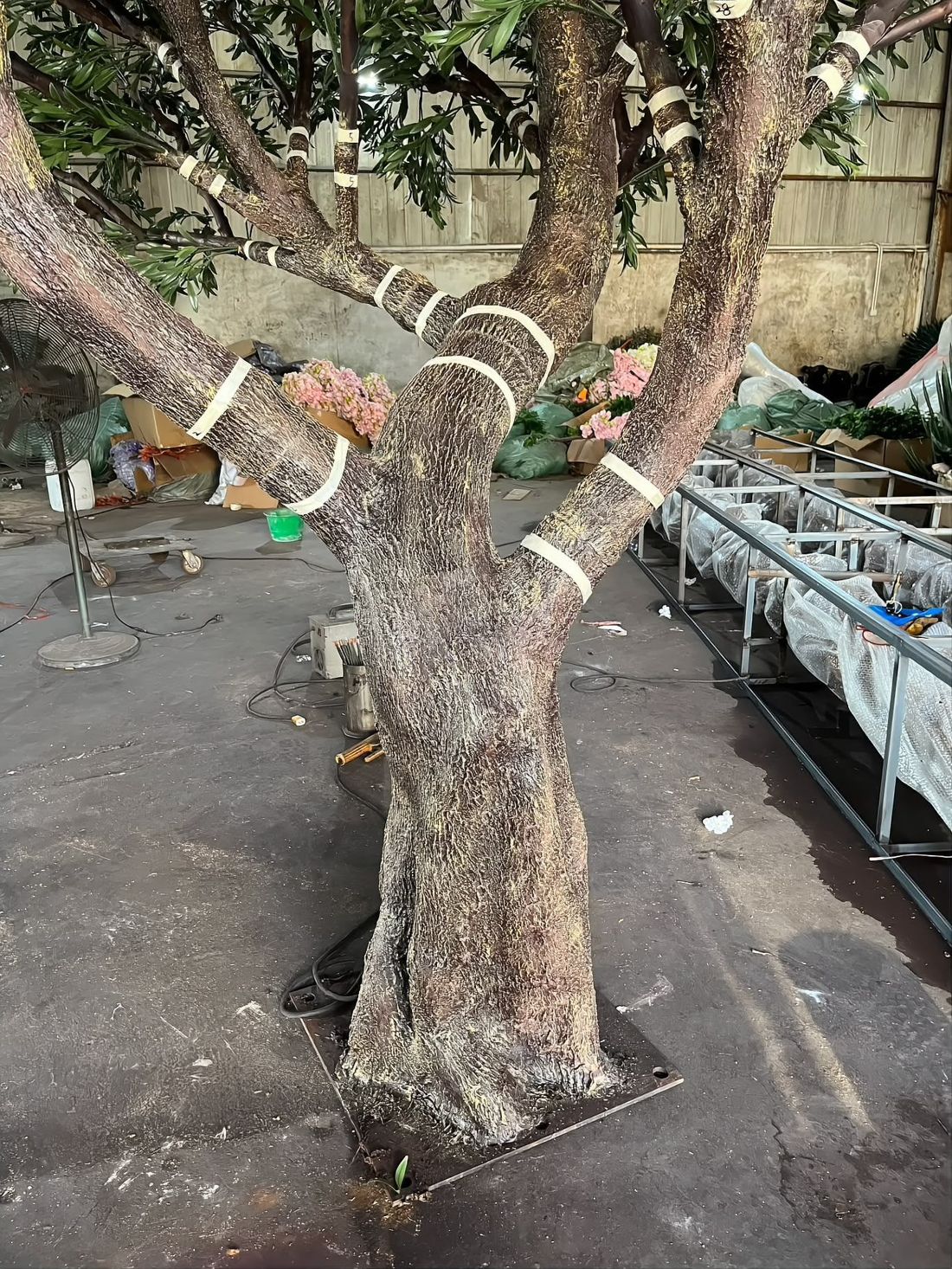
The bark is not a printed sleeve. A fibreglass and resin skin is applied by hand over the core, then worked into the gnarled ridges and colour-washed so the trunk reads correctly at 1–2 metres, not just across the room. Branches slot into welded sockets, which is also what allows a 4–6 m tree to be shipped in sections and bolted together on site.
- Core: welded steel trunk with branch sockets, base plate for bolting or planter fixing.
- Bark: hand-applied fibreglass skin with texture and colour wash — no visible seam lines.
- Canopy: PE/PU foliage in mixed green-silver tones, wired onto branches by hand.
- Fruit: olives set at a stated density — worth specifying, because fruit density is the single most visible realism cue.
The three specifications to put in your purchase order
Most complaints about imported faux olive trees come down to three things that were never written down. Put all three in the PO and the risk moves to the supplier:
- Trunk finish — request photos of the actual bark treatment, not a render. Compare at 1 m distance and at room scale.
- Canopy diameter and density — a "3 m tree" with a 1.2 m sparse canopy looks cheap under lobby lighting. State both height and spread.
- Leaf and fruit variance — one flat green tone reads as plastic. Specify mixed tone ranges and a fruit density you can verify in sample photos.
| Spec line | What to write | Why it matters |
|---|---|---|
| Height × spread | e.g. 3.5 m H × 2.2 m spread | Canopy spread is what makes or breaks the look under lighting |
| Trunk finish | Hand-applied bark, colour-washed, no visible weld seams | The most common failure point of cheap imports |
| Fire standard | NFPA 701 / BS 5867 / EN 13501-1 — documents issued per order | Required by most commercial fit-outs; ask before production, not after |
| UV grade | 3-year outdoor grade or 5-year premium grade | Prevents fade complaints on outdoor or sun-facing installs |
What does a wholesale artificial olive tree cost to ship?
Olive trees pack better than most artificial trees because the canopy foliage compresses without damage and the trunk sections nest. A 3–4 m tree typically ships in 2–3 cartons plus a trunk section; a 6 m specification tree ships bolt-together with the canopy in numbered bags.
We ship sea, air and express (DHL/FedEx/UPS). For a mixed container of trees and green wall panels, sea freight is the norm; sample orders go by express in 5–7 days. Standard lead time is 7–15 days for catalogue specifications and 20–45 days for custom heights and canopy shapes — large multi-tree projects should allow 30–60 days including approvals.
One practical tip: ask the factory for the packed dimensions and gross weight of your specification before you book freight. Canopy diameter, not height, drives the carton size.
How to verify a supplier before the bulk order
Order one sample unit at MOQ 1 piece and put it under the lighting conditions of your actual site — a sample that looks right in a showroom can fail under 4000 K downlights. Check bark texture at arm's length, leaf colour variance from 2 m, and whether olives are wired (they must not fall off in transit).
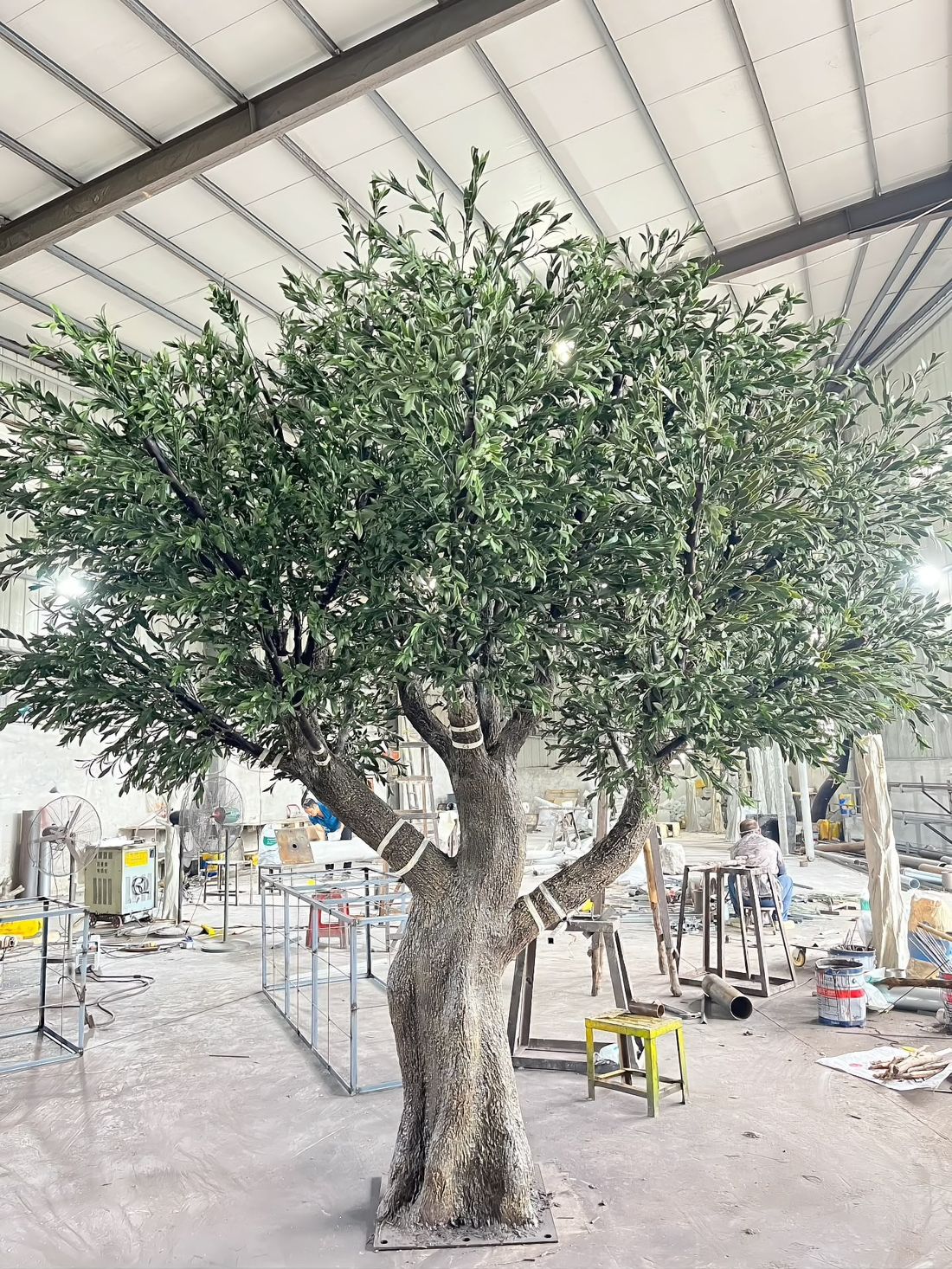
Then ask for production photos of your actual batch at three stages: welded core, bark applied, canopy finished. Any manufacturer with its own workshop can do this in a day; a trading company buying from a market stall cannot. Finally, confirm the fire test documents and UV warranty are issued per order — a generic catalogue certificate is not project documentation.
Frequently asked questions
What is the minimum order for artificial olive trees?
Can the tree be matched to a rendering in my design deck?
How tall can an artificial olive tree be made?
Do artificial olive trees work outdoors?
Related pages
Planning a project?
Send dimensions, drawings or reference images and we will reply with a priced quotation and a production drawing — normally within 24 hours on business days.