What Is the MOQ for Artificial Boxwood?
Artificial boxwood MOQ is quoted per SKU, not per order: sampling starts at 1 piece, and bulk minimums then follow the model and panel format. Standard panel sizes are 50×50, 50×100 and 100×100 cm, standard lead time is 7–15 days, and fully custom runs take 20–45 days.
September 29, 2026 · Buying & Sourcing · 8 min read · By Everflorae Editorial Team
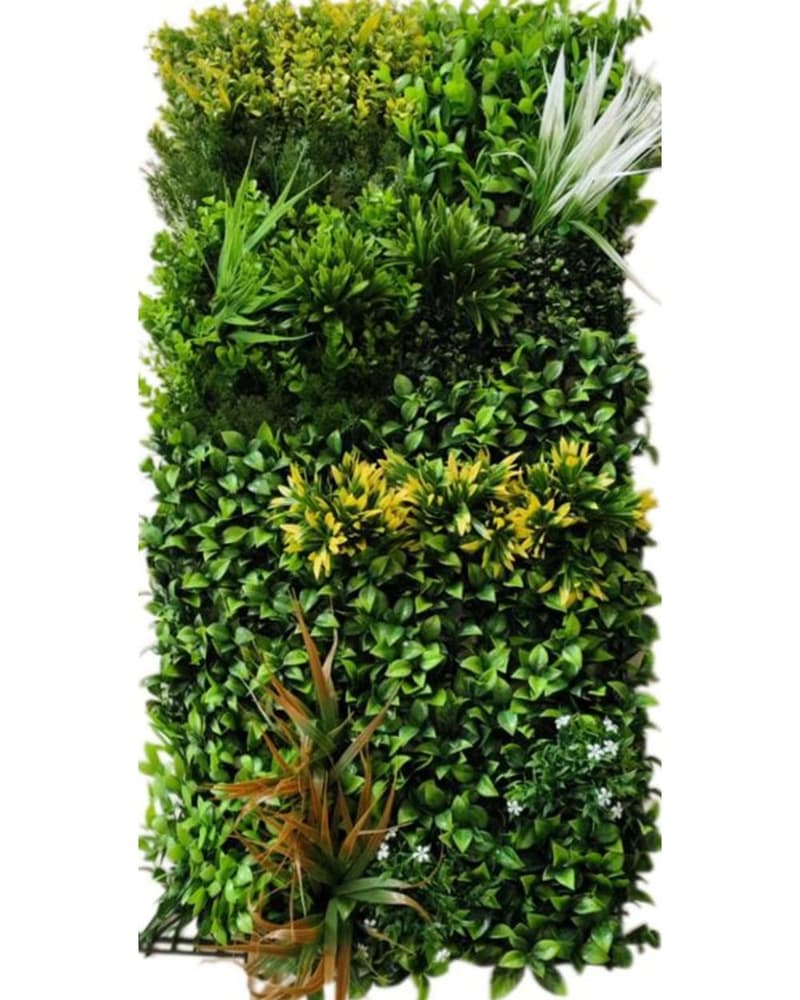
- Sampling starts at 1 piece; bulk minimums are quoted per model and per panel format, not as one blanket number.
- Standard panel formats: 50×50, 50×100 and 100×100 cm, designed to butt-join — one square metre takes 4, 2 or 1 panel respectively.
- Boxwood panels, topiary forms and hedge rolls can be mixed in one container, which is how most wholesale orders reach a full load.
- Standard lead time is 7–15 days after deposit and sample approval; custom colours and non-standard formats take 20–45 days.
- UV grade (3–5 years outdoor) and fire rating (NFPA 701 / BS 5867 / EN 13501-1) are separate specifications — specify both for outdoor commercial installs.
What is the MOQ for artificial boxwood?
The honest answer is that artificial boxwood MOQ depends on which boxwood product you are buying. A boxwood hedge panel is a moulded sheet product: minimums are set by carton and pallet tiers, because panels have to be packed flat and protected. A boxwood topiary form — a ball, cone or spiral — is a piece item, so minimums are set per shape and per diameter. A boxwood hedge roll is a third case again, because rolls are cut to length and packed as a coil.
What we do not do is quote a single "MOQ: 100 pieces" figure that applies to everything, because that number would be wrong for at least two of the three product types above. Instead, the minimum is agreed against the specification sheet for your specific order: which models, which formats, which foliage grade, and whether the shipment is mixed.
Two things are fixed regardless of product type. Sampling starts at 1 piece, so you can hold the actual foliage and inspect the backing board before committing to production. And small minimum orders are supported for project-specific work, which matters for retail fit-outs, hospitality refurbishments and one-off landscape features — see the custom & OEM page for how bespoke specifications are handled.
Why boxwood MOQ is quoted per SKU, not per order
A boxwood panel is not a sack of loose foliage. It is a backing board, a moulded foliage mat, and an edge detail, assembled as one unit. Each of those three elements has its own tooling and its own carton size, and carton size is what actually determines a sensible minimum: you either fill a carton, or you ship air.
That is why the minimum moves when any of the following change: panel format, foliage density, backing board type, edge profile, or colour. A 100×100 cm dense panel and a 50×50 cm lighter panel are different cartons, different pallet layers and different minimums, even though both are sold as "boxwood".
The practical consequence for buyers is simple. Ask for the minimum per SKU, list your SKUs, and then ask what the minimum is for the mixed order as a whole. Those two numbers are often quite different, and the second one is the one that decides whether your order is commercially viable.
Panels vs topiary: how the minimum changes
Boxwood panels are the volume product. They are specified by the square metre you need to cover, then converted into panels. Because the formats butt-join, the arithmetic is direct:
- 50×50 cm panel = 0.25 m², so 4 panels per square metre
- 50×100 cm panel = 0.5 m², so 2 panels per square metre
- 100×100 cm panel = 1.0 m², so 1 panel per square metre
Add roughly 5 percent for cutting waste at edges, corners and around any service penetrations such as sockets or signage, then round up to whole panels. Coverage is the metric that should drive the order, not the panel count — and it is worth writing the coverage figure into the order confirmation so both sides are checking the same number on delivery.
Boxwood topiary — spheres, cones, spirals and single-stem balls — behaves like any other piece-goods order. Minimums are lower in absolute piece count because each unit is larger and individually packed, but the shape and diameter determine the carton, so a 60 cm sphere and a 30 cm sphere will not share a minimum. Topiary is covered on the topiary & sculpted forms page alongside the standard shapes.
For the panel-versus-hedge decision, including when a boxwood hedge panel genuinely beats a fabric hedge roll, our green wall panels vs hedges buying guide works through the trade-offs in detail.
Order a sample first — one piece is enough to judge quality
Sampling is deliberately low-friction: samples start at 1 piece. A single panel tells you more than a catalogue photograph ever will, provided you check the right things when it arrives:
- Foliage density. Look at the panel from the side, not the front. Density that reads well head-on can look thin at a 45-degree angle, which is the angle most people actually see a wall from.
- Colour consistency. Hold the sample against natural light. Boxwood lives or dies on whether the green reads as a plant or as a plastic sheet under real lighting.
- Backing board and edge. Check whether the board is flat, whether the edge is finished, and how the panel will meet its neighbour in a continuous wall.
- Cutting behaviour. Cut a corner off. If the foliage sheds badly at the cut, that matters for every edge panel in your order.
- Attachment points. Confirm how the panel fixes to your substrate before you commit to a wall area.
Sample approval is also the reference for the bulk run. Foliage is produced in batches, and a batch mixed differently will read as a different green once installed — which is exactly why the approved sample, not a screen, is the standard that production is checked against.
What actually drives the unit price of bulk boxwood
We do not publish a price list, because cost per unit is driven by specification rather than by a single rate. For bulk artificial boxwood the main drivers are:
- Foliage density — the single biggest factor. More leaves per square metre means more material, more assembly time and more weight.
- Panel format — larger panels cover area faster but pack less efficiently, so there is a genuine trade-off between 50×50 and 100×100 cm that changes with your wall geometry.
- Foliage grade — standard indoor foliage versus UV-stabilised outdoor grade, and whether fire-retardant treatment is specified.
- Backing board — rigid board versus flexible, and whether the panel is built to be fixed to a wall or handled repeatedly during an event build.
- Packing volume — this is the driver buyers underestimate most. Freight is charged on volume, so a denser, better-packing panel can be cheaper landed than a lighter one that ships loose.
A range quoted against your specification and destination port is a more useful answer than a headline figure, and it is the only version that lets you compare two suppliers fairly.
Lead times: 7–15 days standard, 20–45 days custom
Lead time follows the same logic as the minimum. If the moulds and the panel format already exist, a repeat or standard order ships in 7–15 days after deposit and sample approval. If the order is genuinely custom — a new foliage mould, a non-standard panel format, a bespoke colour match or a branded backing board — the mould or colour batch has to be made first, which puts the run at 20–45 days.
Two dates are worth pinning down before you approve the order. First, when your sample approval is recorded, because the clock starts there rather than at deposit. Second, whether your required delivery date falls in a peak production window such as the run-up to a major trade exhibition, when capacity is booked earlier. If your installation date is fixed, say so at quotation stage — it is much easier to reserve capacity than to recover a missed date.
Packing, freight and mixed containers
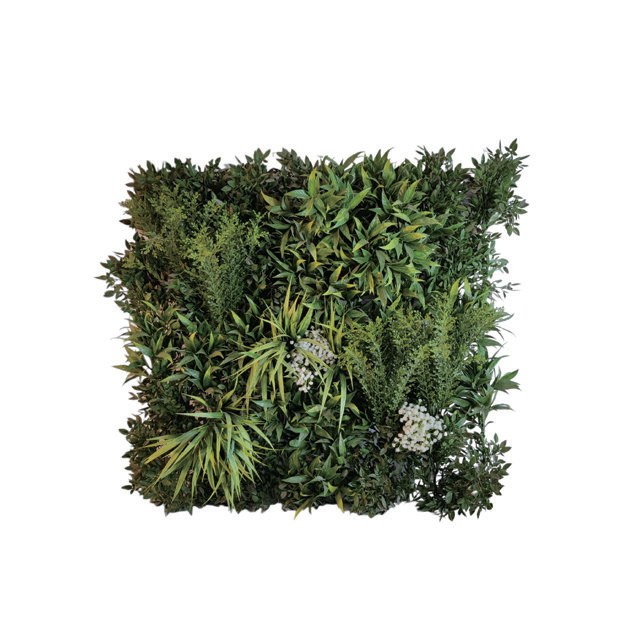
Panels ship flat in reinforced cartons, topiary ships individually wrapped, and rolls ship coiled. Because the three pack differently, a mixed container is loaded by layer and by weight rather than by SKU order — heavy topiary bases low, flat panel cartons above, rolls in the remaining void.
This is why the minimum for a mixed order is often lower than the minimum for any single SKU bought alone: the container fills from several products instead of one. If you are buying for a project with both a wall area and freestanding planters, ask for the mixed-order minimum explicitly. It is frequently the difference between a viable order and one that sits waiting for the next project to top it up.
Ask for the fire and UV documentation at quotation stage rather than after the container has sailed. Certificates and test reports — fire test documents for the exact foliage specification you ordered, or UV grade statements — are issued against the order specification, and they are considerably easier to produce alongside the order than to reconstruct afterwards. Our compliance page explains what documentation is available for each specification, and outdoor-specific behaviour is covered in our UV-resistant outdoor hedge guide.
How to compare bulk quotations
Two quotations for "1,000 boxwood panels" are rarely for the same object. Before comparing prices, ask each supplier for seven things: panel format and tolerance, foliage density or leaves per square metre, foliage grade and whether it is UV-stabilised, backing board type, packing volume per carton, minimum per SKU as well as for the mixed order, and a fire or UV test document for the exact foliage specified.
A quotation that cannot answer those questions is not cheaper. It is unspecified, and the difference will appear on site — as a wall that looks thin at an angle, as a green that does not match between batches, or as a freight bill that erases the saving. The green walls & hedges range page lists the formats we produce, and our foliage and floral lines are described under artificial flowers & floral for buyers specifying mixed greenery schemes.
Frequently asked questions
What is the minimum order quantity for artificial boxwood?
How many artificial boxwood panels do I need for one square metre?
Can I order artificial boxwood in bulk and mix panel sizes in one shipment?
Are bulk artificial boxwood panels suitable for outdoor use?
References & standards
Further reading on the materials, weathering and fire-testing frameworks referenced in this guide:
- ASTM International — weathering test methods (G154/G155)
- ISO — plastics exposure to laboratory light sources (ISO 4892)
- NFPA — fire tests for flame propagation of textiles and films (NFPA 701)
- CEN — European reaction-to-fire standards (EN 13501-1)
Related pages
Need a boxwood specification and a real minimum?
Send the wall area or panel count, the foliage grade and your destination port, and we will reply with panel formats, the minimum per SKU and for the mixed order, and the sampling options — usually within 24 hours on business days.