How Does Artificial Hedge Wholesale Work for Distributors?
Short answer: artificial hedge wholesale is a specification business, not a catalogue business. Sampling starts at 1 piece, hedge panels come in 100×100 and 50×100 cm formats, minimums are quoted per SKU, mixed containers are normal, fire paperwork such as an artificial plant fire retardant test report travels with the order, and standard lead time is 7–15 days.
October 26, 2026 · Buying & Sourcing · 8 min read · By Everflorae Editorial Team

- Artificial hedge wholesale is a SKU system: standard panel formats, batch colour control and repeatable documentation — not one-off project sourcing.
- Standard formats: 100×100 cm, 50×100 cm and 85×85 cm panels plus round discs Ø50–75 cm, at 90–120 stems/m² and 4–6 kg/m².
- Sampling starts at 1 piece; full project walls are quoted from 50 m²; standard panel orders ship in 7–15 days.
- Fire documents — NFPA 701 / BS 5867 / EN 13501-1 — are issued against the order specification; request the artificial plant fire retardant test report at quotation stage.
- Panels, rolls and freestanding screens load together in one mixed container, which is how distributor orders reach a full load.
What wholesale means for artificial hedges
Two very different buyers search for artificial hedges. The first has one project: a restaurant terrace, an office partition, a rooftop screen — bought once, installed once. The second buys hedges as trade goods: distributors, importers, landscape contractors and fit-out companies that need the same product repeatedly, at predictable quality, with paperwork their own customers can accept. Artificial hedge wholesale is built for the second buyer.
In practice, that changes what you are actually buying. A wholesale hedge order is not a custom sculpture quoted from a drawing; it is a modular panel system with fixed formats, fixed carton sizes and repeatable production batches. The same SKU ordered in March and in September should read as the same green, because foliage is produced in controlled batches and checked against the approved sample.
It also changes the paperwork. A project buyer needs one specification sheet; a distributor needs documents that travel with every re-order — fire test reports, UV grade statements, packing data — because their own customers will ask for them, often after the goods have already shipped.
The panel formats behind every wholesale hedge order
The modular panel is the unit of trade. The formats are designed to butt-join along a run, which is what makes coverage arithmetic simple and what keeps cartons stackable:
- 100×100 cm (1×1 m) — the standard module; one panel covers one linear metre of a 1 m high run.
- 50×100 cm — half-metre module for lower runs and tighter packing.
- 85×85 cm and round discs Ø50–75 cm — feature sizes for columns, ceilings and inset panels.
Density is specified as 90–120 stems per square metre, and panel weight lands at 4–6 kg/m² depending on foliage type and backing. Three backing systems cover most resale scenarios: a UV-stabilised PP net with clips for light interior work, a galvanised steel mesh for exterior facades and wind-exposed runs, and an EPE foam-plus-mesh build where panels are handled repeatedly, such as event walls.

Minimums, pricing logic and the mixed container
Wholesale minimums follow the carton, not the wish list. Because panels pack flat in fixed carton sizes, the minimum is quoted per SKU — by panel format, foliage density and backing type — and then re-checked for the mixed order as a whole. Full project walls are normally quoted from 50 m². Sampling is deliberately cheap: one piece is enough to judge density, colour and backing before you commit.
Pricing has no public list because the specification is the price. Foliage density, panel format, UV grade, fire-retardant treatment, backing system and packing volume all move the number — and packing volume is the one distributors underestimate, because sea freight is charged on volume. A denser panel that stacks efficiently can land cheaper than a lighter panel that ships loose.
The mixed container is what makes small-scale wholesale viable. Hedge panels, hedge rolls and freestanding screens load together — heavy screen bases low, flat panel cartons above, rolls in the remaining void — so a distributor order fills a container from several SKUs instead of one, and the mixed-order minimum is often lower than the sum of individual SKU minimums. Send your SKU list and destination port and you will normally have panel formats, minimums and freight data back within 24 hours on business days.
Fire documentation: the artificial plant fire retardant test report
For commercial resale, fire paperwork is not optional. The core document is the artificial plant fire retardant test report: a report issued by a testing body, against a named standard, that identifies the sample tested, the test method applied, the measured result and the report number and date. It is the evidence behind any fire certificate a supplier puts on letterhead.
Three standards cover most markets. NFPA 701 is the US flame-propagation test for textiles and films — the usual requirement for interior decorative foliage in North America. BS 5867 covers flammability of fabrics for curtains and blinds in the UK. EN 13501-1 is the European reaction-to-fire classification that grades construction products into Euroclasses. They are different tests with different scopes, so the report you hand a UK specifier and the report you hand a US specifier will not be the same document.
Two practical rules for wholesale buyers. First, distinguish the documents: a test report is the laboratory result for a sample; a certificate or classification report states what the result qualifies the product as. Second, request the report against your exact foliage specification at quotation stage — reports are issued against the order specification, and reconstructing them after the container has sailed is slow and sometimes impossible.
UV grade and specification for resale markets
Fire is one axis; light is the other. Interior-grade foliage keeps its colour under normal indoor lighting, but unprotected polymer outdoors will fade within a season or two. Outdoor SKUs use UV-stabilised polymer foliage rated for 3–5 years of exterior exposure, and the UV grade is a separate specification from the fire rating — an order can be fire-retardant, UV-stabilised, both or neither, so each must be written on the purchase order.
For a distributor, the working rule is to stock both grades and label them honestly: interior SKUs for hospitality fit-outs and retail interiors, UV-grade SKUs for terraces, facades and pool lines. Every SKU should carry the same spec fields — format, density, backing, UV grade, fire option — so your own sales team can quote without asking the factory each time. That is what turns a factory product into a resale product.
Lead times and re-order planning
Wholesale lives or dies on re-orders, so lead time is a stock variable, not a nicety. Standard panel orders — existing moulds, existing formats, standard colours — ship in 7–15 days after deposit and sample approval. Genuinely custom work, such as a new foliage mould, a non-standard format or a bespoke colour batch, takes 20–45 days because the tooling or colour batch has to be made first.
Plan re-orders backwards from your sell-through plus sea freight, and flag any fixed installation dates at quotation stage. Capacity around major trade exhibitions is booked early; reserving production is far easier than recovering a missed date. And because foliage is batch-produced, re-order against the approved sample so every batch reads as the same green on your customers' walls.
A first wholesale order, step by step
- Shortlist SKUs. Pick two or three panel formats and grades that match your market, not the whole catalogue.
- Order samples — 1 piece each. Judge density from the side, colour in daylight, and cut a corner to check shedding.
- Ask for documents with the quotation. The artificial plant fire retardant test report for your specification, UV grade statements, and carton dimensions per SKU.
- Confirm minimums twice. Per SKU, and for the mixed order as a whole — the second number decides viability.
- Approve the sample as the production reference. Batch colour is checked against it, not against a screen.
- Book the container as a mixed load. Panels, rolls and screens layered by weight, with the packing plan confirmed before loading.
Frequently asked questions
How do I start buying artificial hedges wholesale?
What does an artificial plant fire retardant test report contain?
How long does a wholesale hedge order take?
Can different hedge products ship in one container?
Sources & attributed quotations
Named sources behind this guide. The quotations below are verbatim from the issuing bodies, with outbound links to the official pages.
“This standard establishes test methods to assess the propagation of flame of various textiles and films under specified fire test conditions.”
— NFPA (National Fire Protection Association), NFPA 701, Standard Methods of Fire Tests for Flame Propagation of Textiles and Films (2023 edition), official source
“This document provides the reaction to fire classification procedure for all construction products, including products incorporated within building elements with the exception of power, control and communication cables which are covered by EN 13501-6.”
— CEN (European Committee for Standardization), EN 13501-1, Fire classification of construction products and building elements — Part 1: Classification using data from reaction to fire tests, official source
- NFPA — NFPA 701, Standard Methods of Fire Tests for Flame Propagation of Textiles and Films
- CEN — EN 13501-1, Fire classification of construction products and building elements
Related pages
Related project cases
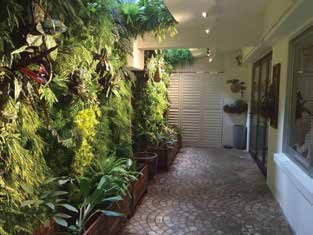
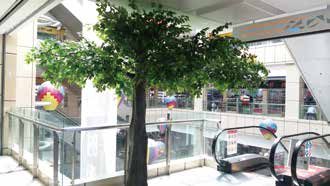
Real projects we have delivered in this kind of setting — on-site photographs, no mock-ups.
Ready to plan your first wholesale hedge order?
Send your SKU shortlist, the foliage grade and your destination port, and we will reply with panel formats, minimums per SKU and for the mixed order, sampling options and the fire and UV documentation — usually within 24 hours on business days.
Sister brand · GardenStone
Pair it with landscaping stone (GardenStone)
From the same supplier group — GardenStone supplies decorative pebbles, gravel and landscape stone that complete the same hotels, resorts, malls and Japanese gardens. One source for the whole landscape.
Explore GardenStone →