What Is the Best Artificial Monstera with Large Leaves Supplier?
Buyers searching for an artificial monstera large leaves supplier are usually specifying a hero plant for a lobby, restaurant or atrium — so the right partner is judged on leaf realism and trunk integrity, not on a low headline price. This guide covers what to ask, what to avoid, and the numbers that matter.
October 1, 2026 · Buying & Sourcing · 8 min read · By Everflorae Editorial Team
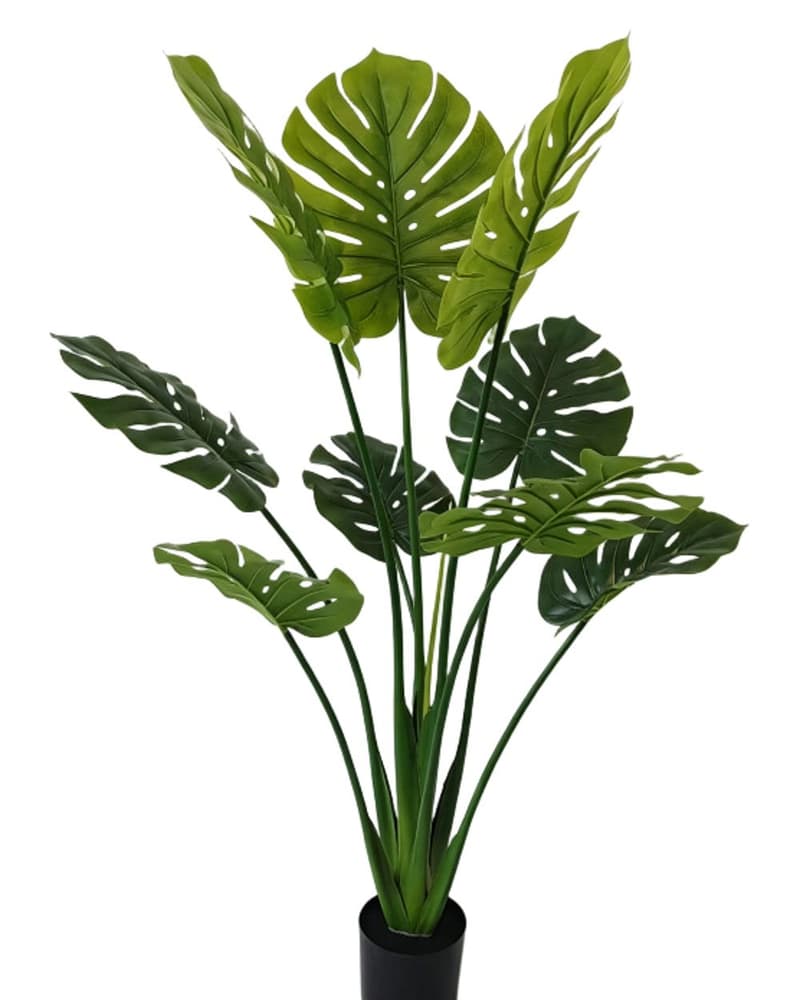
- The "large leaves" claim only means something if the foliage is moulded ABS/PU with natural venation and split patterns, not thin PVC film.
- A real artificial monstera large leaves supplier owns the workshop: ask for production photos and videos, not just catalogue shots.
- Samples start at one piece; typical bulk orders begin at 10 pieces per SKU. Standard lead time is 7–15 days, custom builds 20–45 days.
- Trees are built from 1 m up to 15 m; trunk construction (moulded pole vs engineered steel/fibreglass core) drives most of the price gap.
- Fire rating (NFPA 701, BS 5867, EN 13501-1) and outdoor UV grade (3–5 year colour-fastness) are priced per order with documentation.
What "large leaves" actually means for an artificial monstera
Monstera deliciosa is known for its big, fenestrated leaves — the deep splits and holes that make the silhouette recognisable from across a room. When a supplier advertises "large leaves", the honest specification is a leaf blade often 30–60 cm long on a mature plant, with natural venation and a believable split pattern. The realism is a manufacturing question, not a styling one.
Commercial-grade foliage is moulded from ABS or PU, which holds the leaf shape, edge curl and colour far better than thin PVC film. A serious artificial monstera large leaves supplier treats leaf size, split depth and colour variance as a specification you can state, not a surprise you discover on delivery. For a lobby hero plant, that control is what separates a piece guests admire from one they ignore.
How to vet an artificial monstera large leaves supplier
The single most useful test is whether the supplier runs its own workshop. A factory with its own moulding, welding and foliage assembly can show you the build; a trader reselling someone else's catalogue cannot. Ask for workshop photos and a short production video of a tree like yours — a genuine supplier answers quickly because the floor is twenty metres from the sales desk.
- Sample before bulk. Samples start at one piece, so you can place the plant under your own lighting and against your finishes before committing. This is normal, not a favour.
- Trunk integrity. For anything above roughly 2.5 m, or any piece guests pass at arm's length, the trunk should be a welded steel or fibreglass core with a hand-applied bark skin — not a printed sleeve on a plastic pole that flexes under the canopy.
- Batch verification. Ask the supplier to commit to production photos of your actual batch: welded core, bark applied, canopy finished and packed. A factory with its own line says yes without hesitation.
- Lead time on the table. Standard catalogue specifications run 7–15 days; custom builds run 20–45 days. If a supplier cannot state a window, they are not scheduling their own production.
Red flags are easy to spot once you know them: no workshop evidence, only stock catalogue photos, a minimum order that insists on a full container before they will talk, and no path to fire-rating documents. None of those describes a manufacturer.
MOQ and pricing logic for monstera and artificial orchids
Minimum order quantity is quoted per SKU, not per order, which is why a single enquiry can return very different numbers. For a potted artificial monstera, sampling starts at one piece and bulk typically begins at 10 pieces of the same specification. The same logic applies to a related line buyers often source together — the artificial orchid MOQ. Phalaenopsis orchids are supplied potted or as loose stems, and their MOQ follows the same per-SKU rule: one piece to sample, roughly 10 pieces per configuration for bulk, with custom bloom colours or potting pulling the run toward the 20–45 day custom window.
What actually moves the unit price is consistent across both products:
- Trunk or stem construction — a moulded pole (monstera) or single wired stem (orchid) costs far less than an engineered core or a hand-arranged bloom.
- Leaf or bloom count — more foliage or more flowers means more hand labour and more material, and it is the most visible realism cue.
- Pot and planter — a specified planter (fibreglass, ceramic-look, or client-supplied) is priced separately from the plant.
- Options — fire-rated and UV-stabilised foliage add per-order cost with documentation.
Sample pricing sits above the per-unit bulk price because the factory runs one unit through a line built for batches and often ships it by express. That premium is expected and worth it: one plant under your light tells you more than any render.
Fire rating and UV resistance for commercial installs
Commercial fit-outs — hotels, malls, restaurants — routinely require documentation, and the three standards buyers meet most are NFPA 701 (United States, flammability of textiles and films), BS 5867 (UK, curtains and drapes, extended to fabricated foliage) and EN 13501-1 (EU, reaction to fire classification). A competent artificial monstera large leaves supplier offers inherently or treated flame-retardant foliage with test documents issued per order, not a generic "fireproof" claim.
Outdoor use is a separate, equally specific question. Indoor ABS/PU foliage placed outside fades noticeably within one or two seasons. UV-stabilised foliage carries a 3-year colour-fastness warranty as standard outdoor grade and up to 5 years in premium outdoor grade. For covered entries, atriums and poolside, specify the outdoor grade so the large leaves keep their colour through the seasons.
Production and shipping timeline
Artificial trees are built from 1 m up to 15 m, and the structural requirements step up rather than scale smoothly: past roughly 4 m, trunks ship in bolt-together segments with the canopy packed in numbered bags. Standard catalogue specifications run 7–15 days from confirmation to packed; a custom build — non-standard height, bespoke trunk shape, split-leaf pattern or integrated planter — moves to 20–45 days because it adds engineering and approval rounds.
Freight is where canopy diameter, not height, quietly re-enters the cost: a wide, low canopy can cost more to ship than a taller narrow one. A responsible supplier quotes packed dimensions and gross weight for your specification before freight is booked, and mixed containers — trees, foliage and green wall panels in one shipment — are routine for project buyers. See our artificial flowers and foliage range for the companion lines most often ordered alongside monstera.
Frequently asked questions
What is the minimum order quantity for artificial monstera with large leaves?
How much does a large artificial monstera cost?
How long does it take to produce a custom artificial monstera?
Is artificial monstera with large leaves suitable for outdoor use?
Sources & attributed quotations
Named sources behind this guide. The quotations below are verbatim from the issuing bodies, with outbound links to the official pages.
“The United Nations Comtrade database aggregates detailed global annual and monthly trade statistics by product and trading partner for use by governments, academia, research institutes, and enterprises.”
— United Nations Statistics Division, UN Comtrade Database, official source
“Trade Map offers one of the world's most comprehensive trade data through interactive tables and charts in a user-friendly interface. Covering over 230 economies, it provides trade data for goods and services.”
— International Trade Centre (ITC), Trade Map, official source
Related pages
Want a monstera specification you can trust?
Send your height, leaf size and install setting. We return an itemised quotation with trunk construction, foliage spec, fire and UV options shown as separate lines — normally within 24 hours on business days.