Artificial Olive Tree Price Guide: What Actually Drives the Cost
Ask three factories what a 3-metre artificial olive tree costs and you will get three different answers — all of them technically correct. This guide explains the factors that actually move the price of a wholesale olive tree and the logic behind the ranges, so you can read a quotation instead of just comparing totals.
September 26, 2026 · Buying Guides · 8 min read
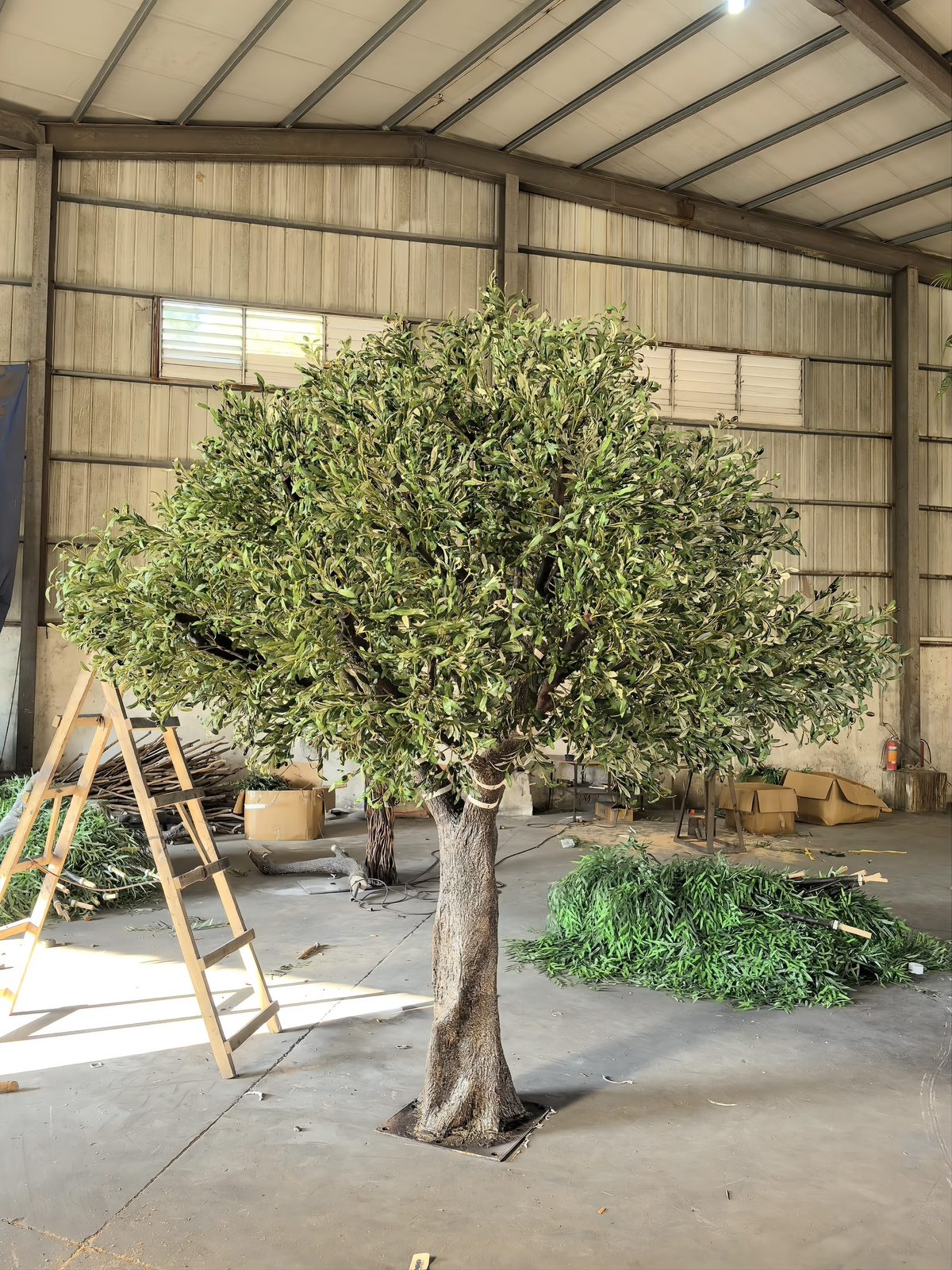
- Height alone explains very little of the price. Trunk construction, foliage grade and canopy density usually matter more.
- A moulded trunk on a plastic pole and a hand-built tree on a steel or fibreglass core can share a product name and sit at very different points of the price range.
- Fire treatment (NFPA 701, BS 5867, EN 13501-1) and outdoor UV grade (3–5 year colour-fastness warranty) are priced per order because they add real material and documentation cost.
- Samples start at one piece; typical bulk orders start at 10 pieces. Standard lead time is 7–15 days, custom builds 20–45 days.
- Compare quotations on identical specification lines, never on headline totals.
Why one price list for olive trees does not exist
The first thing to accept: any factory publishing a single "price per tree" is either selling one very generic product or rounding away the differences that matter. An artificial olive tree is not a catalogue item like a chair — it is assembled to a specification, and several independent cost drivers move the total. Understanding those drivers turns a confusing spread of quotations into a readable breakdown.
Here is the honest position from the factory floor: two trees of identical height can differ in cost by a multiple, and both can be reasonable purchases depending on the project. A budget café refresh and a hotel atrium with 4000 K downlights and a fire marshal do not need — and should not pay for — the same tree.
Cost driver 1: what the trunk is actually made of
This is the single largest factor, and the one least visible in product photos. The market sells two fundamentally different constructions under the name "artificial olive tree":
- Moulded trunk on a plastic pole — a printed or moulded sleeve around a light internal post. Cheap to produce, light to ship, and acceptable at a distance in low-ambient settings. Up close, the bark repeats, seams show, and the trunk flexes under the canopy weight of taller trees.
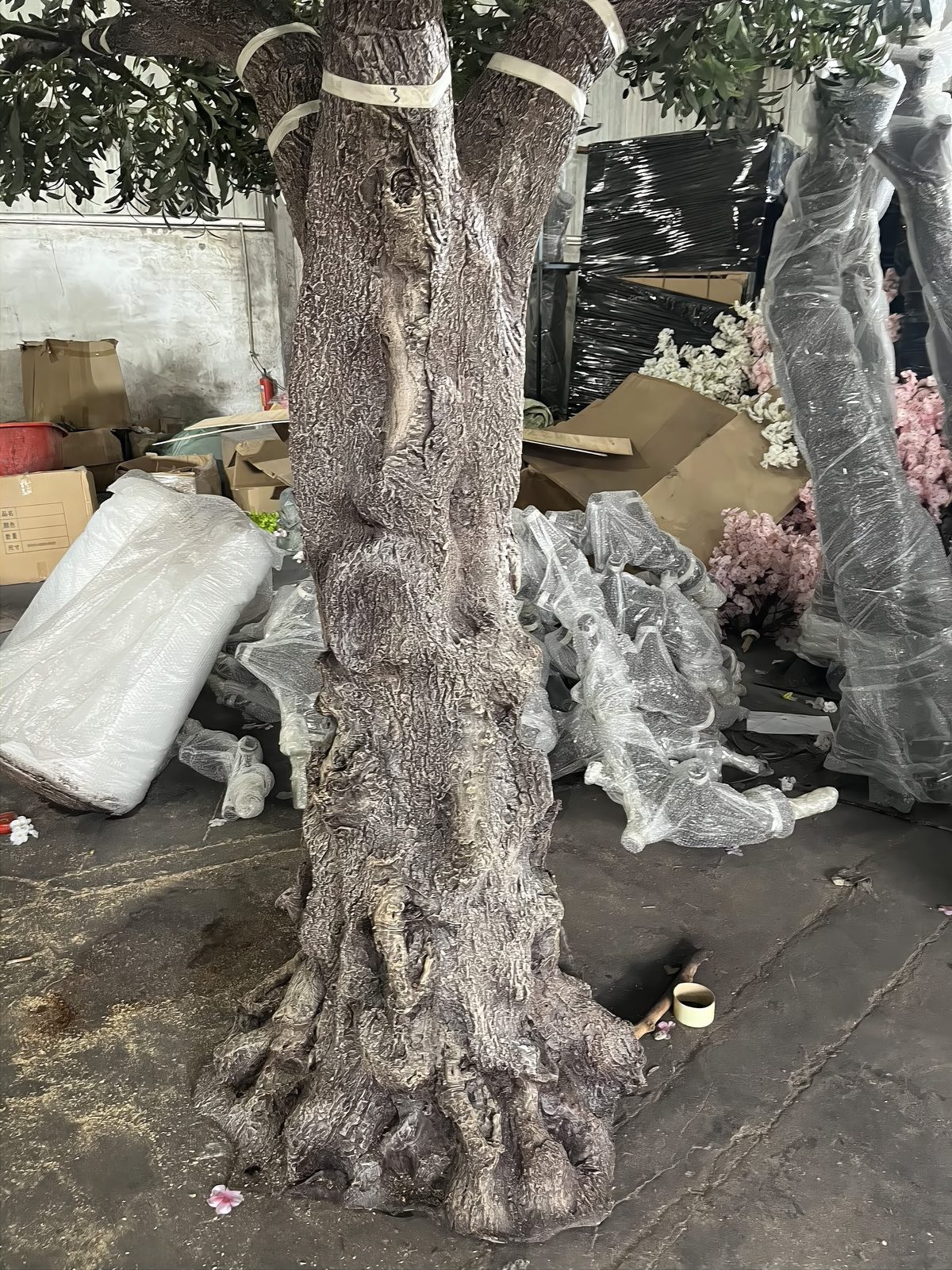
- Hand-built trunk on an engineered core — a welded steel skeleton (or fibreglass core) with branch sockets, over which a fibreglass and resin bark skin is applied by hand, textured and colour-washed. More material, more skilled labour, and a structurally credible trunk that survives close inspection and supports real canopy weight.
The price gap between the two reflects welding hours, fibreglass lay-up and finishing labour — not branding. For anything from roughly 2.5 m upward, or any project where guests walk past the tree at arm's length, the engineered construction is the defensible choice, and the quotation will show it.
Cost driver 2: foliage material and canopy density
The second driver is what the leaves are made of and how many of them there are. Commercial-grade foliage is moulded from ABS or PU, which holds shape and colour far better than thin PVC film — but ABS/PU foliage costs more per leaf than film-grade alternatives, and a realistic canopy needs thousands of leaves wired on by hand.
Three specification lines move this part of the price:
- Canopy spread and density — a 3 m tree with a 1.2 m sparse canopy is cheaper to build and looks cheaper in the room. Spread and leaf count, not height, drive the foliage cost.
- Colour variance — multi-tone green-silver leaf mixes require more tooling and sorting than a single flat green.
- Fruit density — wired olives are set at a stated density; more fruit means more hand-labour. It is also the most visible realism cue, so it is worth specifying rather than leaving to chance.
Cost driver 3: height, spread and what shipping does to the total
Height matters, but not linearly, and not only through materials. Artificial trees are built from 1 m up to 15 m, and the structural requirements change in steps, not smoothly: beyond roughly 4 m, trunks are engineered to ship in bolt-together segments with the canopy packed in numbered bags, which changes both production and packing cost.
Freight is where height and spread quietly re-enter the price. Canopy diameter — not height — drives the carton size, so a wide, low canopy can cost more to ship than a taller narrow one. This is why a serious supplier quotes packed dimensions and gross weight for your specification before freight is booked, and why "same height, different price" between two suppliers is often just different packing assumptions.
Cost driver 4: options priced per order
Three add-ons are legitimately priced on top of the base tree, and each should appear as its own line on a professional quotation:
- Fire-retardant foliage with documentation. Inherently or treated flame-retardant foliage certified to NFPA 701, BS 5867 or EN 13501-1, with test documents issued per order. Commercial fit-outs often require it; the cost is real and so is the paperwork.
- Outdoor UV grade. UV-stabilised foliage carries a 3-year colour-fastness warranty as standard outdoor grade, or up to 5 years in premium outdoor grade. Indoor foliage placed outdoors will fade noticeably within a season or two — the warranty difference is what you are paying for.
- Custom specification. A non-standard height, spread, trunk shape or planter integration moves the job from catalogue production (7–15 days) to custom build (20–45 days), with engineering time and approval rounds reflected in the price.
If a quotation omits these lines entirely, ask which of them is included. An all-inclusive quote can be fair; a quote that silently assumes none of the three will look artificially cheap until the fire documents are requested.
Sample pricing versus bulk pricing logic
Samples start at one piece, deliberately: one unit under your site's lighting tells you more than any catalogue. Expect sample pricing to sit above the per-unit bulk price — the factory is running a single build through a production line optimised for batches, and often shipping one unit by express rather than consolidating a container.
Bulk orders typically begin at 10 pieces per specification. As volume rises, unit cost improves through material batching and shared tooling, but the improvement is not uniform across specifications: an engineered-core tree gains less from volume than a moulded one, because much of its cost is hand labour that does not batch. Mixed containers — trees, palms and green wall panels in one shipment — are routine for project buyers and change the freight arithmetic more than the unit price.
How to compare two quotations fairly
Put two quotations side by side and normalise them on five lines before looking at the totals:
- Trunk construction — moulded pole or engineered core with hand-applied bark? This alone can explain most of a price gap.
- Foliage spec — ABS/PU or film, canopy spread, leaf density, fruit density.
- Compliance lines — are NFPA 701 / BS 5867 documents and UV warranty grade included, excluded, or simply not mentioned?
- Logistics — packed dimensions, gross weight, Incoterms, and whether assembly hardware and instructions are included for segmented trunks.
- Verification — does the supplier commit to production photos of your actual batch (welded core, bark applied, canopy finished)? A factory with its own workshop says yes easily.
Only after those five lines match does the total price become a meaningful comparison. A quotation that is 30% lower because it assumes a moulded trunk, film foliage and no fire documents is not a discount — it is a different product wearing the same name.
Frequently asked questions
Why do artificial olive trees of the same height have such different prices?
Do you publish a fixed price list for artificial olive trees?
Can I order one sample tree before committing to a bulk order?
Which options add the most to the price of an artificial olive tree?
Related pages
Want a quotation you can actually read?
Send your height, spread and installation setting. We return an itemised quotation with trunk construction, foliage spec, fire and UV options shown as separate lines — normally within 24 hours on business days.