What Is the Lead Time for Artificial Orchids?
Buyers asking about the artificial orchid lead time usually need a date they can drop into a purchase order. For standard potted phalaenopsis, production runs 7–15 days from confirmation to packed; custom dye-matched or bespoke-potting builds take 20–45 days. Samples start from one piece, so you can verify colour and finish before committing to a carton-quantity order.
October 2, 2026 · Buying & Sourcing · 8 min read · By Everflorae Editorial Team
- For standard catalogue orchids, the realistic window is 7–15 days from confirmed order to packed cartons.
- Custom work — dye-matched bloom colour, hand-arranged stems, or a specified planter — moves to 20–45 days.
- Samples start at one piece; bulk is quoted per SKU, typically from 10 pieces of the same configuration.
- Fire rating (NFPA 701, BS 5867, EN 13501-1) and outdoor UV grade (3–5 year colour-fastness) are priced per order with documentation.
- Orchids are potted decorative pieces (roughly 0.3–1.5 m); the factory's trees scale from 1 m up to 15 m, so mixed shipments are routine.
How artificial orchid lead time is actually measured
The number only means something if you agree on where the clock starts. A credible artificial orchid lead time is measured from order confirmation — when the specification, planter and options are locked — to "packed", when cartons are closed and ready for freight booking. It does not include the back-and-forth of sampling, and it does not include ocean transit, which is a separate line on your timeline.
This is why two buyers can be quoted very different numbers for "the same orchid". One has approved a catalogue item and wants ten pots; the other is still deciding on bloom colour and pot. Treat the lead time as a production window, not a shelf-pick time, and the planning gets far easier.
Standard vs custom lead times for artificial orchids
For standard catalogue phalaenopsis — a known bloom colour, a standard pot and a fixed stem count — production runs 7–15 days from confirmation to packed. That window covers moulding or assembly of the blooms, arranging the stems, potting, quality check and carton packing.
A custom build is a different animal. If you need a dye-matched bloom colour to sit beside an existing scheme, a hand-arranged stem count, or a planter specified by your interior designer, the run moves to 20–45 days. The extra weeks are not overhead — they are dye-matching, hands-on assembly and the approval rounds that stop a 500-pot order from arriving in the wrong shade. For a project with a fixed opening date, lock the specification early so the clock starts on the short window, not the long one.
What drives the lead time for artificial orchids
Several variables push the date one way or the other, and a transparent supplier states them up front:
- MOQ per SKU. Bulk is quoted per configuration, not per order. A single potted orchid samples from one piece; the same SKU in volume typically begins at about 10 pieces, and mixing several colourways in one shipment is normal.
- Potting and planter. A catalogue pot is fast. A specified fibreglass or ceramic-look planter, or a client-supplied vessel, adds a sourcing or fitting step.
- Bloom colour and count. Standard colours are on the shelf; a custom dye match is the single biggest schedule risk, so confirm a physical swatch before mass production.
- Options. Fire-rated foliage (NFPA 701, BS 5867, EN 13501-1) and UV-stabilised outdoor grade (3–5 year colour-fastness) are applied or treated per order and add documentation time.
None of these are reasons to avoid custom work — they are simply the levers you control. State them in the enquiry and the quote comes back with a defensible date instead of a vague promise.
An artificial orchid maintenance guide
The second question every facilities manager asks is the running cost, so a proper artificial orchid maintenance guide belongs in the same conversation as the lead time. The good news is that maintenance is minimal compared with live plants.
- Dust control. Once a week, brush the blooms and leaves with a soft feather duster or use a low-pressure air blower. In lobbies with HVAC, a quick pass prevents the grey film that reads as "cheap" from across the room.
- Periodic wipe. Every few months, wipe glossy leaves and petals with a lightly damp microfibre cloth, then dry. Avoid solvent cleaners, which can dull the moulded surface.
- Placement. Keep arrangements out of prolonged direct sunlight. Indoor-grade foliage holds colour for years; only UV-stabilised outdoor grade should sit in sun or under a covered entrance.
- No life support. There is no watering, no fertiliser and no root care. The only "failure mode" is physical damage, which is why a spare-parts policy (extra blooms or a replacement pot) is worth agreeing at order time.
A quality UV-stabilised piece keeps its look for 3–5 years indoors, and because the blooms are moulded ABS/PU rather than silk film, they do not curl or yellow the way cheap imports do. That durability is part of what you are actually buying when you pay a per-unit price above the bargain end of the market.
Production and shipping timeline
Artificial orchids are potted decorative pieces, typically 0.3–1.5 m tall, so they pack densely and ship efficiently. By contrast, the same factory builds trees from 1 m up to 15 m, and past roughly 4 m those trunks ship in bolt-together segments with the canopy in numbered bags. Orchid cartons are far friendlier to freight.
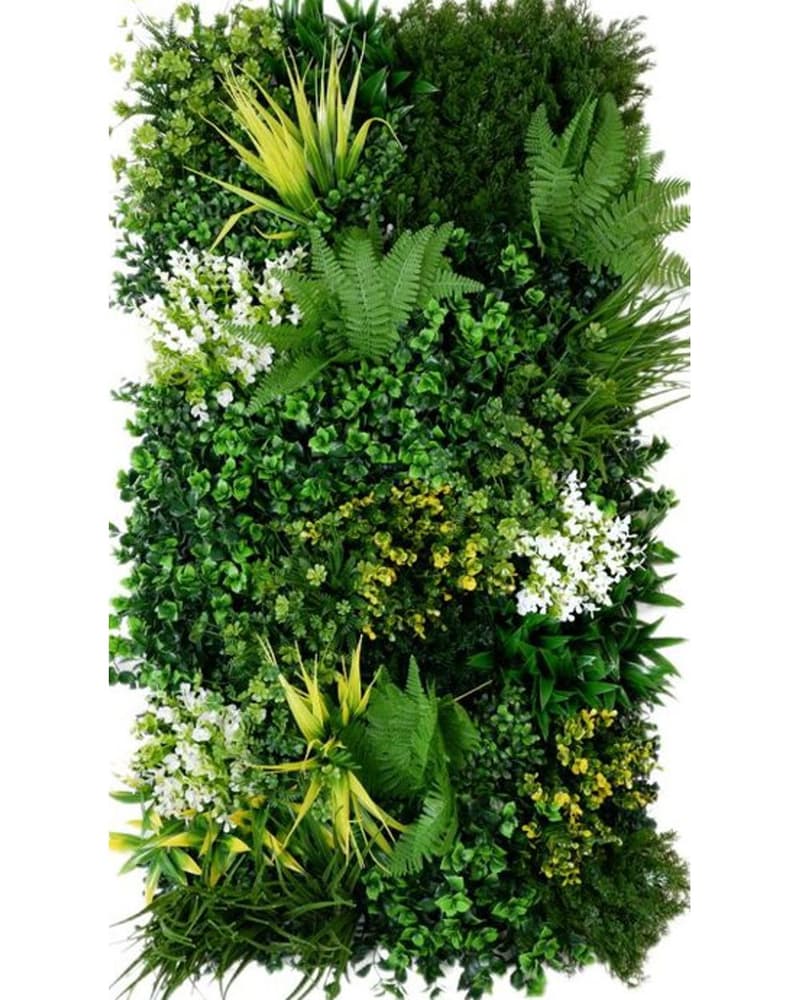
Standard catalogue orchids run 7–15 days to packed; custom dye or potting runs 20–45 days. A responsible supplier quotes packed dimensions and gross weight for your specification before freight is booked, and mixed containers — orchids, foliage and green wall panels in one shipment — are routine for project buyers. For the companion lines most often ordered alongside orchids, see our artificial flowers and foliage range.
Frequently asked questions
What is the minimum order quantity for artificial orchids?
How much does an artificial orchid cost?
How long does it take to produce a custom artificial orchid?
How do you maintain artificial orchids?
Sources & attributed quotations
Named sources behind this guide. The quotations below are verbatim from the issuing bodies, with outbound links to the official pages.
“The United Nations Comtrade database aggregates detailed global annual and monthly trade statistics by product and trading partner for use by governments, academia, research institutes, and enterprises.”
— United Nations Statistics Division, UN Comtrade Database, official source
“Trade Map offers one of the world's most comprehensive trade data through interactive tables and charts in a user-friendly interface. Covering over 230 economies, it provides trade data for goods and services.”
— International Trade Centre (ITC), Trade Map, official source
Related pages
Need an orchid specification with a real date?
Send your bloom colour, stem count and planter. We return an itemised quotation with the lead time shown as a separate line — standard 7–15 days or custom 20–45 days — normally within 24 hours on business days.