Which Artificial Orchid Suits Hotel Decor Wholesale?
For hotel decor wholesale programmes, potted phalaenopsis is the order to start with: silk and fabric petals on colour-matched wired stems in weighted pots, sampling from 1 piece, standard lead time of 7–15 days, custom dye matching in 20–45 days — with fire documentation to NFPA 701, BS 5867 or EN 13501-1 available per order.
October 2, 2026 · Applications · 7 min read · By Everflorae Editorial Team
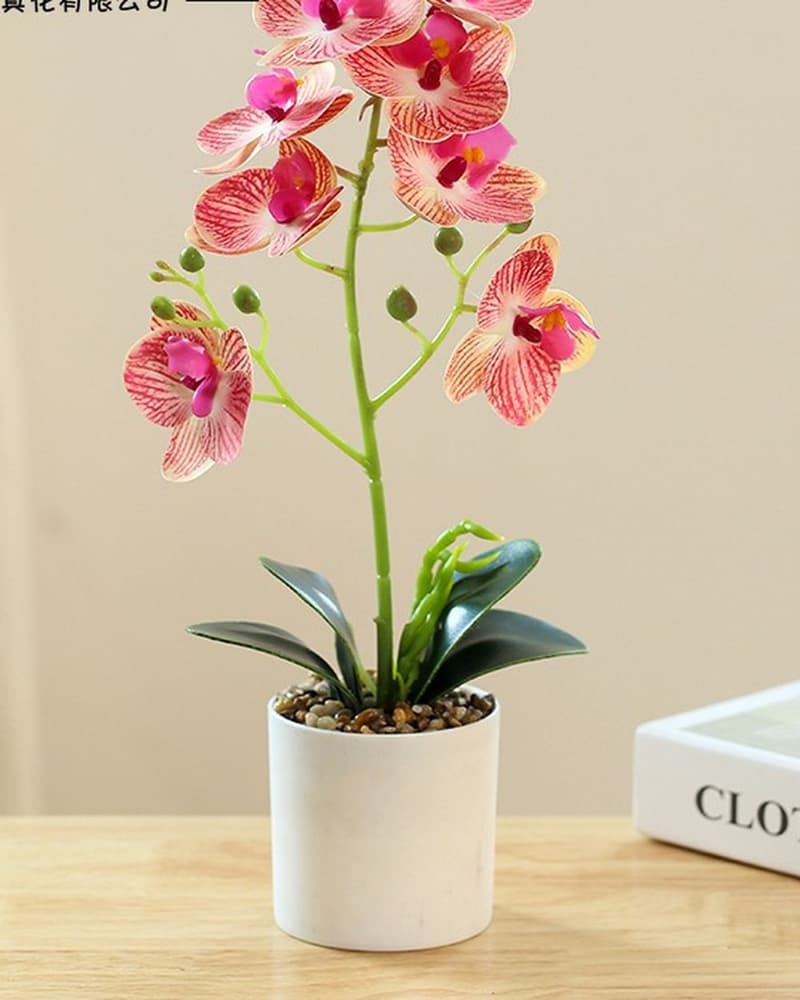
- Potted phalaenopsis is the most versatile artificial orchid for hotel decor: reception, consoles, table centres and spa areas all take the same format.
- Wholesale orchid buying is quoted per SKU in carton quantity, with mixed SKUs accepted; sampling starts from 1 piece at unit price.
- Standard production lead time is 7–15 days; custom dye-matched colours and pot formats run 20–45 days; Ramadan programmes should be ordered 60–90 days ahead.
- For hotel interiors, fire documentation (NFPA 701 / BS 5867 / EN 13501-1) is a per-order option — request it with the quotation, not after delivery.
Why phalaenopsis leads hotel floral programmes
Ask five hotel florists which artificial orchid they reorder most and the answer is nearly always the same: phalaenopsis, the moth orchid. The reasons are practical rather than romantic. The arching stem carries eight to a dozen blooms on a single plant, so one pot fills a console table that would need three or four arrangements of smaller flowers. The bloom shape reads as premium at a distance of several metres, which matters in a lobby where the first impression is formed from across the room. And the colour range — white, blush, purple, butter yellow — maps cleanly onto most hotel brand palettes.
There is also a maintenance argument. A live phalaenopsis in a hot, air-conditioned lobby is a scheduled replacement item: blooms drop, roots suffer from treated water, and the plant is finished in weeks. An artificial one holds its appearance for years, needs dusting rather than watering, and — importantly for a procurement team — turns an unpredictable recurring cost into a one-time line item with a known specification.
Ordering artificial orchids in bulk: MOQ, sampling and lead time
Buying an artificial orchid in bulk works differently from buying a single décor piece, and buyers who understand the mechanics get better prices and fewer surprises. MOQ is quoted per SKU, not per order, and it is measured in carton quantity. Mixed SKUs are accepted on one order — a typical hotel programme combines potted phalaenopsis in two or three colours with matching stem formats for vases.
Sampling comes first. Everflorae ships samples from 1 piece at unit price, so a purchasing team can put the actual pot, petal texture and colour on the table before committing to a production run. That sample then becomes the reference standard: the production batch is checked against it, which is how colour drift between the approved sample and the delivered cartons gets prevented.
Lead time follows the specification. Standard SKUs in stock colours run 7–15 days from order to ex-factory. Custom work — dye-matched colours, bespoke pot finishes, private-label packaging — runs 20–45 days because the colour must be matched, sampled and approved before the run. Seasonal programmes have their own clock: Middle East Ramadan and Eid collections should be ordered 60–90 days ahead of the season, because fibre, dye lots and labour are planned around that peak rather than treated as a normal month.
Materials and realism: what to check on the sample
- Petal material and veining — quality phalaenopsis use silk or fabric petals with printed or hand-painted veining; a flat, unpatterned petal is the fastest way to spot a low-grade product.
- Wired, shapeable stems — every stem should contain a wire core so housekeeping can re-pose the arch after cleaning; a stem that cannot be re-shaped will look wrong within a month.
- Colour-matched components — stems, buds and leaves should be colour-matched to the blooms, not generic green; mismatches show up badly under lobby downlighting.
- Weighted base — the pot should carry real weight (ceramic or stone-finish) so the arrangement cannot be tipped by a passing trolley or a guest's bag.
- Stem length range — orchid stems are made from 20 cm to 120 cm; confirm the lengths against the vases and planters already specified in the project.
Fire documentation: the hotel compliance step
Fire behaviour is the one specification line that determines whether an orchid programme survives a hotel inspection. Decorative foliage and florals in public interiors are expected to demonstrate flame-propagation performance, and the three documents that matter in practice are NFPA 701 (the US test for flame propagation of textiles and films), BS 5867-2 (the British specification for fabrics in non-domestic curtains and drapes) and EN 13501-1 (the European reaction-to-fire classification).
The operational point is simple: fire retardant treatment is a per-order option, not a factory default. If the hotel's fire officer requires documentation, request the certification with the order and keep the test documents in the project file. Retrofitting documentation after delivery is not possible — the test applies to the production batch.
Custom colours, pots and branded programmes
Hotel groups rarely want an off-the-shelf colour. The standard route is stock palette plus custom dye matching: the buyer supplies a Pantone reference or a physical swatch, the factory matches the dye lot on a pre-production sample, and the approved sample governs the batch. Pot formats follow the same logic — ceramic, stoneware or fibre-glass finishes can be matched to the FF&E schedule, and private-label packaging is available for groups that distribute through their own channels.
For procurement teams running multi-property programmes, the useful question is not "can you make it" but "can you repeat it": a dye lot held on file, a pot sourced against a confirmed mould, and a QC reference standard per SKU are what make year-two reorders identical to year-one deliveries.
What actually drives wholesale price
Three variables move the unit price of a wholesale orchid order, and none of them is the "orchid" itself:
- Grade of the bloom — standard versus premium head size, and whether veining is printed or hand-finished.
- Material mix — full silk petals cost more than fabric blends; weighted ceramic pots cost more than light plastic.
- Order structure — larger single-SKU runs amortise set-up better than fragmented small lots, which is why consolidated mixed-SKU carton orders price better than ten separate small orders.
Rather than quoting a number that changes with spec and volume, ask suppliers to quote the same specification across all three variables — that is how a comparison becomes fair.
Frequently asked questions
What is the MOQ when ordering artificial orchids in bulk?
How long does a wholesale artificial orchid order take?
Are artificial orchids fire-safe for hotel interiors?
Which orchid formats work best in hotel decor?
Sources & attributed quotations
Named sources behind this guide. The quotations below are verbatim from the issuing bodies, with outbound links to the official pages.
“This standard establishes test methods to assess the propagation of flame of various textiles and films under specified fire test conditions.”
— NFPA (National Fire Protection Association), NFPA 701, Standard Methods of Fire Tests for Flame Propagation of Textiles and Films (2023 edition), official source
“This part of BS 5867 specifies flammability requirements for fabrics and fabric assemblies for use in the production of non-domestic curtains, drapes and window blinds and for finished articles including combinations of curtains and linings when tested by the methods specified in BS EN ISO 6941 and BS EN ISO 15025.”
— BSI (British Standards Institution), BS 5867-2:2008, Fabrics for curtains, drapes and window blinds — Flammability requirements. Specification, official source
Related pages
Building a hotel floral programme?
Send the formats, colour direction and estimated volume, and we will return a structured quotation with sample options, fire documentation paths and lead times — usually within 24 hours on business days.