How Do You Choose an Artificial Planter Supplier?
A reliable artificial plant planter supplier is a manufacturer with its own Guangzhou factory, not a trading company — offering both stock and custom planters and bases, fire-rated foliage tested to NFPA 701 / BS 5867 / EN 13501-1, UV-stabilised options for outdoor use, sampling from 1 piece, and a 7–15 day standard lead time (20–45 days custom). Below are the checks that separate a supplier you can specify from one you cannot.
October 15, 2026 · Buying & Sourcing · 8 min read · By Everflorae Editorial Team

- Verify the factory first: a real artificial plant planter supplier runs its own Guangzhou workshop and can show production, not just a catalogue.
- Look for both stock and custom planters and bases — stock for fast delivery, custom for project-specific sizes and finishes.
- Fire-rated foliage is a per-order option tested to NFPA 701, BS 5867 or EN 13501-1; outdoor use needs UV-stabilised foliage with 3–5 year colour retention.
- Numbers a supplier should quote in writing: sampling from 1 piece, 7–15 days standard lead time, 20–45 days custom.
- Ask for references, factory photographs and the actual fire-test documents for the foliage in your order — before the container sails.
What an artificial plant planter supplier should manufacture in-house
The single most useful question to ask any artificial plant planter supplier is whether the product is made in its own factory or simply resold. A manufacturer controls the mould, the gel-coat or finish, the steel base plate and the foliage grade, which is what lets it hold a specification, match a colour across sizes, and take responsibility for the fire rating. A reseller can only pass those questions upstream and usually cannot show the workshop.
Our planters and bases range is produced in our own Guangzhou facility, alongside the trees, palms and green walls the planters are built to sit under. When you ask a supplier for factory photographs, a production video, or a video call from the workshop floor, the answer tells you more about lead-time reliability than any price sheet.
One practical check: ask what is welded and what is bought in. A supplier that moulds its own planter bodies and welds its own base plates can usually offer a custom size without a third party, which is the difference between a 20–45 day custom job and one that slips by weeks because the real maker was two steps away.

Stock planters and bases versus custom: what the range should cover
A capable supplier offers both ends of the range. Stock planters and bases — existing moulds, existing finishes, standard packing — are what let a first order ship in 7–15 days and ship consolidated with trees or green wall panels in one container. Custom work — a new size, a new finish, a branded shape — is what lets a project specify exactly what the architect drew.
The honest suppliers are clear about which of your models are stock and which are custom, and they quote the minimum per model rather than a single order-wide number. Our custom and OEM work covers the third case, where a planter is built to a supplied drawing. Knowing which bucket each line falls into is what keeps a first order small and a second order predictable.
Range also means material honesty. Fibreglass, metal and stone-composite planters each behave differently outdoors and carry different weights and costs. A supplier that can explain why a ribbed fibreglass planter suits an indoor lobby but a UV-stabilised composite suits a pool deck is one that understands the specification, not just the catalogue.
Fire rating and UV grade: ask which component is actually tested
The planter body — fibreglass, metal or stone composite — is rarely the item carrying the fire certificate; the foliage planted in it is. For indoor public spaces, fire-retardant foliage is tested to NFPA 701, BS 5867 or EN 13501-1 depending on the market, and the certificate should name the exact foliage in your order. For outdoor planters, the relevant grade is UV colour-fastness on the foliage and on any painted or gel-coated surface, with a 3–5 year retention expectation.
State indoor or outdoor use in the enquiry and ask the supplier which component is tested to which standard. A supplier that answers precisely — and attaches the document — is one you can put in front of an inspector. One that answers vaguely is a risk you do not need on a commercial fit-out.
Lead time, MOQ and sampling — the numbers a supplier should quote you
Four numbers should appear in every quotation. Sampling starts at 1 piece, so you can approve the finish, wall thickness and how the planter sits under a planted tree before committing. Standard stock planters ship in 7–15 days after deposit and sample approval; fully custom work takes 20–45 days, because a new mould or finish is prepared first. And the per-model minimum should be stated separately from the order volume.
Where a project hands over in phases, ask whether deliveries can be split to match the planting programme rather than arriving months early. A supplier that plans logistics with you — container packing, nesting to save volume, phased dates — is doing the work a reseller cannot.
Two documents should be agreed before production: a sealed finish reference signed by both parties, and a packing specification stating carton dimensions and units per carton, because that is what decides the freight figure. We export to more than 50 countries, and the packing data is the variable that most often decides whether a landed cost holds.
How to verify a supplier before you commit
Before a first production order, four moves de-risk the choice. First, ask for factory evidence — photographs, a workshop video, or a live call from the floor. Second, ask for references from buyers in your market, ideally a project of similar scale. Third, request the actual fire-test and UV documents for the foliage you will receive, not a generic certificate. Fourth, start with a 1-piece sample so the specification becomes a physical reference both sides hold.
A reliable planters and bases supplier welcomes these questions; a reseller stalls on them. The cost of the check is one sample and one phone call, and the saving is a container that matches the drawing instead of a dispute six weeks later.
Frequently asked questions
What is an artificial plant planter supplier?
How do I verify an artificial planter supplier is a real factory?
How long does an artificial planter order take?
Does an artificial planter supplier's foliage need a fire rating?
Sources & attributed quotations
Named sources behind this guide. The quotations below are verbatim from the issuing bodies, with outbound links to the official pages.
“This standard establishes test methods to assess the propagation of flame of various textiles and films under specified fire test conditions.”
— NFPA (National Fire Protection Association), NFPA 701, Standard Methods of Fire Tests for Flame Propagation of Textiles and Films (2023 edition), official source
“This document provides the reaction to fire classification procedure for all construction products, including products incorporated within building elements with the exception of power, control and communication cables which are covered by EN 13501-6.”
— CEN (European Committee for Standardization), EN 13501-1, Fire classification of construction products and building elements — Part 1: Classification using data from reaction to fire tests, official source
- NFPA — NFPA 701, fire tests for flame propagation of textiles and films
- CEN — EN 13501-1, reaction-to-fire classification
- Everflorae — Fire & UV Compliance Documentation
Related pages
Related project cases
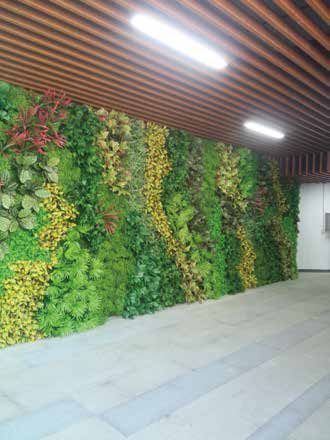
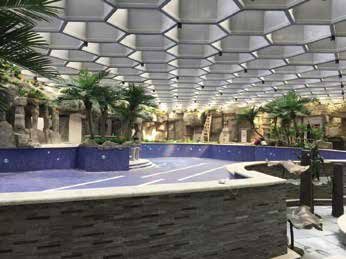
Real projects we have delivered in this kind of setting — on-site photographs, no mock-ups.
Want a planter supplier you can specify?
Tell us the planter sizes, finish and whether the order is stock or custom, and we will quote the per-model minimum, the lead time and the packing data — usually within 24 hours on business days.
Sister brand · GardenStone
Pair it with landscaping stone (GardenStone)
From the same supplier group — GardenStone supplies decorative pebbles, gravel and landscape stone that complete the same hotels, resorts, malls and Japanese gardens. One source for the whole landscape.
Explore GardenStone →