What Is an Artificial Plant UV Stability Test Report?
An artificial plant UV stability test report is a laboratory document that shows how a foliage material behaves under accelerated sunlight — specimens are exposed to fluorescent UV lamps, heat and condensation following ISO 4892-3 or ASTM G154, and the results back the outdoor colour-fastness rating you were quoted, typically 3–5 years for UV-stabilised polymer foliage.
October 25, 2026 · Buying & Sourcing · 8 min read · By Everflorae Editorial Team

- A UV stability test report is material-level laboratory evidence: real foliage specimens exposed to fluorescent UV lamps, heat and condensation under ISO 4892-3 or ASTM G154.
- Read five lines first: specimen identity, standard and lamp type, cycle and total hours, what was measured, and the pass criteria.
- The report supports a colour-fastness rating — typically 3–5 years outdoors for UV-stabilised polymer foliage — but it is not a site-specific warranty on its own.
- The same documentation habit covers indoor projects: artificial plants suit an allergy-free office because they release no pollen and need no soil or watering.
- Ask for the report at enquiry stage; samples start at 1 piece and stock plants-and-foliage lines ship in 5–12 days.
What an artificial plant UV stability test report actually is
An artificial plant UV stability test report is a laboratory document, not a marketing claim. It records that specimens of a specific foliage material — the ABS or PU polymer your leaves are moulded or cast from — were placed in a weathering apparatus, exposed to fluorescent UV lamp radiation, heat and moisture for a defined number of hours, and then measured for change. The two standards that govern how that exposure is run are ISO 4892-3 for plastics and ASTM G154 for the operation of fluorescent UV lamp apparatus, and both are quoted verbatim in the sources section below.
Three things distinguish a genuine report from a brochure sentence. First, it names the material: not “artificial plants” in general, but the leaf polymer of a product line. Second, it names the method: which standard, which lamp type, which cycle, how many hours. Third, it states what was measured and what changed — usually colour, sometimes gloss or mechanical properties. Anything less than those three is an assertion, and assertions are exactly what a project specification is supposed to replace.
How the laboratory test works
The logic of the test is acceleration. In a weathering chamber, specimens are cycled between periods of intense UV exposure at elevated temperature and periods of condensation humidity, which reproduces — in days — the wet-dry, hot-cold rhythm a facade faces over months. ISO 4892-3 specifies methods for exposing plastic specimens to fluorescent UV lamp radiation, heat and water; ASTM G154 defines how the apparatus itself is operated so results are repeatable between laboratories. A common cycle alternates UV exposure with condensation, and total exposure is counted in hours.
What the chamber deliberately compresses is time. Hundreds of hours under a fluorescent UV apparatus are intended to induce property changes consistent with end-use conditions, in the words of ASTM G154 — but the conversion between chamber hours and outdoor years is not a fixed constant, because real sunlight, latitude, altitude and orientation all vary. That is why serious suppliers quote a colour-fastness rating for outdoor use — 3–5 years for UV-stabilised polymer foliage — and support it with the report, rather than pretending the report itself is a stopwatch.
The five lines to read first in any report
You do not need a laboratory background to interrogate a report. Read five lines, in this order:
- Specimen identity — which foliage or polymer was tested, and whether it is the line you are actually buying.
- Standard and lamp — ISO 4892-3 or ASTM G154, and the lamp type, because different lamps emit different spectra.
- Cycle and duration — how long the exposure ran and how UV and moisture alternated.
- What was measured — colour change is the usual metric for foliage; the report should say how it was evaluated.
- The conclusion — what passed, what degraded, and who issued the document.
If a supplier cannot produce a report and answers only with “our material is UV-stabilised”, ask which grade, tested to which method. Sometimes the honest answer is that the line is new and the test is still in progress — a workable answer for a low-stakes installation, and an unworkable one for a south-facing facade on a building you have to maintain for a decade.
What the report does not promise
A test report is evidence at material level. It does not promise that your specific installation will look new for a stated number of years, because installation conditions dominate once the product leaves the chamber. A planter facing south on a rooftop takes more UV than the same plant in a shaded courtyard; foliage beside a swimming pool deals with reflected light and chlorine mist; coastal sites add salt. Our guide to how outdoor fading actually works walks through these environment effects in detail.
What the report does do is make the supplier’s rating falsifiable. When a catalogue says UV-stabilised foliage is rated for 3–5 years of outdoor colour-fastness, the report is the document behind that number — and it gives both sides a shared technical basis if colours drift earlier than expected on a protected, correctly installed site.
Why artificial plants are the default for an allergy-free office
The report habit is not only for facades. Indoors, the specification conversation usually starts with fire rating and materials, but there is a quieter reason artificial plants allergy free office projects default to artificial greenery: it releases no pollen, it holds no soil, and it needs no watering — so there is nothing in the planter to trigger hay-fever sufferers or feed mould. For receptions, clinics and tenant fit-outs where the occupants cannot be chosen, that combination matters as much as any colour number.
For indoor lines the UV question mostly disappears — window glass filters most of the spectrum that degrades foliage — which is why our standard potted plants and foliage are specified for interior use and the UV outdoor series is a separate, graded line. Asking for the artificial plant UV stability test report on an interior project is not wrong, but the documents a fit-out team will actually request are the fire certificates: NFPA 701, BS 5867 or EN 13501-1, depending on your market.
How to get a report before you order
Ask at enquiry stage, not after the deposit. When you request a quotation, state the installation environment (indoor, outdoor, covered outdoor), your market, and that you want the UV documentation for the outdoor lines — for example the HXUV outdoor plant wall series, whose 100×100 cm modules are UV-treated and rated for 3–5 years outdoors. If a third-party report does not exist for the exact line, ask what in-house or batch testing the factory can supply, and treat a refusal to document anything as data in itself. Our compliance page lists the fire and UV standards we work to.
Then close the loop physically. Samples start at 1 piece, so you can put the actual leaf in your own sunlight — a windowsill test is not a laboratory, but it will catch a badly graded material faster than any conversation. On the volume plants-and-foliage line, stock items ship in 5–12 days and production orders in 15–25 days; custom tree and topiary work runs 7–15 days standard and 20–45 days for built-to-drawing orders.
Frequently asked questions
What does an artificial plant UV stability test report contain?
How long does UV-stabilised artificial foliage last outdoors?
Is a UV test report the same as a warranty?
Are artificial plants a good choice for an allergy-free office?
Sources & attributed quotations
Named sources behind this guide. The quotations below are verbatim from the issuing bodies, with outbound links to the official pages.
“This document specifies methods for exposing plastic specimens to fluorescent UV lamp radiation, heat and water in apparatus designed to simulate the weathering effects that occur when plastic materials are exposed in actual end-use environments to global solar radiation, or to window-glass filtered solar radiation.”
— ISO (International Organization for Standardization), ISO 4892-3:2024, Plastics — Methods of exposure to laboratory light sources — Part 3: Fluorescent UV lamps, official source
“The use of this apparatus is intended to induce property changes consistent with the end use conditions, including the effects of the UV portion of sunlight, moisture, and heat.”
— ASTM International, ASTM G154-23, Standard Practice for Operating Fluorescent Ultraviolet (UV) Lamp Apparatus for Exposure of Materials, official source
- ISO — ISO 4892-3:2024, fluorescent UV lamp exposure of plastics
- ASTM International — ASTM G154-23, operation of fluorescent UV lamp apparatus
- Everflorae — Fire & UV Compliance Documentation
Related pages
Related project cases
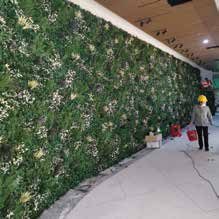
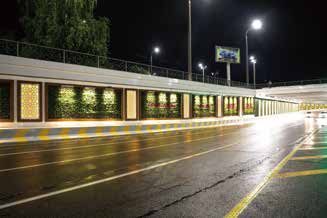
Real outdoor installations we have delivered in conditions that test a UV rating — on-site photographs, no mock-ups.
Need UV documentation with your order?
Tell us the installation environment, your market and the lines you are shortlisting, and we will send the relevant UV and fire documentation together with a quotation path and 1-piece sampling options — usually within 24 hours on business days.