UV-Resistant Artificial Plants: How Outdoor Fading Actually Works
Every buyer has seen it: an artificial tree that looked perfect on delivery and faded to a pale ghost of itself within two summers. This guide explains what ultraviolet light actually does to artificial foliage, how UV-resistant foliage differs, what the warranty grades really promise — and what they honestly do not.
September 26, 2026 · Technical Guides · 8 min read
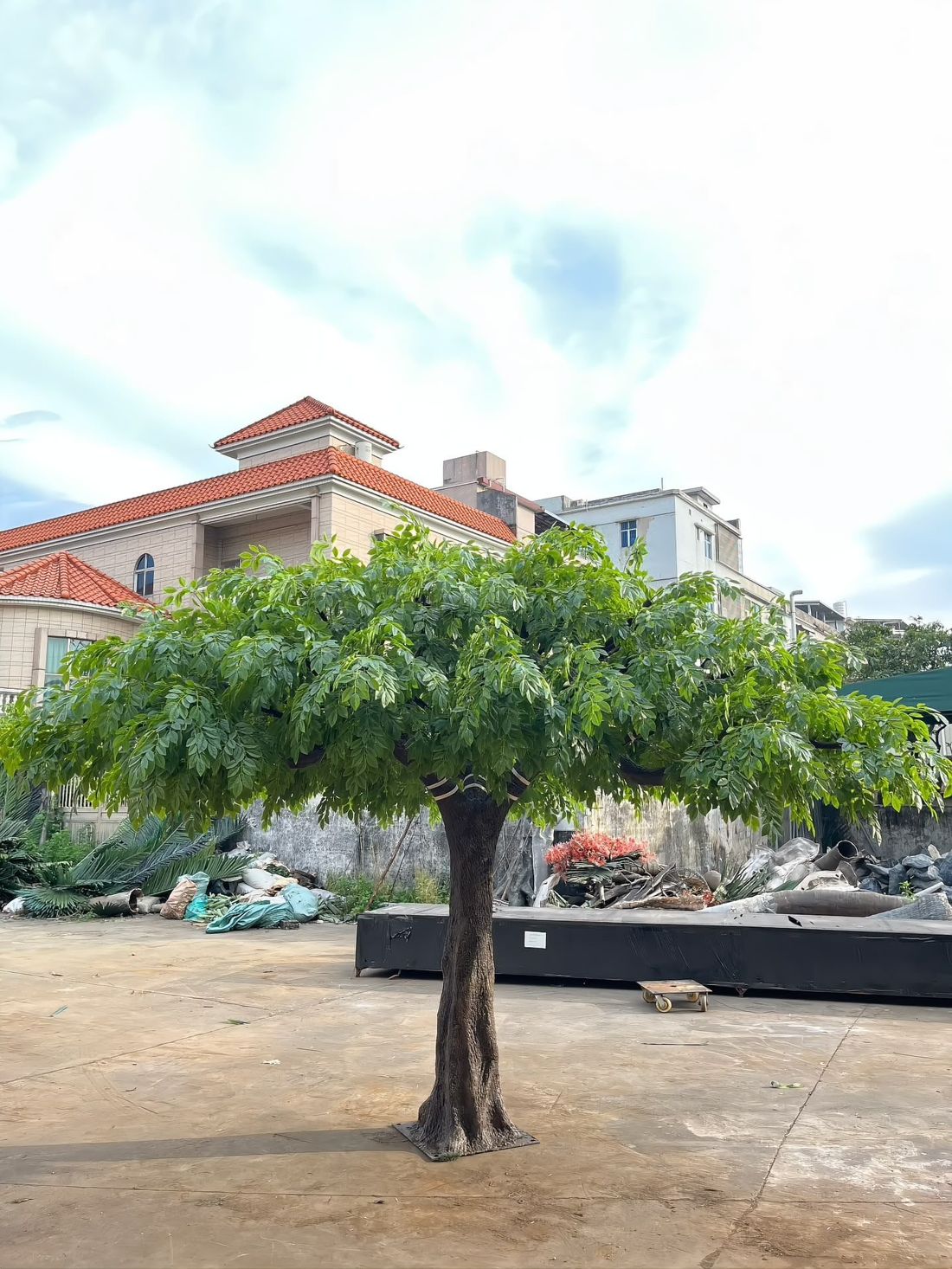
- UV light breaks down both the polymer surface and the pigments of ordinary foliage — fading is chemical degradation, not dirt.
- UV resistance comes from stabilisers and quality pigments built into the material during moulding, not from a spray-on coating.
- Outdoor grade carries a 3-year colour-fastness warranty; premium outdoor grade extends to 5 years.
- Environment changes the maths: poolside chlorine, coastal salt air and reflected light from glass all accelerate fading.
- No artificial foliage is fade-proof. Anyone promising "never fades" is selling you something they will not put in writing.
What ultraviolet light actually does to artificial foliage
Sunlight carries ultraviolet radiation — wavelengths shorter than visible light, with enough energy to break the chemical bonds in polymers and pigments. Over months of exposure, three things happen to ordinary artificial foliage, in roughly this order:
- Pigment breakdown. The colourants mixed into the plastic absorb UV energy and lose their colour-carrying structure. Greens shift first — often toward a pale, yellowish or greyish tone that no longer reads as a living plant.
- Surface degradation. The polymer surface itself becomes brittle and micro-rough. A faded leaf is not just paler; it scatters light differently, which is why old outdoor foliage develops a distinctive chalky, matte look.
- Embrittlement. In advanced stages the leaf material loses flexibility and cracks at stress points. By then the damage is structural, not cosmetic.
Two practical conclusions follow. First, fading cannot be wiped off or washed out — it is the material itself changing. Second, the process is driven by cumulative UV dose, which is why the same tree fades faster on a south-facing rooftop than under a covered terrace.
How UV-resistant foliage is actually made
There is no magic material that ignores the sun. UV resistance is engineered in two ways, both applied during manufacturing — not after:
- UV stabilisers blended into the compound. Additives mixed into the base material before moulding absorb or neutralise UV energy before it can break the polymer bonds or attack the pigments. The protection is distributed through the entire thickness of the leaf — it cannot scratch off, because it is not a coating.
- Fade-resistant pigmentation. The colourants used in outdoor-grade foliage are selected for UV stability, in tested proportions. A multi-tone green-silver leaf mix for a hotel entrance and a flat indoor green are not the same formulation, even when the finished leaves look similar in a showroom photo.
Our commercial foliage is moulded from ABS or PU, which take and hold the stabiliser package well and keep their shape under temperature swings — one reason outdoor trees also survive frost and heat cycling better than thin film products. The honest caveat: additives are consumed as they work. That is why UV protection is expressed as a warranty period, not a permanent property.
What the warranty grades really mean
We offer two outdoor foliage grades, and the difference is worth understanding before you compare quotations:
- Outdoor grade — 3-year colour-fastness warranty. The standard specification for outdoor trees, hedges and topiary in normal exposure. Correctly specified and installed, the foliage holds its commercial appearance for at least three years of year-round outdoor exposure.
- Premium outdoor grade — up to 5 years. A heavier stabiliser package and higher-grade pigmentation, specified for high-exposure settings: full sun façades, pool decks, coastal sites, or any project where the planting must still look fresh in year five.
Read both as colour-fastness warranties, not "no visible change ever" promises. Under enough cumulative UV dose every polymer fades; the warranty states how long the foliage stays within commercially acceptable colour limits. This is also why warranty terms are issued per order against a stated installation setting — a tree under a glass atrium roof and a tree on an open rooftop are not the same exposure, and honest suppliers treat them differently.
Environment changes everything
The warranty baselines assume normal outdoor exposure. Real sites push the numbers in both directions, and a specification that ignores the setting is guesswork:
- Direct all-day sun — the baseline case. South-facing façades in strong-sun climates accumulate UV dose fastest; premium grade is the sensible default here.
- Reflected and amplified light — glass curtain walls, light-coloured paving and water surfaces bounce additional UV and heat onto foliage. Plants near a glazed façade can fade measurably faster than the same product in open shade.
- Poolside and water parks — chlorine and splash chemistry attack both pigment and polymer, on top of high reflected UV. This is a premium-grade environment almost by definition.
- Coastal sites — salt mist corrodes hardware and dulls leaf surfaces. UV-stable foliage still needs corrosion-resistant trunks, fixings and planters to survive the same years.
- Covered outdoor spaces — terraces, porticos and deep overhangs cut direct UV dramatically. Outdoor grade in a covered space often outlives its warranty comfortably.
The practical rule: when you enquire, state the setting — direct sun, poolside, coastal, covered — and ask which grade the factory specifies for it. A supplier who answers that question with a follow-up question is doing their job.
What does not work: the two shortcuts to avoid
Two shortcuts account for most of the faded artificial planting we are asked to replace:
- Indoor foliage moved outdoors. Indoor-grade foliage is moulded without the stabiliser package. It may survive a sheltered summer, but in direct sun it shifts tone within one to two seasons, often with visible chalking. No warranty applies, because the product was never specified for the environment.
- Spray-on "UV protection" coatings. Aftermarket clear coats create a thin sacrificial layer that degrades unevenly, changes surface sheen, traps dirt at the leaf veins and must be re-applied — on a 4 m tree. Protection that is part of the material is not comparable to protection sitting on top of it.
If a quotation offers either shortcut as an equivalent to genuine outdoor-grade foliage, it is not an equivalent — it is a deferred replacement cost.
How to specify UV grade before you order
Put four lines in every outdoor purchase order:
- Installation setting — direct sun, poolside, coastal, covered outdoor. This drives the grade, not the other way round.
- Foliage grade and warranty in writing — outdoor grade (3-year) or premium outdoor grade (up to 5-year), stated on the quotation, not assumed.
- Material and construction — ABS/PU foliage on engineered trunk cores for anything structural, with fixings matched to the environment.
- Verification — production photos of the actual batch before container sealing, and colour samples if the tone must match an existing scheme.
For projects that also need fire documentation — many outdoor-adjacent installations, such as restaurant terraces and mall entrances, do — ask for NFPA 701 or BS 5867 test documents per order at the same time. UV and fire specifications are independent options; a supplier who treats them as one bundled line is hiding something on one of them.
Frequently asked questions
How long do UV-resistant artificial plants last outdoors?
Can I put regular indoor artificial plants outside?
Does UV-resistant mean fade-proof?
Do harsh environments shorten the life of outdoor artificial plants?
Related pages
Specifying an outdoor installation?
Tell us the setting — direct sun, poolside, coastal or covered — and we will confirm the foliage grade and warranty in writing with your quotation, normally within 24 hours on business days.