What Artificial Plants Suit a Shopping Mall Project?
The best artificial plants for a shopping mall project are potted floor plants from 45 to 250 cm — monstera, dracaena, ficus, fiddle-leaf fig and palms in ABS/PU foliage — backed by fire-rated foliage walls and planter-ready drop-ins, with UV grades for skylit atriums, carton-quantity MOQ, samples at unit price, 5–12 days in stock and 15–25 days made to order.
October 14, 2026 · Buying & Sourcing · 7 min read · By Everflorae Editorial Team

- Potted floor plants 45–250 cm cover most mall locations: walkway anchors, seating groups, lift lobbies and atrium edges.
- High-level zones take 210 cm trailing vines and 60/90/120 cm wall hangings, planted out of shoppers' reach.
- Fire-rated foliage is specified to NFPA 701, BS 5867 or EN 13501-1; UV-stabilised grade carries a 3–5 year colour-retention expectation on skylit faces.
- Timing: sample at unit price first; in-stock SKUs ship in 5–12 days, produced orders in 15–25 days, engineered walls in 20–45 days.
What does a mall project demand from artificial plants?
A shopping mall is the highest-traffic, most tightly regulated interior an artificial plant will ever sit in. Shoppers brush past planters at arm's length, children touch the foliage, cleaning crews work around the trading schedule, and the fire marshal treats every square metre of an enclosed retail space more seriously than any hotel ballroom. So when a buyer searches for artificial plants for shopping mall project tenders, the honest answer is a specification that covers distance, durability, compliance and logistics — not a list of product names.
Five pressures shape that specification:
- Proximity. Unlike atrium trees seen from across a lobby, mall planting sits beside walkways and seating. Two-tone matte foliage in ABS or PU is the minimum that survives a close look; glossy single-tone leaves read plastic immediately.
- Operating hours. Malls trade seven days a week. There is no watering rotation, no repotting crew and no grow-light schedule — which is precisely why the planting is artificial in the first place.
- Fire compliance. Enclosed retail is the strictest code environment in commercial interiors. A named standard — NFPA 701, BS 5867 or EN 13501-1 — belongs in the specification wherever the project's code path requires one.
- Sunlight extremes. Skylit atriums fade real foliage in months and bake it in others; windowless basement corridors kill it outright. Artificial foliage handles both ends — UV-stabilised grade outdoors and in sun, indoor grade in the dark zones.
- Procurement scale. A single mall fit-out routinely mixes hundreds of pieces across many SKUs — potted plants, hanging foliage, panels, planters — that must arrive colour-matched in one or two shipments.
Which plant formats work where in a mall?
A mall is a stack of different planting problems. The formats that cover them map onto the artificial plants & foliage line as follows:
- Potted floor and table plants — the workhorse format. Heights run from 10 cm up to 180 cm per SKU, with species reaching 250 cm in the range table: monstera 65–180 cm, dracaena fragrans 80–250 cm, ficus 90–215 cm, fiddle-leaf fig 60–180 cm, bamboo 120–260 cm, and palms, cycas, sansevieria and sweet bay at 45–250 cm. They anchor walkway junctions, seat clusters, lift lobbies and atrium edges.
- Trailing and hanging foliage — 210 cm vines and wall hangings at 60, 90 and 120 cm, planted into high-level planters and balustrades where they green the sightline from below and stay out of reach.
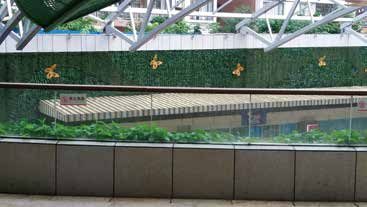
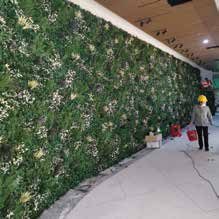
- Foliage walls and panels — for feature walls at escalator landings and mall entrances, built from modular panels at 4–6 kg/m² with fire-rated options; the formats are detailed in our green wall panels vs hedges guide.
- Planter-ready drop-in units — foliage grown to drop straight into fibreglass planters from 30 to 150 cm, which keeps the installation crew's work to "place and water-free". The container side is covered by the planters & bases line.
- Foliage bunches — 25–40 cm bundles, including flame-retardant versions, for green-wall infill and seasonal replanting of beds without touching the structure.
Where an anchor point calls for height rather than density, the potted range hands over to the artificial trees line — the same workshop produces both, which is what keeps the greens matched. How these formats have performed in real retail builds is on the shopping malls & retail applications page.

How do you specify mall plants so every quote matches?
Mall tenders usually collect three or more quotations, so the specification has to pin down the variables before pricing starts:
- Foliage: ABS (injection-moulded, holds its shape, UV-stabilised) or PU (cast, softer hand-feel) — named explicitly.
- Heights: per SKU from the range table, in centimetres, not "medium".
- Pot: pot included, or plant-only for planters you are sourcing separately.
- Fire standard: NFPA 701, BS 5867 or EN 13501-1, per the code path; FR foliage bundles at 25–40 cm where infill needs it.
- UV grade: outdoor 3–5 year colour-retention grade for skylit atriums and sun-facing faces; indoor standard elsewhere.
- Packing: flat-packed, carton quantity per SKU — the number that decides your freight bill.
- Colour control: foliage produced in batches against a retained colour standard, with a physical reference sample held for repeat orders.
Quotes that answer all seven items can be compared line by line. A quote that says "premium quality artificial plants" cannot.
What about dark zones — corridors and offices without daylight?
Every mall has zones where real planting has already failed once: basement corridors, cinema concourses, back-of-house walkways, and the management offices inside the building. The best artificial plants for dark office and no-daylight corridors follow the same specification logic as the mall floor — dense ABS/PU foliage, a named fire standard where the code asks for one, no UV premium needed because sunlight never reaches them. What changes is the format: sansevieria, dracaena and monstera in the 45–180 cm range carry a dark corridor at eye level, and wall hangings green the upper half without floor space. This is also where the budget argument lands hardest: live planting in a windowless zone needs grow lighting, a watering rota and quarterly replacement, and the plants still look tired — the total-cost comparison for that decision is in our artificial vs real plants TCO guide. The commercial workflow is identical: send the dimensions and setting, and a specification sheet with pricing comes back normally within 24 hours on business days.
How much do you need, and how long does it take?
MOQ on the plants-and-foliage line is carton quantity per SKU — not a fixed order size. A walkway of 20 planter bays at 2 potted plants each is roughly 40 pieces across 2–3 SKUs; mixed containers combining potted plants, foliage bunches and wall panels are normal, and the packing list is built around your carton quantities with total CBM confirmed before shipping is booked, so there is no surprise on the freight invoice.
Sequencing: a sample at unit price comes first, then volume against the approved reference. In-stock SKUs ship in 5–12 days; produced orders take 15–25 days; engineered feature walls and made-to-order forms run on the 20–45 day custom schedule including drawing approval. Flat-packed cartons keep the container count down, and private labelling — tags, pot branding, carton marking to your barcode — is available for distribution buyers.
Frequently asked questions
What are the best artificial plants for a shopping mall project?
How many artificial plants does a shopping mall project need?
How long does a shopping mall plant order take?
Are artificial plants safe for enclosed mall environments?
Sources & attributed quotations
Named sources behind this guide; the quotations are verbatim from the issuing bodies, with links to the official pages.
“This standard establishes test methods to assess the propagation of flame of various textiles and films under specified fire test conditions.”
— NFPA (National Fire Protection Association), NFPA 701, Standard Methods of Fire Tests for Flame Propagation of Textiles and Films (2023 edition), official source
“This document provides the reaction to fire classification procedure for all construction products, including products incorporated within building elements with the exception of power, control and communication cables which are covered by EN 13501-6.”
— CEN (European Committee for Standardization), EN 13501-1, Fire classification of construction products and building elements — Part 1: Classification using data from reaction to fire tests, official source
- NFPA — NFPA 701, fire tests for flame propagation of textiles and films
- CEN — EN 13501-1, reaction to fire classification of construction products
- BSI — BS 5867-2:2008, flammability requirements for curtain and blind fabrics
- Everflorae — Fire & UV Compliance Documentation
Related pages
Related project cases
Real projects we have delivered in this category — on-site photographs, no mock-ups.
Specifying plants for a mall project?
Send the floor plan, the locations and heights you need, the installation setting (indoor, skylit or windowless), and the fire and UV specification. We will come back with the specification sheet, carton quantities, unit pricing and lead time — normally within 24 hours on business days.
Sister brand · GardenStone
Pair it with landscaping stone (GardenStone)
From the same supplier group — GardenStone supplies decorative pebbles, gravel and landscape stone that complete the same hotels, resorts, malls and Japanese gardens. One source for the whole landscape.
Explore GardenStone →