Artificial Trees for Hotel Lobbies: A Specification Guide for FF&E Buyers
A lobby tree is the single most photographed piece of greenery in any hotel — and the one most often re-ordered because it was specified too small, too sparse or without fire documents. This guide walks through the decisions an FF&E buyer or designer should lock down before the purchase order, written from the factory floor.
September 26, 2026 · Applications · 7 min read
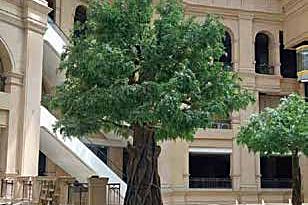
- Size the tree to the ceiling volume, not the planter: lobbies with atriums typically take 3.5–6 m trees, and artificial trees are buildable from 1 m up to 15 m.
- Olive, ficus and banyan trees are the workhorses of lobby schemes; blossom and maple trees carry seasonal or themed branding.
- Fire compliance is per-order documentation: NFPA 701, BS 5867 or EN 13501-1 test papers should be requested before production, not after delivery.
- Trees above roughly 4 m ship in bolt-together trunk segments with numbered canopy bags and assemble on site in under an hour with two people.
- Plan lead times around approvals: 7–15 days for standard catalogue trees, 20–45 days for custom builds, 30–60 days for full multi-tree lobby projects.
What size artificial tree does a hotel lobby actually need?
The most common specification mistake is sizing the tree to the planter instead of the volume. A 2.5 m tree that looked generous on a showroom floor disappears under a double-height lobby ceiling. A practical rule from project drawings: with a standard 3 m ceiling, a 2.5–3 m tree with a wide canopy works; once you have an atrium or double-height volume, 3.5–6 m reads correctly, and signature atrium installations go higher.
Because artificial trees are built on a welded steel core, height is not bought off a shelf — our workshop builds from 1 m up to 15 m. Canopy spread matters as much as height under lobby lighting: a tall tree with a sparse canopy looks thin in photos, and photos are where your guests judge it. State both dimensions on the drawing.
| Lobby type | Typical tree height | Notes |
|---|---|---|
| Standard reception (≈3 m ceiling) | 2.5–3 m | Wide canopy more important than height |
| Double-height lobby | 3.5–6 m | Ships in bolt-together trunk segments |
| Atrium / signature installation | 6 m and above | Engineered core, on-site assembly sequence provided |
Which tree species work best in hotel interiors?
Olive trees dominate hospitality schemes for a reason: the silvery-green palette sits quietly behind almost any brand colour, and the canopy can be shaped to any silhouette. Ficus and banyan trees — with their aerial roots and broad canopies — anchor Asian-themed and resort interiors, and they read as substantial from the lobby entrance.
For branding moments, blossom trees (cherry and magnolia) carry seasonal campaigns and Chinese New Year programming, while autumn maple tones warm wine bars and restaurant corners within the same property. Because every tree is built to drawing, designers routinely order the same species in graded heights — 3 m, 4 m, 5 m — to create rhythm along a corridor or around a seating cluster.
How do you handle fire compliance for lobby trees?
Hotel interiors are the strictest fire environment artificial greenery meets, and the failure mode is predictable: documents requested after delivery, when the local inspector wants them and the factory can only offer a generic catalogue certificate.
The fix is procedural, not technical. Fire performance is available to NFPA 701 (the reference standard for US-style hospitality interiors), BS 5867 (UK/EU furnishings) or EN 13501-1 (EU reaction-to-fire classification for fixed installations such as green walls) — and the test documentation is issued per order, for the batch actually shipped. Put the required standard in the purchase order and ask for the documents with the production photos, before the container is sealed.
How are large lobby trees shipped and installed on site?
Anything above roughly 4 m does not ship as a single object. The trunk is built in bolt-together steel-cored segments; the canopy foliage is packed in numbered bags matched to the assembly sequence, and two people can assemble a 5–6 m tree on site in under an hour with no specialist rigging. Branches slot into welded sockets, so the silhouette you approved on the 3D render is the one that rebuilds on site.
Standard catalogue specifications ship in 7–15 days; custom heights, canopy shapes and finishes take 20–45 days; and a full lobby programme — multiple trees plus green wall panels and planters in one consolidated shipment — should be planned at 30–60 days including drawing approvals. Sea freight is the norm for full projects; sample units at MOQ 1 piece go by express (DHL/FedEx/UPS).
What should an FF&E buyer confirm with the factory before ordering?
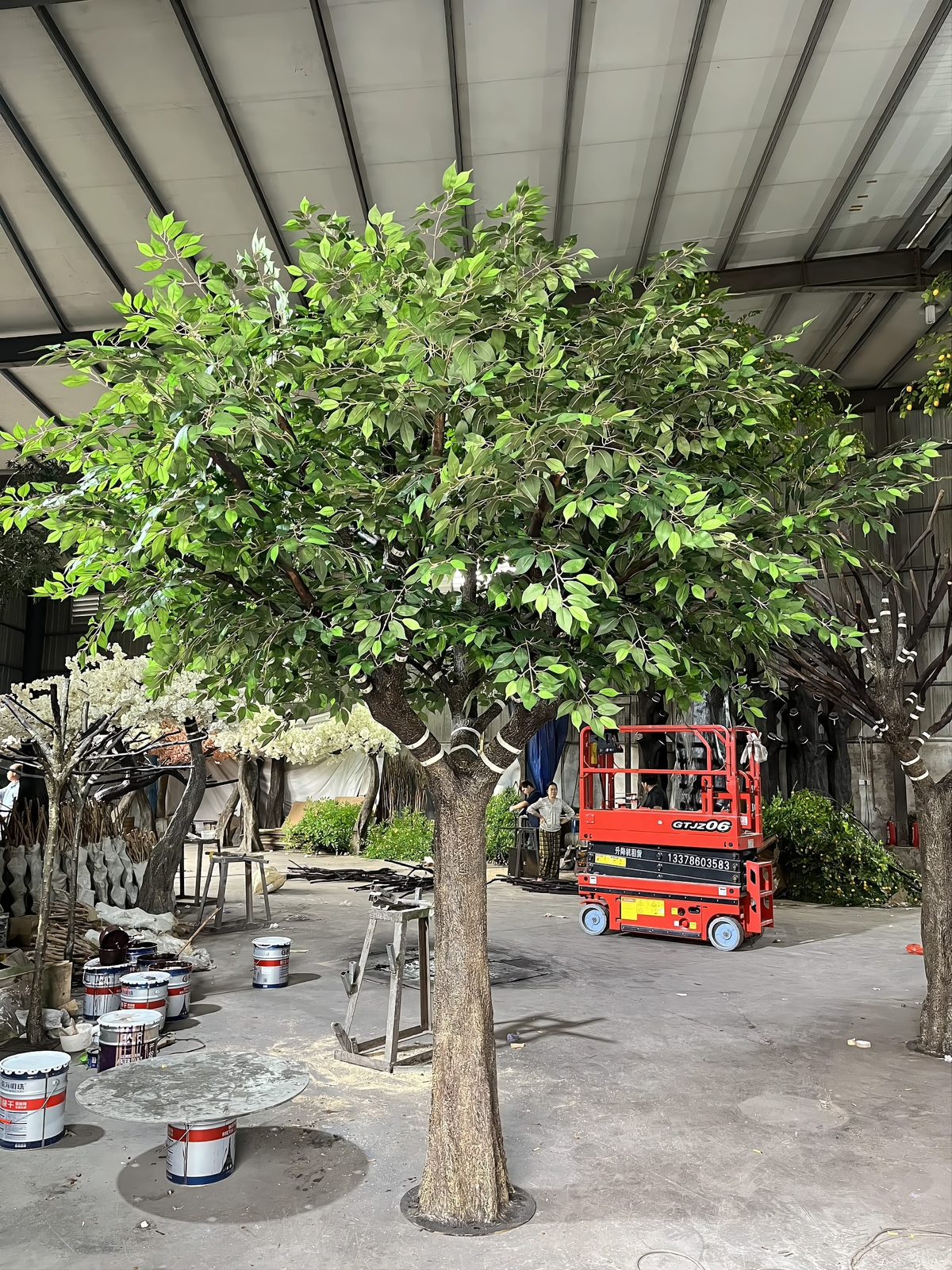
Four written confirmations separate a smooth lobby install from a re-order. One: a production drawing and 3D render for approval, so the approved height, canopy spread and trunk shape are the ones that ship. Two: fire documents issued per order to the standard your project requires. Three: production photos of your actual batch at three stages — welded core, bark applied, canopy finished. Four: packed dimensions and gross weight of your specification before freight is booked, because canopy diameter, not tree height, drives the carton size.
And one habit worth keeping: order one sample tree and view it under lighting close to your lobby's — a canopy that looks right in a warehouse can read flat under 3000 K downlights. Our factory in Guangzhou has built hospitality trees for export to 50+ countries since 2012, and the projects that go smoothly are always the ones where these four items were in the PO.
Frequently asked questions
How tall can an artificial lobby tree be made?
Do hotel lobby artificial trees need fire certification?
What is the minimum order for lobby trees?
Can the tree be matched to my design rendering?
Related pages
Planning a project?
Send dimensions, drawings or reference images and we will reply with a priced quotation and a production drawing — normally within 24 hours on business days.