How Are Artificial Trees Made in a Factory?
An artificial tree is built in five stages: a welded steel or fibreglass trunk core, moulded ABS or PU leaves, hand-painted bark, branch-by-branch assembly, then inspection and packing. Standard sizes run from 1 m to 15 m, samples start at 1 piece, standard lead time is 7–15 days, and fully custom trees take 20–45 days.
September 29, 2026 · Factory & Manufacturing · 8 min read · By Everflorae Editorial Team
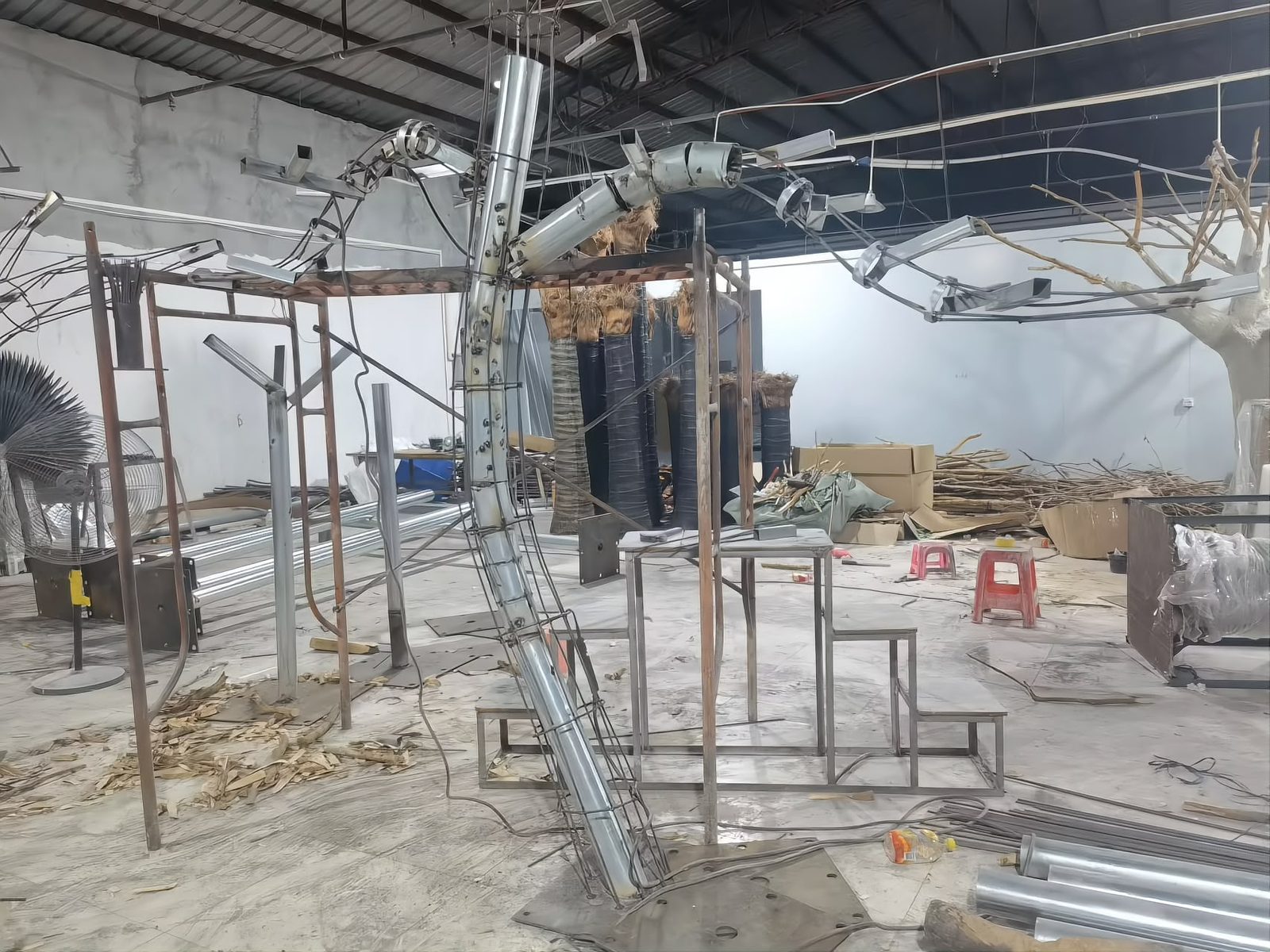
- Five stages: trunk core, leaves, bark finishing, assembly, then inspection and packing.
- Trunks are welded steel — galvanised or powder-coated — or glass-fibre (FRP) for very large trees and palms.
- Leaves are injection-moulded ABS for crisp detail or cast PU for a softer, lifelike surface; outdoor trees add UV-stabilised foliage with 3–5 year colour-fastness.
- Samples start at 1 piece, standard lead time is 7–15 days, custom work is 20–45 days.
- Fire rating (NFPA 701 / BS 5867 / EN 13501-1) is a separate option from UV grade — specify both for indoor commercial installs.
What a factory-made artificial tree is actually made of
Every commercial artificial tree, whether it is a 15 m atrium banyan or a 1.5 m olive tree for a reception desk, is three systems bolted together. The structure is the trunk and branch skeleton, plus the base plate that keeps the tree standing. The foliage is the leaves — injection-moulded, cast, or fabric — clipped onto that skeleton. The finish is what you actually see at eye level: bark texture, paint, and the colour match between trunk and canopy.
Almost every quality problem buyers complain about traces back to one of those three systems being under-specified. A tree that tilts has a base-plate problem. A tree that looks plasticky has a leaf-material problem. A tree that looks cheap in a photograph but convincing on site usually has a canopy-density problem. Knowing the five production stages is what lets you ask the right questions before you place an order on artificial trees.
Stage 1 — Welding and inspecting the trunk core
The trunk starts as steel tube, cut to the drawing and welded into a tapered or straight core. Branch sockets are welded onto the core in batches, so each branch position is repeatable across a production run instead of measured by eye. Large trees get a full-weld base plate rather than a tacked one, because the base plate carries the whole bending load when the tree is tall or freestanding.
Before the frame leaves the welding bay, wall thickness and pipe diameter are checked with a caliper against the drawing. This is a genuine structural step, not a formality: a 15 m tree specified with a thin-wall tube is a wind-load and stability risk regardless of how good the foliage looks. We compare steel-core, FRP and moulded trunk options in more detail in our trunk materials comparison.
Stage 2 — Moulding and colour-matching the leaves
Leaves are made in steel moulds, and the mould is the single biggest determinant of how real the tree reads. ABS leaves are injection-moulded: the plastic is forced into a hot mould, which produces a crisp edge, fine veining and a consistent thickness — good for ficus, olive and most foliage seen at close range indoors. PU leaves are cast, which gives a softer surface and a slightly translucent look that photographs better under warm hospitality lighting.
Colour is matched to an approved sample, not to a screen. Foliage is produced in batches, and a batch that is mixed differently will read as a different green once installed — which is why serious buyers ask for a physical sample approval step before mass production. Trees destined for full sun, pool decks or coastal sites are produced in UV-stabilised polymer with a 3-year colour-fastness warranty, or up to 5 years on premium outdoor grade. Fire-retardant additives, tested to NFPA 701, BS 5867 or EN 13501-1, are a separate specification from UV grade.
Stage 3 — Bark texture and hand painting
Trunk realism is finished by hand. Depending on the model, the core is wrapped in fibreglass (FRP) or coated in a moulded bark shell, then hand-painted in layers so the ridges, knots and colour variation follow the shape of that specific trunk rather than a repeating pattern. Airbrushing and dry-brush passes add the grey-green and ochre tones that real bark carries.
This stage is also where trunks are matched to each other. For a project with three trees in one lobby, the workshop numbers the trunks and holds the same paint mix across them, because two trunks painted a week apart from different mixes will show a visible difference side by side.
Stage 4 — Assembly and canopy shaping
Branches are inserted into the welded sockets and locked, then the canopy is shaped against the approved drawing: overall width, crown height, and how dense the outer layer should be. Dense canopies read better up close and in photographs but weigh more, which feeds back into the base plate and the packing method. Very large trees are assembled and checked under a scissor lift so the workshop can confirm the finished silhouette at the height it will actually stand.
Trees above roughly 3–4 m are normally built in sections so they can be crated and shipped, then re-assembled on site with the same joints. If your site has a lift, a narrow service corridor or a low ceiling on the delivery route, tell the factory at quotation stage — the sectioning plan is set during design, not after packing.
Stage 5 — Inspection, packing and container loading
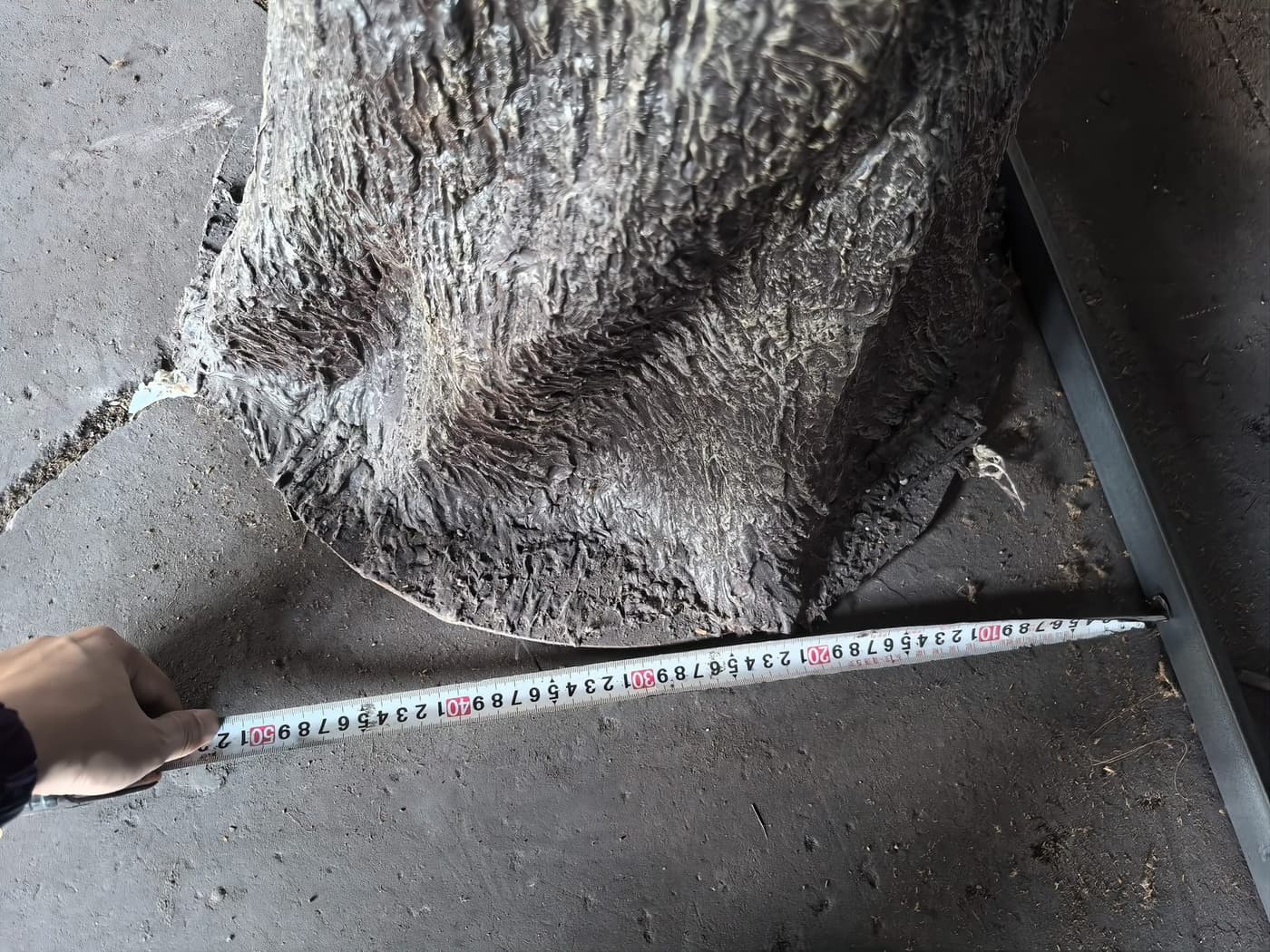
Finished trees are inspected against the drawing before packing: trunk diameter and height, base plate dimensions, canopy width, leaf colour against the approved sample, and branch count. Trunks are then packed on iron frames or in reinforced cartons with the canopy protected, and containers are loaded with the heaviest frames at the bottom so nothing crushes in transit.
This is also the stage to think about documentation. Certificates and test reports — fire test documents for the exact panel or foliage specification you ordered, or UV grade statements — are issued against the order specification. Ask for them at quotation stage, not after the container has sailed.
Lead times, samples and minimum order quantity
Timing follows the same logic as the stages above. If the frame and moulds already exist, a repeat or standard order ships in 7–15 days after deposit and sample approval. If the tree is truly custom — a new canopy shape, a non-standard trunk form, or a height outside the usual 1–15 m range — the frame has to be built and the moulds prepared first, which puts the run at 20–45 days.
Sampling is deliberately low-friction: samples start at 1 piece, so you can hold the actual leaf material, test the weld on the base plate and judge canopy density before committing to a production order. Small minimum orders are supported for project-specific trees, which matters for boutique hotels, restaurants and one-off landscape features. Custom dimensions, colours, trunk forms and branding are covered on our custom & OEM page, and the wider process — tooling, showroom, workshop — is described on the factory page.
How to compare quotes from different factories
Two quotations for "a 3 m artificial ficus tree" are rarely for the same object. Before comparing prices, ask each supplier for five numbers and one document: steel wall thickness, base plate dimensions, leaf material and mould type, branch count, packed volume per tree, and a fire or UV test document for the exact foliage specified. A quotation that cannot answer those questions is not cheaper — it is unspecified, and the difference will appear on site.
We do not publish price lists, because cost per tree is driven by height, canopy density, trunk structure and packing volume rather than by a single unit rate. A range, quoted against your drawing and destination port, is a more honest answer than a headline number.
Frequently asked questions
How long does it take to manufacture an artificial tree in a factory?
What is the minimum order quantity for a factory-made artificial tree?
What are the leaves of an artificial tree made of?
Is a factory-made artificial tree suitable for a hotel lobby or atrium?
References & standards
Further reading on the materials, weathering and fire-testing frameworks referenced in this guide:
- ASTM International — weathering test methods (G154/G155)
- ISO — plastics exposure to laboratory light sources (ISO 4892)
- NFPA — fire tests for flame propagation of textiles and films (NFPA 701)
- CEN — European reaction-to-fire standards (EN 13501-1)
Related pages
Need a tree built to your drawing?
Send the height, canopy width, setting and reference images, and we will reply with a production drawing, a priced quotation and the sampling options — usually within 24 hours on business days.