What Is an Artificial Boxwood Privacy Screen?
An artificial boxwood hedge privacy screen is a modular, foliage-covered panel that creates instant, maintenance-free screening for balconies, fences and facades. Standard panels cover about 0.5–1 m², ship flat and install in hours; stock colours run 7–15 days, custom 20–45 days, with samples from one piece and outdoor UV colour-fastness rated 3–5 years.
October 3, 2026 · Buying & Sourcing · 8 min read · By Everflorae Editorial Team
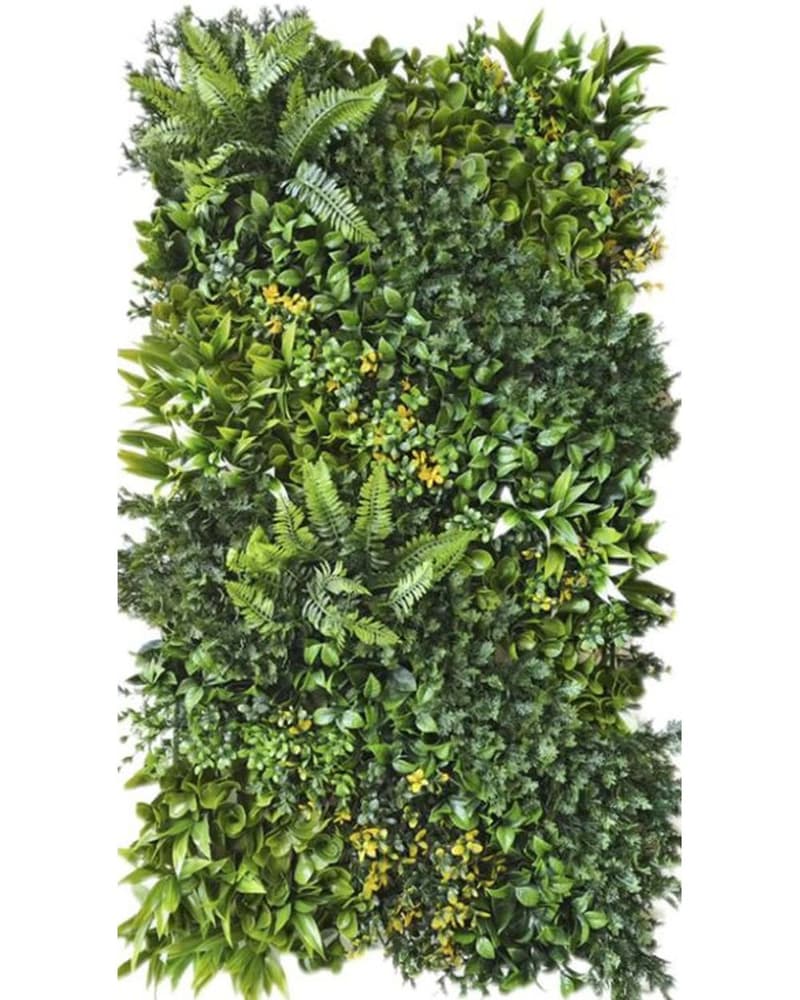
- A boxwood hedge screen is a clip-together foliage panel system, not a living plant — no watering, no trimming, no pests.
- Stock panels run 7–15 days from confirmed order to packed; custom sizes and framing run 20–45 days.
- Samples start at one piece; panels cover 0.5–1 m² each and build runs up to about 1.8 m tall.
- Outdoor grade is UV-stabilised for 3–5 year colour-fastness; fire-rated foliage (NFPA 701, BS 5867, EN 13501-1) is optional for public sites.
- For the full green-wall range these clip into, see our green walls & hedges product line.
What an artificial boxwood hedge privacy screen actually is
The phrase artificial boxwood hedge privacy screen describes a manufactured panel — usually a rigid plastic grid or steel frame faced with moulded boxwood-style foliage — that you join edge-to-edge to form a solid green barrier. Unlike a living hedge it reaches full height the day you install it, stays the same shape through every season, and never drops leaves onto the patio. Buyers spec it for balconies, rooftop terraces, fence lines, pool enclosures and the street-facing side of a commercial facade where a real hedge would be impossible or high-maintenance.
Because the product is modular, a screen scales to the job: a few panels hide a bin store, a continuous run wraps a courtyard, and a tall version screens a mezzanine edge. The same factory that builds these also produces trees from 1 m up to 15 m, so mixed shipments of panels and specimen pieces are routine for landscape contractors.
How the panels are built
Material choice is what separates a screen that looks cheap in six months from one that still reads as a hedge in year four. The foliage on a quality panel is moulded from ABS (injection-moulded) or PU (cast) rather than cut silk film, so the leaves hold their shape and colour. The backing is typically a UV-stabilised polyethylene grid or a powder-coated steel frame, and the panel edges carry interlocking clips so相邻 panels sit flush.
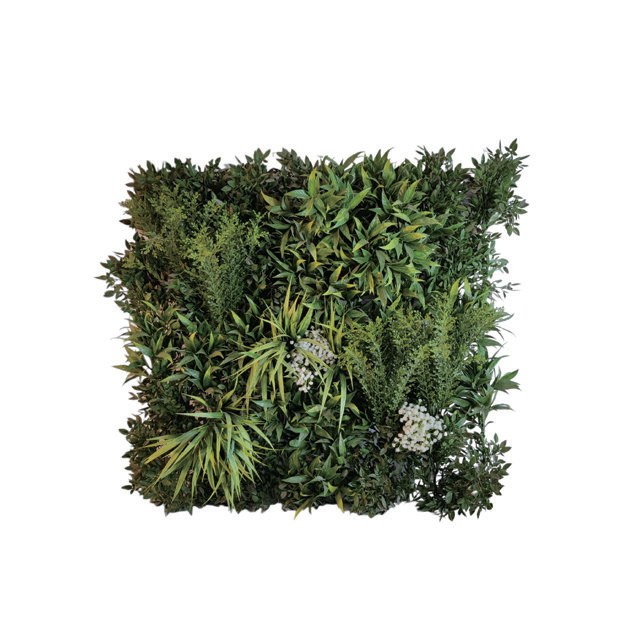
- Foliage. Moulded ABS/PU leaves in 2–3 green tones give the depth that reads as a real boxwood from two metres away.
- Backing. A rigid grid keeps the panel flat against wind; a steel frame version adds structural height for freestanding runs.
- Fixings. Built-in clips, zip ties or a slotted rail let you attach to chain-link, timber, masonry or a planter box without custom fabrication.
- Options. Fire-rated foliage (NFPA 701, BS 5867, EN 13501-1) and outdoor UV grade are applied or treated per order, with documentation supplied for the specification file.
Sizing and how many panels you need
Most modular panels come in 0.5 m × 0.5 m, 1 m × 1 m or 1 m × 1.5 m footprints and clip together to build a continuous run from about 0.6 m up to 1.8 m tall, with custom heights quoted per project. To estimate, multiply the linear metres you want to screen by the height, then divide by the panel area — a 10 m balcony at 1.2 m needs roughly 12–24 panels depending on the tile size. Each panel is a rigid, foliage-faced tile (typically 800 g to 1.5 kg), so a full run is a few cartons rather than a freight headache, and the trees in the same factory scale from 1 m to 15 m if you need specimen height elsewhere on the site.
Indoor vs outdoor: UV and weather resistance
This is the line that matters most for a screen that lives outside. Indoor-grade panels use foliage stabilised for interior light and should stay under cover. Outdoor-grade panels use UV-stabilised ABS/PU foliage rated for 3–5 years of colour-fastness under direct sun, plus a weather-resistant backing that shrugs off rain and humidity. For a sun-exposed balcony or facade, only the outdoor UV grade belongs there.
On the compliance side, public and hospitality sites often require documented fire performance. Fire-rated foliage options are tested to NFPA 701, BS 5867 and EN 13501-1, and the test paperwork travels with the order. Our compliance page explains which standard applies to your market.
Installation and mounting options
Most screens are DIY-friendly at small scale and crew-installed at commercial scale. Common mounts:
- Fence or rail. Clip or zip-tie panels to an existing chain-link, timber or metal fence for an instant privacy boost.
- Wall. A slotted rail or direct fixings attach panels to masonry or rendered facades, useful for street-facing screening.
- Freestanding. Steel-framed panels drop into planter boxes or bolt to posts for a movable run that needs no wall.
- Integrated. For bespoke projects, panels are built into a specified frame or planter as part of a custom OEM package.
Because panels ship flat and click together, a typical balcony run installs in an afternoon with no soil, no irrigation and no planting permit.
Cleaning and long-term upkeep
Upkeep is the headline advantage over a living hedge. A light dusting with a soft brush or low-pressure water a few times a year keeps the foliage looking fresh; there is no watering, fertilising, pruning or pest control. The only real failure mode is physical damage, so a spare-panel policy is worth agreeing at order time.
At scale — long facade runs or multi-floor atriums — some facilities add mechanised help. An artificial green wall cleaning robot traverses the panel surface on a tracked or rail-guided base, brushing dust from the foliage without ladders or scaffolding. It is not required for a home balcony, but for a 200 m² commercial installation it turns a half-day manual clean into a scheduled, low-labour pass. Either way, the moulded ABS/PU leaves do not curl or yellow the way cheap silk-film foliage does, which is what protects the 3–5 year outdoor look.
MOQ, sampling and lead time
Production follows the same rhythm as the rest of the catalogue. Samples start from one piece so you can verify leaf colour and density under your own light before committing. Standard stock-colour panels run 7–15 days from confirmed order to packed cartons; a custom build — bespoke panel size, a specific boxwood leaf shape, or integrated framing and posts — moves to 20–45 days because it adds tooling, assembly and an approval round. A responsible supplier quotes packed dimensions and gross weight for your specification before freight is booked, and mixed containers of panels, foliage and trees are routine for project buyers. For the companion lines most often ordered alongside these screens, see our artificial plants & foliage range.
Frequently asked questions
What sizes do artificial boxwood hedge privacy screens come in?
How much does an artificial boxwood privacy screen cost?
How long does a custom boxwood hedge screen take to make?
Are artificial boxwood privacy screens suitable for outdoor use?
Sources & attributed quotations
Named sources behind this guide. The quotations below are verbatim from the issuing bodies, with outbound links to the official pages.
“This standard establishes test methods to assess the propagation of flame of various textiles and films under specified fire test conditions.”
— National Fire Protection Association, NFPA 701, Standard Methods of Fire Tests for Flame Propagation of Textiles and Films, official source
“This document specifies methods for exposing plastic specimens to fluorescent UV lamp radiation, heat and water in apparatus designed to simulate the weathering effects that occur when plastic materials are exposed in actual end-use environments to global solar radiation, or to window-glass filtered solar radiation.”
— International Organization for Standardization, ISO 4892-3:2024, Plastics — Methods of exposure to laboratory light sources — Part 3: Fluorescent UV lamps, official source
- National Fire Protection Association — NFPA 701, Fire Tests for Flame Propagation of Textiles and Films
- International Organization for Standardization — ISO 4892-3:2024, Fluorescent UV lamp exposure of plastics
- Everflorae — Fire & UV Compliance Documentation
Related pages
- Green Walls & Hedges — Manufacturer & Supplier
- Artificial Plants & Foliage
- Compliance: Fire & UV Documentation
- Custom & OEM — Made-to-drawing Panels
- UV-Resistant Outdoor Artificial Hedge — Buying Guide
- Green Wall Panels vs Hedges — Buying Guide
- Fire-Rated Artificial Green Walls — NFPA, BS, EN Explained
Need a boxwood hedge screen specified to your site?
Send your run length, height and whether it is indoor or outdoor. We return an itemised quotation with the lead time shown as a separate line — standard 7–15 days or custom 20–45 days — normally within 24 hours on business days.