How Do You Choose an Artificial Boxwood Supplier?
Choose an artificial boxwood supplier on control, not on the quote. A real factory makes its own backing board, foliage mat and edge detail, quotes standard panel formats of 50×50, 50×100 and 100×100 cm with density in leaves per square metre, samples from 1 piece, ships standard panels in 7–15 days, and issues fire or UV test documents against your exact order specification.
October 1, 2026 · Buying & Sourcing · 9 min read · By Everflorae Editorial Team
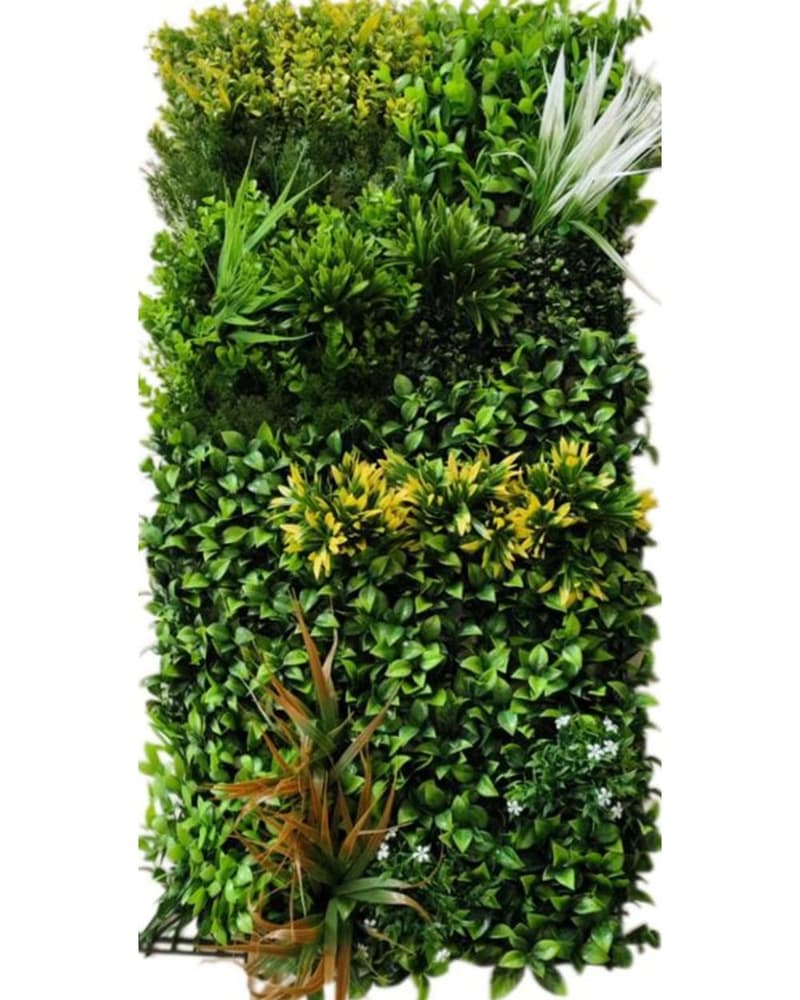
- Judge a supplier on in-house control: backing board, foliage mat and edge detail made under one roof.
- Standard panel formats are 50×50, 50×100 and 100×100 cm; density should be quoted in leaves per square metre, not as "thick".
- Artificial boxwood wholesale price is driven by density, format, foliage grade, backing board and packing volume — not by one headline rate.
- Standard lead time is 7–15 days; bespoke moulds, colours or formats take 20–45 days.
- Sampling starts at 1 piece, and the approved sample becomes the reference for the production run.
How do you choose an artificial boxwood supplier?
There is no shortlist of names that will answer this for you, because the differences between suppliers are structural rather than reputational. The useful way to choose is to define what a supplier must be able to do, then test each candidate against that list with the same questions. That is what the rest of this guide does — written from the factory side, by a team that has watched these orders go wrong on both the buyer's side and ours.
The first test is control. A supplier that makes the backing board, moulds the foliage mat and finishes the edge detail in its own workshop can answer a question like "what is the foliage density of the 50×100 panel in leaves per square metre?" with a number. A supplier that buys finished panels and rebadges them cannot, and the gap between those two answers is where project risk lives.
What a supplier must control to be a real manufacturer
Boxwood looks like a simple product — a green rectangle — but a panel is three systems assembled as one unit: the backing board that gives rigidity, the moulded foliage mat that provides the leaves and their density, and the edge detail that decides how cleanly panels meet in a continuous wall. A manufacturer makes all three. A trader buys all three, or buys the finished panel and puts its own label on the carton.
That matters commercially, not just philosophically. When the board, the foliage and the edge come from three different upstream suppliers, the minimum order quantity, the lead time and the packing plan are all set by whichever supplier is slowest — and those are exactly the numbers a reseller cannot control or promise. Panels and rolls that sit alongside boxwood in a scheme belong to the green walls & hedges range, and being able to mix those formats in one container is a factory capability rather than a catalogue one.
Supplier or trading company? The six questions that decide it
The distinction is not about size or legitimacy — plenty of trading companies coordinate small orders perfectly well. It is about who answers when the technical questions get hard. Ask every candidate for these six items, in writing, before you compare anything:
- Panel format and tolerance — 50×50, 50×100 or 100×100 cm, and how far the finished size varies.
- Foliage density — in leaves per square metre, not as a description.
- Foliage grade — standard indoor, or UV-stabilised outdoor with a stated colour-fastness period.
- Backing board type — rigid or flexible, and how the panel fixes to your substrate.
- Packing volume per carton — the number that decides your freight cost and container plan.
- A fire or UV test document for the exact foliage you are buying, not a generic one for a different product.
Two other signals are worth watching. First, sampling from 1 piece: a factory can pull one panel from the line, a trader has to buy it from someone else first, which shows up in the sample cost and turnaround. Second, a credible custom route: ask what happens if you want a non-standard format or a bespoke colour. A manufacturer describes tooling and colour-batch steps; a trader says "we can do anything" without saying how. What each specification produces in documentation terms is set out on the compliance page.
What drives artificial boxwood wholesale price
We do not publish a price list, because artificial boxwood wholesale price is driven by specification rather than by a single rate, and a headline number that ignores the variables is not a real price. In rough order of impact, the drivers are:
- Foliage density. The largest single factor: more leaves per square metre means more material, more assembly time and more weight.
- Panel format. Larger panels cover area faster but pack less efficiently, so there is a genuine trade-off between 50×50 and 100×100 cm depending on your wall geometry.
- Foliage grade. Standard indoor foliage versus UV-stabilised outdoor grade, and whether fire-retardant treatment is specified as well.
- Backing board. Rigid versus flexible, and whether the panel must survive repeated handling during an event build.
- Packing volume. The driver buyers underestimate most — freight is charged on volume, so a denser, better-packing panel can be cheaper landed than a lighter one that ships loose.
The practical consequence is that a range quoted against your specification sheet and destination port is a more useful answer than a unit figure, and it is the only version that lets you compare two suppliers fairly. On the sourcing side, mixed-order and bulk logic runs alongside boxwood in the artificial flowers & floral line, and the factory page shows the workshop, tooling and showroom behind the numbers.
How wholesale orders are structured
Wholesale minimums are quoted per SKU rather than per order, and that single fact explains most of the confusion around "minimum order" in this category. One panel format in one foliage grade can start at a few hundred panels; a mixed container combines several formats and grades to reach a practical freight volume. This is why two quotes for "1,000 boxwood panels" are rarely for the same object, and why the coverage arithmetic matters more than the panel count.
Because freight is charged on volume rather than weight, the packing plan is a first-order commercial decision, not an afterthought. A panel that measures the same on the wall but occupies less carton volume can be materially cheaper landed, and a supplier that can advise on format mix against your wall area is doing work a reseller cannot. The coverage maths and the mixed-container minimum are worked through in our artificial boxwood MOQ guide.
Sampling, lead time, UV and fire — the tests that separate suppliers

A single sample panel tells you more about a supplier than any quotation. Sampling starts at 1 piece. When it arrives, inspect foliage density from the side rather than head-on, check the colour under natural light, examine whether the backing board is flat and the edge finished, cut a corner to see how the foliage behaves at a cut, and confirm how the panel attaches to your substrate. An approved sample then becomes the reference the bulk run is checked against, which is precisely why it shortens production instead of adding to it.
Lead time separates factories from middlemen more sharply than price does. Where the moulds and the panel format already exist, a real manufacturer ships standard panels in 7–15 days after deposit and sample approval. A genuinely custom run — a new foliage mould, a non-standard format or a bespoke colour match — takes 20–45 days, because the tooling or colour batch has to be made first. A supplier who quotes one lead time for every order has not asked which situation applies; the full sequence is set out in our artificial boxwood lead time guide, and the sourcing comparison behind these claims is in the manufacturer guide.
The same logic applies to performance specifications. Outdoors, specify UV-stabilised foliage, which carries a 3-year colour-fastness warranty as standard, or up to 5 years on premium outdoor grade. Indoors, where fire compliance matters, fire-retardant treatment tested to NFPA 701, BS 5867 or EN 13501-1 is a separate option from UV grade — specify both where both apply, and request the test documents against your exact order specification rather than after the container has sailed. Custom formats, colours and branded backing boards are handled through the custom & OEM route.
Frequently asked questions
How do you choose an artificial boxwood supplier?
What is artificial boxwood wholesale price based on?
What is the minimum order for artificial boxwood wholesale?
Will an artificial boxwood supplier send a sample before a wholesale order?
Sources & attributed quotations
Named sources behind this guide. The quotations below are verbatim from the issuing bodies, with outbound links to the official pages.
“Trade Map offers one of the world's most comprehensive trade data through interactive tables and charts in a user-friendly interface. Covering over 230 economies, it provides trade data for goods and services.”
— International Trade Centre (ITC), Trade Map, official source
“The United Nations Comtrade database aggregates detailed global annual and monthly trade statistics by product and trading partner for use by governments, academia, research institutes, and enterprises.”
— United Nations Statistics Division, UN Comtrade Database, official source
Related pages
Want a specification, not a slogan?
Send the wall area or panel count, the foliage grade and your destination port, and we will reply with panel formats, density, packing volume and the sampling options — usually within 24 hours on business days.