What Fire Certificate Do Artificial Green Wall Panels Need?
The fire-rated certificate an artificial green wall panel needs depends on the code your project is inspected under: NFPA 701 in the US and Gulf, BS 5867-2 in the UK and EN 13501-1 in Europe. Panels are a 1 × 1 m standard module at 4–6 kg per m², MOQ 50 m², stock lead time 7–15 days.
October 11, 2026 · Buying & Sourcing · 7 min read · By Everflorae Editorial Team

- There is no single "fire certificate" for artificial greenery. The document is issued against one test standard and one tested specimen: NFPA 701, BS 5867-2 or EN 13501-1.
- Ask for it at quotation stage. Fire-retardant foliage is specified per foliage type, so naming the standard early keeps the 7–15 day panel window intact.
- Panels are a 1 × 1 m standard module (also 85 × 85 cm, 50 × 100 cm, round Ø50–75 cm) weighing 4–6 kg per m², with MOQ 50 m².
- The certificate must match the panel format, foliage and backing you actually receive — an FR panel and an FR round mat are separate test specimens.
- Mixing non-FR stock panels into a certified wall, or adding an after-market spray treatment, invalidates the certificate on site.
Why "fire certificate" is not one document
Procurement teams often ask us for "the fire certificate" and expect a single PDF that covers everything. It does not exist in this category, and assuming it does is how a wall passes visual inspection and then fails the fire officer's file review.
A certificate is a statement from a testing laboratory about a specific specimen, tested to a specific method, on a specific date. Change the foliage mix, the backing or the panel format and you have a different specimen — one the existing report does not cover. So the useful question is not "do you have a fire certificate?" but "does your certificate name the panel I am ordering, tested to the standard my authority names?"
In practice the answer is a short list: three standards do almost all the work in commercial specification, each belonging to a different regulatory culture.
Which standard applies in which market
NFPA 701 is what most US architects and authorities having jurisdiction (AHJs) cite, and it travels into Gulf projects that follow US practice: the Standard Methods of Fire Tests for Flame Propagation of Textiles and Films.
BS 5867-2 is the British standard for curtain, drape and blind fabrics — the requirement UK specifiers most often name for interior greenery. It defines Type B and Type C, with Type C the more demanding.
EN 13501-1 is the European reaction-to-fire classification: it turns test data into a class such as C-s2,d0 — the letter for contribution to fire, the s-number for smoke, the d-number for flaming droplets. EU building control works in these classes, so this is the certificate filed with the wall build-up.
Send the wrong one and it counts for nothing — a certificate to a standard your inspector does not recognise is, for compliance purposes, no certificate at all. Ask which standard governs the specific approval, and treat that as the target.
What each certificate actually covers
They are not competing tests of the same thing, so comparing them line by line misses the point — each answers the question its own market asks.
NFPA 701 measures how flame propagates across a textile or film specimen under defined conditions: a strip of the foliage material, hung and ignited in the prescribed way, does not carry flame as untreated plastic would. It says nothing about smoke or droplets, because it does not test them.
BS 5867-2 goes the specification route: it states flammability requirements for fabrics and fabric assemblies used in non-domestic curtains and blinds, tested by BS EN ISO 6941 and BS EN ISO 15025, and places a product in Type B or Type C. Written for commercial drapery, it maps neatly onto a vertical foliage surface.
EN 13501-1 is the classification layer rather than one bench test, and it is the only one of the three that also grades smoke and flaming droplets — which is why European fire strategies lean on it for wall finishes.
If your specification names more than one, that is normal on international projects; we supply the documented options and you file the one your inspector asks for. Our fire and UV compliance documentation sets out what is available per product line, with the standard-by-standard comparison in our guide to NFPA 701, BS 5867 and EN 13501-1.
What module size are artificial green wall panels available in?
The artificial green wall panel module size question and the fire certificate question are linked more tightly than they first appear, because the size of the panel is part of what the laboratory tested.

The standard module is 1 × 1 m. The range also includes square panels at 85 × 85 cm and 100 × 100 cm, rectangular panels at 50 × 100 cm, and round mats at Ø50 cm and Ø75 cm, with custom sizes made to project drawing. Coverage is roughly 90–120 stems per m² depending on species, and a finished panel weighs about 4–6 kg per m².
Behind the foliage sits one of three backings: a UV-resistant PP grid with snap-fit connectors for the standard modular line, galvanised iron mesh for outdoor and fire-retardant panels, or EPE foam with iron mesh for indoor interiors. Panel MOQ is 50 m².
Here is where the certificate catches people out. A fire report is written around a tested construction — format plus backing plus foliage. A 1 × 1 m FR panel on galvanised mesh and a Ø75 cm round mat on a different backing are two specimens, not one, so the paperwork has to follow the item on your order. If a wall mixes formats, say so at quotation stage and ask explicitly that the certificate covers each one; that is far cheaper than discovering the gap at handover.
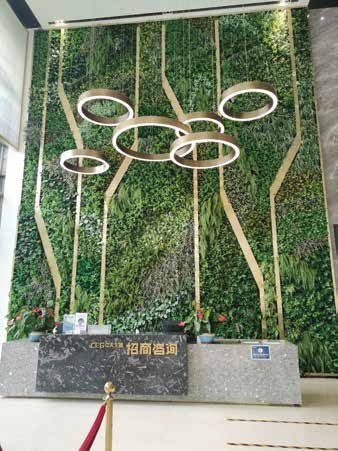
Module size also decides how the wall reads. Uniform 1 × 1 m modules give a deliberate, tiled rhythm that suits a reception wall; mixing 50 × 100 cm rectangles and round mats breaks the grid and reads more organic. Both are available in fire-retardant specification — the whole range is on the green walls & hedges product page.
How do you verify a fire certificate before you pay a deposit?
Verification is a reading exercise, not a trust exercise. A usable certificate names six things, and if any of them is missing or vague, ask again before money moves.
- The product and format. It should identify the panel type, not just "artificial foliage". Compare it, character by character, with the item on your purchase order.
- The foliage and backing. Flame-retardant behaviour is a property of the material and the construction, so the foliage mix and the mesh behind it belong in the description.
- The standard and its edition. "NFPA 701" without a year is weaker than "NFPA 701 (2023 edition)" — standards are revised, and an old report may not satisfy a current specification.
- The testing laboratory. A named, accredited lab is the whole point of the document. An in-house test sheet is a factory claim, not a certificate.
- The report or certificate number, so the inspector can verify it rather than take your word for it.
- The date of issue, and how long the supplier will stand behind it.
Two habits close the remaining risk. Request the certificate with the quotation, not after production — that is the moment when changing the foliage allocation is still free. And approve a 1-piece physical sample of the exact fire-rated specification, not a generic panel; sampling starts at one piece because we would rather you test the real thing.
What can invalidate a certificate on site?
The certificate describes a product; a site is an assembly. Four common shortcuts break the link between the two.
Mixing non-FR panels into a certified wall. The most frequent and the most damaging shortcut. A certified FR panel beside a standard stock panel makes the whole elevation an untested construction. If a wall has to be compliant, every panel in it has to be.
Changing the backing or the mounting. The tested specimen includes the backing and the fix, so swapping galvanised mesh for a lighter grid, or changing to a glued direct fix, takes the installation outside the tested construction.
Applying an after-market spray treatment. Spray-on retardants applied on site do not carry the original certificate and are not accepted as a substitute in most jurisdictions. If a surface needs treating, it should be treated at the point of manufacture and tested in that state.
Substituting the foliage on a reorder. If the foliage specification drifts between phase one and phase two, the original certificate no longer describes what was delivered — which is why we keep panel formats and grids stable and re-quote the FR specification on every order.
How to write the requirement into your purchase order
Everything above compresses into a short clause any supplier can be held to, worth pasting into the order rather than paraphrasing in an email thread.
- State the standard and edition: NFPA 701 (2023) / BS 5867-2:2008 Type C / EN 13501-1 class, whichever your approval names.
- Name the panel format and quantity: for example 240 × 1 × 1 m FR panels and 60 × 50 × 100 cm FR rectangles, 300 m² total.
- Require the certificate to cover each format in the mix, and each foliage type.
- Require the certificate at quotation stage, before deposit.
- Require a 1-piece sample of the exact fire-rated specification for approval.
- Note the delivery expectation: 7–15 days for stock panels, 20–40 days for engineered walls built from a drawing.
- Ask for the certificate to be filed with the handover documents, not just the invoice.
Written this way the order is unambiguous and the schedule is protected. The green wall lead time guide covers timing in more detail, and bespoke layouts can be quoted through our OEM and custom manufacturing service.
Frequently asked questions
What fire certificate do artificial green wall panels need?
How much does a fire-rated artificial green wall panel cost?
How long does a fire-rated green wall panel order take?
Is a certified artificial green wall panel suitable for a hotel lobby?
Sources & attributed quotations
Named sources behind this guide. The quotations below are verbatim from the issuing bodies, with outbound links to the official pages.
“This standard establishes test methods to assess the propagation of flame of various textiles and films under specified fire test conditions.”
— NFPA (National Fire Protection Association), NFPA 701, Standard Methods of Fire Tests for Flame Propagation of Textiles and Films (2023 edition), official source
“This document provides the reaction to fire classification procedure for all construction products, including products incorporated within building elements with the exception of power, control and communication cables which are covered by EN 13501-6.”
— CEN (European Committee for Standardization), EN 13501-1, Fire classification of construction products and building elements — Part 1: Classification using data from reaction to fire tests, official source
- NFPA — NFPA 701, Standard Methods of Fire Tests for Flame Propagation of Textiles and Films
- BSI — BS 5867-2:2008, Fabrics for curtains, drapes and window blinds — Flammability requirements. Specification
- CEN — EN 13501-1, Fire classification of construction products and building elements
- Everflorae — Fire & UV Compliance Documentation
Related pages
Related project cases
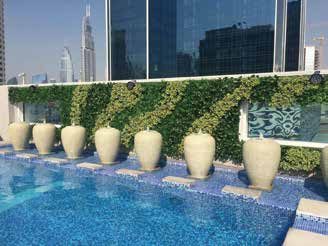
Real projects we have delivered in this category — on-site photographs, no mock-ups.
Need the fire certificate fitted to your panel, not to a generic sample?
Send the panel area in m², the formats in your wall, the fire standard your inspector names and your target installation week. We will come back with the specification sheet, the documented standard options and a quotation — normally within 24 hours on business days.
Sister brand · GardenStone
Pair it with landscaping stone (GardenStone)
From the same supplier group — GardenStone supplies decorative pebbles, gravel and landscape stone that complete the same hotels, resorts, malls and Japanese gardens. One source for the whole landscape.
Explore GardenStone →