What Is the Lead Time for an Artificial Green Wall?
The artificial green wall lead time is 7–15 days for standard modular panels and 20–40 days for engineered floor-to-ceiling walls, counted from deposit and specification approval. Panels come in a 1 × 1 m standard size at roughly 4–6 kg per m², the panel MOQ is 50 m², fire-retardant foliage is available to NFPA 701, BS 5867 and EN 13501-1, and ocean freight to your port is quoted separately on packed volume.
October 7, 2026 · Buying & Sourcing · 8 min read · By Everflorae Editorial Team
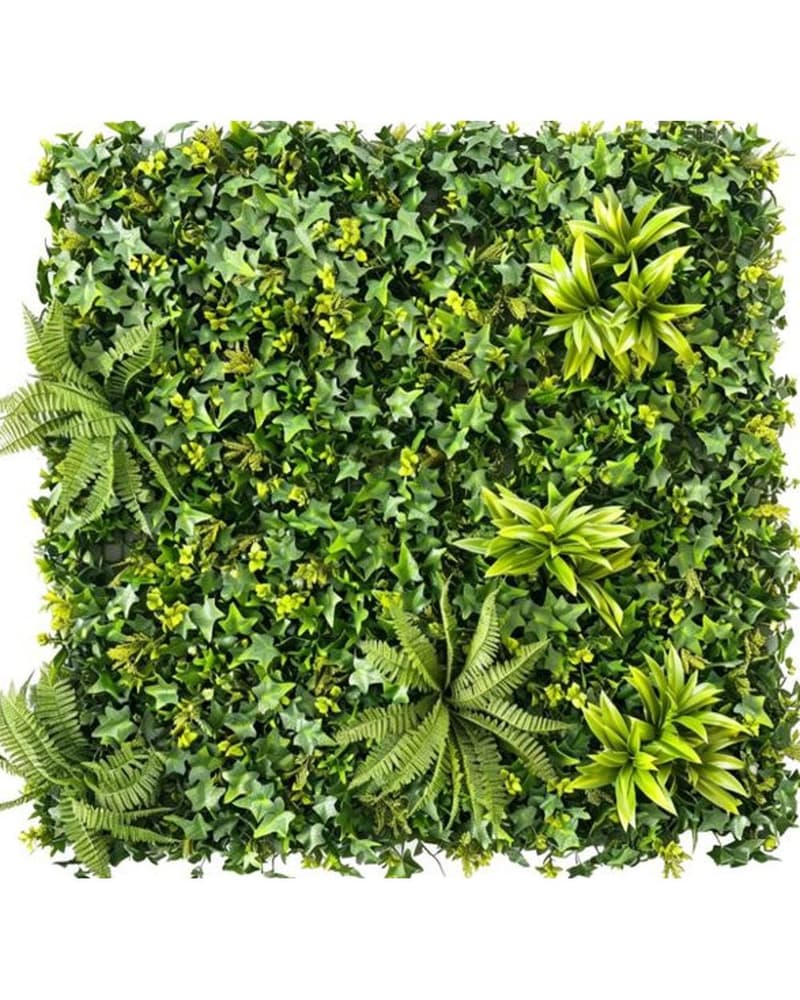
- Two clocks, not one: stock modular panels ship in 7–15 days; engineered floor-to-ceiling walls built from a drawing run 20–40 days.
- Panel basics that drive the schedule: 1 × 1 m standard size, ≈ 90–120 stems per m², ≈ 4–6 kg per m², snap-fit connectors on a shared mounting grid.
- Panel MOQ is 50 m²; engineered walls are quoted project by project from your wall dimensions.
- Fire-retardant foliage to NFPA 701, BS 5867 or EN 13501-1 is an option, not a stock default — name the standard at quotation stage to keep the schedule intact.
- Ocean freight is quoted separately on packed volume to your port, so the delivery date you plan around is production lead time plus transit.
What does "lead time" actually cover for an artificial green wall?
The word gets used loosely, and that is where most delivery disputes start. In this category, artificial green wall lead time has two parts that should never be blended into one number.
Production time is the window from deposit and specification approval to the goods being packed and ready at the factory in Guangzhou. For modular panels it is 7–15 days; for engineered walls it is 20–40 days. Transit time is the ocean or air leg from a Chinese port to yours, quoted on packed volume once the packing list exists — a 50 m² panel order palletises into a predictable volume, while an engineered wall's crates depend on the frame design.
If your installer is booked for a fixed week, plan backwards from that week: production window, plus transit, plus a buffer for customs. A procurement timeline that treats the 7–15 day figure as "delivery to my site" will be wrong by the length of the sea crossing, every time.
Why standard panels ship in 7–15 days
The modular panel line is built for distributors who buy by the pallet, and the schedule reflects that. Stock panels are produced continuously in four foliage styles in square 1 × 1 m and 85 × 85 cm formats, 50 × 100 cm rectangles, and round Ø50–75 cm mats — fifteen named mixes in the current catalogue, from Fern & Vine to Moss & Lavender. Because the tooling, foliage stock and backing systems already exist, an order is a matter of allocating production slots and packing, not starting from zero.
The panels themselves are light and dense: roughly 90–120 stems per square metre depending on species, at 4–6 kg per m². They connect with snap-fit connectors onto a shared mounting grid, so panels ordered today interlock with panels ordered last quarter — which is also why a reorder for phase two of a project does not disturb the schedule. At a 50 m² MOQ, a typical first order is a few pallets, packed flat, carton quantities issued with the catalogue quotation.
That is the whole mechanism behind the 7–15 day figure: no drawing to approve, no frame to fabricate, no site conditions to interpret. The green walls & hedges range lists the current panel formats and specifications.
Why engineered walls run 20–40 days
An engineered floor-to-ceiling green wall is a different product wearing similar foliage. It is quoted and built from your wall dimensions, and the extra time buys the parts of the job that a panel cannot do: a concealed, irrigation-ready frame sized to the elevation, a panel layout drawing that accounts for columns and returns, fixing details for the specific wall build-up, and a final assembly check before crating.
The sequence is simple but not compressible to panel pace. The elevation drawing is confirmed first, because every downstream step keys off it. Then the frame is fabricated, panels are laid out and fixed to the layout, and the whole wall is checked against the drawing before it is split into crates. A retail feature wall and a 4,600 m² building facade are both "engineered walls" in this sense — the 20–40 day window holds because the process is the same even when the areas are not. Our OEM and custom manufacturing service covers the drawing-driven side of this work.
If your programme cannot absorb 20–40 days, there is a legitimate middle path: an engineered frame built from stock panels. The panels ship on the panel schedule and the frame fabrication runs in parallel, which trims weeks off a fully bespoke build while keeping a designed edge-to-edge result.
What can move an artificial green wall lead time
Three variables do most of the moving, and all three are controllable at quotation stage.
Fire rating. Flame-retardant foliage is available to NFPA 701, BS 5867 and EN 13501-1, but it is specified per foliage type rather than held as a universal stock finish. Naming the standard your authority requires when you request the quotation means the correct foliage is allocated inside the normal window; discovering the requirement after production means re-work, and re-work is the single biggest self-inflicted delay we see. Our compliance documentation sets out the options per line.
Custom sizes and species mixes. Stock panels cover the common formats; a non-standard size or a bespoke foliage mix moves the line items from stock into production. It does not stop the order — custom sizes are made to project drawing as standard — but it does move the clock toward the longer end of the 7–15 day window or into engineered-wall territory.
Approval speed on your side. Both clocks start at deposit and specification approval. A sample held for three weeks of internal review is three weeks added to the schedule, and no factory action can recover it. If a sample round is needed, ask for it at the quotation stage and give the review a date.
What maintenance does an artificial green wall need after delivery?
Lead time planning is also where a practical artificial green wall maintenance guide belongs, because the near-zero upkeep after installation is part of why the product suits commercial interiors. There is no watering, no pruning and no lighting schedule to maintain. Indoor panels need an occasional pass with a soft brush or low-pressure air to lift dust out of the foliage; panels behind a bar or in a restaurant kitchen area can be wiped with a damp cloth. Outdoor UV panels can be rinsed with a hose once or twice a year, which restores the foliage appearance after a dusty season.
Two expectations are worth setting with the client at handover. First, foliage colour outdoors is rated for 3–5 years of direct-sun exposure for UV-stabilised lines, so a facade wall is a scheduled-refresh product, not a lifetime fixture. Second, the fire certificate that applies to the delivered foliage belongs in the handover documents — the building's file, not just the invoice folder. The cleaning routines are the same ones we describe for specimen trees in our commercial cleaning and maintenance guide, and the fire-standard side is explained in our fire-rated green wall guide.
The checklist that keeps a green wall order on schedule
- Decide early whether the job is a panel order (7–15 days) or an engineered wall (20–40 days) — the decision drives everything downstream.
- Send wall dimensions and site photos with the enquiry; engineered-wall quotations and layout drawings come back normally within 24 hours on business days.
- Name the fire standard at quotation stage, and ask for the certificate document with the quotation, not after production.
- Confirm the panel format against the mounting grid you will install on — panels interlock, so mixing formats is fine, but the grid is common.
- Book the installer against production plus transit plus customs, and put a buffer on top.
- If a sample is needed, request it with the quotation and give the review a deadline.
Frequently asked questions
How long does an artificial green wall take to deliver?
What is the minimum order for artificial green wall panels?
What maintenance does an artificial green wall need after installation?
Is an artificial green wall suitable for fire-regulated interiors?
Sources & attributed quotations
Named sources behind this guide. The quotations below are verbatim from the issuing bodies, with outbound links to the official pages.
“This standard establishes test methods to assess the propagation of flame of various textiles and films under specified fire test conditions.”
— NFPA (National Fire Protection Association), NFPA 701, Standard Methods of Fire Tests for Flame Propagation of Textiles and Films (2023 edition), official source
“This document provides the reaction to fire classification procedure for all construction products, including products incorporated within building elements with the exception of power, control and communication cables which are covered by EN 13501-6.”
— CEN (European Committee for Standardization), EN 13501-1, Fire classification of construction products and building elements — Part 1: Classification using data from reaction to fire tests, official source
- NFPA — NFPA 701, flame propagation of textiles and films
- CEN — EN 13501-1, reaction-to-fire classification
- Everflorae — Fire & UV Compliance Documentation
Related pages
Related project cases
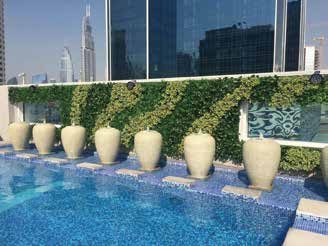
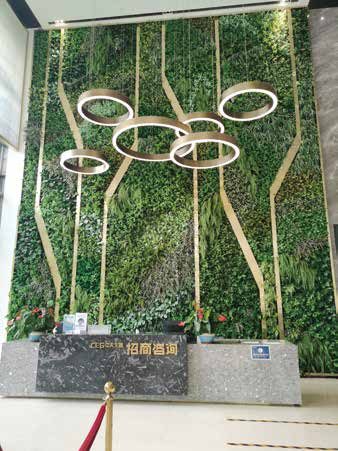
Real projects we have delivered in this category — on-site photographs, no mock-ups.
Need a green wall delivery date you can plan around?
Send the wall dimensions or the panel area in m², your fire standard and your target installation week, and we will come back with the production window, packing data and a quotation — normally within 24 hours on business days.