How Do You Maintain an Artificial Hedge Outdoors?
An artificial hedge needs four things: a dust-and-rinse cycle two to four times a year, a fixing check after major storms, cleaning with water and mild soap rather than solvents or a close-range pressure washer, and honest colour management — UV-stabilised foliage is rated for 3–5 years outdoors. Standard 1 × 1 m panels ship in 7–15 days, so a damaged section is normally a two-week panel swap, not a rebuild.
October 19, 2026 · Care & Maintenance · 8 min read · By Everflorae Editorial Team

- Two maintenance clocks run at once: foliage cleaning (dust indoors, rinse outdoors) and structural checks (fixings, backing, panel edges) — only the first is visible from a distance.
- The safe cleaning kit is a soft brush, a vacuum with a brush attachment on low suction, low-pressure air, and lukewarm water with mild pH-neutral soap. No solvents, no bleach, no pressure washer held close.
- UV-stabilised outdoor foliage carries a 3–5 year colour expectation in direct sun. The foliage sheds rain; the backing is what holds water, so panels must drain and dry.
- Plan replacement instead of rescue: stock panel formats ship in 7–15 days, custom runs take 20–45 days, the panel MOQ is 50 m², samples start at 1 piece — keep 5–10% spares from the first order.
What does artificial hedge maintenance actually involve?
Any useful artificial hedge maintenance guide has to separate two surfaces that get confused: the foliage you can see and the structure you cannot. The foliage is a dense mat — 90–120 stems per square metre on our panels, each leaf a small moulded ABS or PU part — and it collects dust, pollen, traffic film and, outdoors, salt and bird droppings. The structure is the backing system (UV-stabilised PP grid, galvanised iron mesh, or EPE foam with mesh, depending on the line), the fixings that hold the hedge to the wall or frame, and the panel edges and joints.
Four jobs cover the whole subject:
- Cleaning the foliage. Dust and rinse cycles on a schedule, with materials that do not damage the leaf surface.
- Checking the structure. Fixings, backing flatness, panel edges and joints — seasonally, and after any major storm.
- Managing colour honestly. UV-stabilised foliage is rated for 3–5 years of direct-sun exposure outdoors, so an outdoor hedge is a refresh-cycle product, not a lifetime fixture.
- Keeping the documents. Where fire-retardant foliage was specified, the test report naming NFPA 701, BS 5867 or EN 13501-1 belongs in the building’s handover file, not the invoice folder.
None of these jobs is difficult, and that is exactly why they get skipped. What sends hedges into early replacement is almost never the leaves — it is a fixing that worked loose two years earlier, or water trapped against a backing board nobody inspected.
How do you clean an artificial hedge without damaging it?
The order of operations matters more than the products. Follow the same sequence every time:
- Dry-clean first. Work downward with the lie of the foliage using a soft brush, or a vacuum with a brush attachment on low suction. For long commercial runs, low-pressure air from a distance lifts dust out of the leaf axils quickly. Dry first always — wetting dust turns it into a paste that sticks.
- Wet-clean only where needed. Lukewarm water with a few drops of mild pH-neutral soap, applied with a soft cloth or sponge and wiped along the leaf direction. Dampen the foliage, not the backing board.
- Rinse top down, outdoors. A garden hose on a low setting is enough. Let the panel drain and air-dry; do not rehang it wet.
- Dry fully before rehanging indoor panels. Lay the panel flat, foliage up, until the backing is dry — typically within a day in a ventilated room.
Just as important is what never touches the hedge: solvents and acetone, bleach, abrasive creams, scrubbing against the grain, and a pressure washer held close — the jet strips the colour coat off moulded leaves and bends stems flat. A few minutes per square metre is the realistic budget for a dry pass; a full wet clean of a 20 m² hedge is a half-day job including drying.
Indoors and outdoors: two different maintenance rhythms
The same hedge product lives on two very different schedules, and mixing them up is how panels either get neglected or get over-serviced:
- Indoor, high traffic (hotel lobby, restaurant, mall corridor): a dry dust pass every 4–6 weeks and a deeper clean once a year. Behind bars and near kitchens, an oily film builds faster — use the damp-cloth soap method more often.
- Indoor, low traffic (meeting rooms, corridors, offices): a quarterly dry pass is enough.
- Outdoor, inland: rain does most of the cleaning. One or two hose rinses a year — after the spring pollen season and after a dusty autumn — restore the foliage colour.
- Outdoor, coastal: rinse about three times a year. Salt film dulls the foliage and holds moisture against the leaf surface.
- Every climate: check fixings and panel joints twice a year, and after any storm with strong gusts. Ten minutes on a ladder beats replacing a dropped run of panels.
What shortens an artificial hedge’s life?
Installed and cared for properly, the foliage itself is close to indestructible indoors. The things that actually end a hedge’s service life are a short, known list:
- Direct sun. UV is the main clock outdoors: 3–5 years of colour retention for UV-stabilised foliage, with the sunniest face going first. Orientation matters more than brand.
- Trapped water. Moulded foliage sheds rain, but backings absorb or hold it — EPE foam in particular. Panels must drain, and flat-stored panels must not sit in water.
- Heat sources. Patio heaters, barbecues and extractor outlets scorch and discolour foliage locally. Keep a clearance, the same as you would for live planting.
- Chemicals. Pool chlorine splash, solvent-based cleaners and herbicide overspray all attack the leaf surface faster than weather does.
- Mechanical damage. A hedge trimmer on an artificial hedge, a close-range pressure washer, or abrasive pads — each one is a repair order, not a cleaning method.
- Wrong fixings. Cheap cable ties go brittle outdoors in a season or two. Use UV-rated ties or the mounting grid with stainless fixings.

When should panels be replaced — and how long does a replacement order take?
Replacement is a panel decision, not a wall decision, and the signs are specific:
- A visible colour shift between the sun-facing panels and the shaded ones.
- A bald or flattened patch that combing will not recover.
- Rust weeping from a galvanised mesh backing, or a cracked or delaminating board.
- Torn fixing holes or a panel that no longer sits flush on the grid.
Because panels interlock on a shared mounting grid, you swap only the affected modules — new panels ordered today connect with the originals, provided the format and foliage style match. That leads straight to the scheduling question, and it is the same two windows that govern first orders:
- Stock formats: 7–15 days. The 1 × 1 m, 85 × 85 cm, 50 × 100 cm and round Ø50–75 cm panels, once the specification is confirmed.
- Custom sizes or colour matches: 20–45 days. Any format outside the standard range, including drawing approval.
Two commercial notes. First, panel orders start at 50 m², which is why the cheapest replacement strategy is not a reorder but spares: keep 5–10% of the original quantity, plus one or two spare panels per visible face. Second, if the original hedge was fire-treated to a named standard, the replacement foliage must match it — a swapped-in untreated panel quietly breaks the compliance file. Our green wall lead time guide covers the ordering windows in detail, and the compliance page lists the documentation that ships with treated foliage.
Frequently asked questions
How often does an artificial hedge need cleaning?
What is safe to clean artificial hedge foliage with?
How long does an artificial hedge last outdoors?
How long does it take to replace damaged hedge panels?
Sources & attributed quotations
Named sources behind this guide; the quotations are verbatim from the issuing bodies, with links to the official pages.
“This standard establishes test methods to assess the propagation of flame of various textiles and films under specified fire test conditions.”
— NFPA (National Fire Protection Association), NFPA 701, Standard Methods of Fire Tests for Flame Propagation of Textiles and Films (2023 edition), official source
“This document provides the reaction to fire classification procedure for all construction products, including products incorporated within building elements with the exception of power, control and communication cables which are covered by EN 13501-6.”
— CEN (European Committee for Standardization), EN 13501-1, Fire classification of construction products and building elements — Part 1: Classification using data from reaction to fire tests, official source
- NFPA — NFPA 701, fire tests for flame propagation of textiles and films
- CEN — EN 13501-1, reaction to fire classification of construction products
- BSI — BS 5867-2:2008, flammability requirements for curtain and blind fabrics
- Everflorae — Fire & UV Compliance Documentation
Related pages
Related project cases
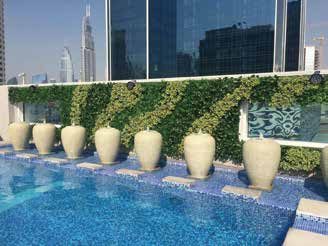
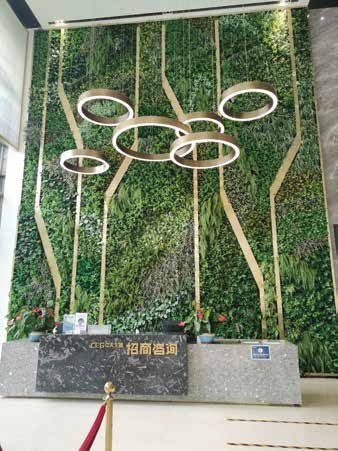
Real installations in this kind of setting — on-site photographs, no mock-ups.
Servicing or extending an existing hedge?
Send the area to top up or replace (in m²), the panel format and foliage style of the original order, and the fire standard it was specified to. We will come back with the replacement window, packing data and pricing — normally within 24 hours on business days.
Sister brand · GardenStone
Pair it with landscaping stone (GardenStone)
From the same supplier group — GardenStone supplies decorative pebbles, gravel and landscape stone that complete the same hotels, resorts, malls and Japanese gardens. One source for the whole landscape.
Explore GardenStone →