How Do You Maintain an Artificial Olive Tree?
Maintain an artificial olive tree by dusting ABS or PU foliage every 4–6 weeks indoors and rinsing it every 8–12 weeks outdoors, checking base fixings and trunk bolts once a year, and expecting 3–5 years of colour in direct sun. Our olive trees run 2–4.5 m tall with 1.5–4 m canopies, samples start at one piece and standard builds ship in 7–15 days.
October 24, 2026 · Maintenance & Operations · 8 min read · By Everflorae Editorial Team

- Dust an indoor olive every 4–6 weeks; rinse an outdoor one every 8–12 weeks, and monthly on coastal or poolside sites.
- Leaf material sets the method: ABS moulded leaves take a damp cloth, PU cast leaves need blotting and never hot water. No solvents, bleach, pressure washers or leaf-shine sprays.
- Outdoor UV grade holds colour 3–5 years in direct sun; the sunniest face always goes first, so rotate or swap trees rather than re-scheme.
- Order spare sprigs, a fixing kit and a retained colour standard with the tree: repeat builds run 7–15 days, custom 20–45 days.
Why an olive tree needs its own maintenance routine
An olive tree does not look like other artificial trees, and it does not age like them either. The canopy is deliberately open: small, narrow leaves held on fine twigs, matte olive-green on top and pale silver underneath, with gaps you can see through. That silhouette is why designers specify olive for terraces and restaurant frontages — and why it shows neglect faster than a dense ficus.
Three things follow from that geometry:
- Dust sits in plain sight. On a dense canopy, dust disappears between leaves. On an olive, it lands on the top surface of an open crown and dulls the two-tone effect that makes the tree read as real.
- Damage is visible, not hidden. One bent tip branch or one empty patch breaks the outline immediately, because there is no bulk foliage behind it to close the gap.
- The tree is usually outside. Olive is one of the few forms we build that is specified outdoors as often as indoors, so UV, salt and wind matter from day one.
Our olive line runs 2–4.5 m tall with a 1.5–4 m canopy as standard, built to drawing on fibreglass or steel cores with ABS, PU or PE foliage, and the wider range goes to 15 m. Whatever the height, this artificial olive tree maintenance guide applies the same logic: clean the leaf surface, protect the outline, inspect the parts that carry load.
How often should you clean an artificial olive tree?
Calendar intervals are a starting point, not a rule. The honest test is a white cloth: wipe the top of a leaf in the least-visited part of the canopy. If it comes up grey, the tree is due. Baseline for a commercial site:
| Position | Dry dust | Wet clean | What sets the interval |
|---|---|---|---|
| Hotel lobby or reception | 4–6 weeks | every 6 months | Foot traffic, HVAC airflow, hands on the canopy |
| Covered atrium or mall interior | 4–6 weeks | every 4–6 months | Canopy height, air movement, access equipment |
| Sheltered outdoor terrace | 6–8 weeks | every 8–12 weeks | Rain does part of the work; wind brings new dust |
| Exposed plaza or street planter | 4–6 weeks | monthly rinse | Traffic film, pollen, paving dust |
| Coastal or poolside | 3–4 weeks | monthly fresh-water rinse | Salt film and chlorine mist hold moisture on the leaf |
| Straight after building works | once, immediately | once | Cement and gypsum dust are alkaline and etch a matte surface |
Two notes: wet cleaning is not hosing — indoors it means wiping leaves, not soaking a trunk over a stone floor. And a tree installed during a fit-out looks grey within weeks even if it arrived clean, so book one clean after handover.
How do you clean ABS and PU olive leaves without damaging them?
Leaf material decides the method, so confirm what you bought before anyone picks up a cloth. Our olive trees use ABS moulded or PU cast leaves, matte on top with a paler underside. That two-tone finish is the point of the tree and the easiest thing to ruin.
ABS moulded leaves. Firmer, with a crisp edge and consistent colour across the canopy. They tolerate routine handling:
- Dry: soft brush or feather duster, working top-down so dust falls off the tree instead of into the crown.
- Wet: lukewarm water with a few drops of neutral dish soap. Sponge the top face, rinse with a clean damp cloth, then dry with a microfibre.
- Never: acetone, thinners, bleach, abrasive cream, a pressure washer, or a leaf-shine spray. The first four attack the surface; the last kills the two-tone read and attracts dust.
PU cast leaves. Softer and slightly translucent, closer to a real olive leaf at 50 cm viewing distance, and less forgiving:
- Blot, do not scrub. A soft damp cloth pressed and lifted takes dust off without stretching the leaf.
- Keep the water warm at most. Hot water softens PU, and a leaf that dries bent stays bent.
- Do not fold a leaf back to clean underneath — work up from below with a soft brush instead.
Olives and branch tips. The fruit on an olive branch is a moulded part fixed to the stem; do not pull it off to clean behind it — a soft brush reaches the gap. At the tips, support the branch with one hand while wiping with the other. The twig is the thinnest wire in the tree and the easiest thing to bend.
The trunk. Dry microfibre only. On a bark-textured fibreglass trunk, brush along the grain. Never oil or wax it: a shiny trunk reads as plastic from ten metres, which is exactly the impression the olive form is bought to avoid.
What actually fades an olive tree outdoors?
Outdoor-grade foliage carries a 3–5 year expectation for colour in direct sun, and inside that window the tree will not fade evenly. The sunniest face goes first. Reflected heat from pale paving and glass curtain walling accelerates it, dark planters push leaf temperature higher again, and on a coastal site a salt film both dulls the surface and holds moisture against it.
So map light before you map cleaning: photograph the tree from the same four sides on installation day and again at twelve months, and the comparison shows which face is spending its colour budget.
What you can actually do about it:
- Rotate where the base allows. A tree on a steel plate or in a loose planter can be turned 90–180° a year so no single face takes the whole dose. Bolt-down trees cannot be rotated — decide that at specification stage, not in year three.
- Rinse salt monthly. Fresh water, no soap, early morning so the foliage dries before the sun is on it.
- Replace the worst units, not the scheme. When one tree reads as a different green from its neighbour, two or three replacements is the cheap fix. Spraying foliage to “restore” colour is not: it looks wrong at daylight and voids any colour claim.
How fading actually works — which wavelengths do the damage and why orientation beats any brand claim — is set out in our UV-resistant artificial plants guide.

How do you inspect the trunk, base and fixings?
A 3 m olive with a 3 m canopy is a sail. Structural checks are annual, and they belong on the calendar before storm season rather than after it.
- Base. Steel plate bolted to the slab, cement-filled base, or weighted planter — check the fixing, not just the look. On a plate, look for lifted bolts and rust at the holes; on a cement base, for cracks; in a planter, confirm the ballast is still where it was installed.
- Joints. Trees longer than a shipping carton are built in bolt-together trunk segments. Re-torque the joint and watch for movement when you push the trunk at chest height — a tree that rocks at the joint will not stay upright in wind.
- Drainage. Outdoor planters need open drainage. A blocked hole means standing water at the base, which is where a steel core rusts first — and where mosquitoes breed in warm climates.
- Canopy fixings. Check the branch-to-trunk clips you can reach from a platform. A loose branch is a falling object, not a cosmetic issue.
Record every tree against its production number. Each trunk we ship carries a numbered QC tag and the pack list matches those numbers to the drawing — the simplest asset register a facilities team will get, and what makes a spare-part order possible two years later.
How do you put a canopy back into shape?
Artificial olive branches are wired, and the wire holds the form. When a branch is knocked out of line — by a delivery trolley, a ladder, or a cleaner reaching too far — bend it back slowly at the wire arm, close to where it leaves the trunk, never at the tip. Bending at a leaf clip fatigues the clip, and a clip that lets go takes a whole sprig with it.
If foliage has been lost, individual sprigs are replaceable, which is why spare sprigs are worth ordering with the tree rather than after the damage. Rebuilding a crown after transport is a pack-list job: foliage ships in numbered bags numbered to the branch each bundle belongs to.
One thing not to do: never prune an artificial olive the way you would prune a real one. There is no regrowth. Cutting through a wire arm leaves a blunt stub that never fills in, and the correct fix is to replace the branch section, not to trim around it.
What should an artificial olive tree manufacturer provide for upkeep?
This is the part of supplier selection buyers usually skip, and it is the part that sets maintenance cost for the next five years. Ask for it in writing, with the quotation:
- The cleaning method for the leaf type actually supplied. ABS and PU need different handling; a generic “wipe with a damp cloth” line is not enough.
- Spare sprigs and a fixing kit. A handful of spare branches in the delivered colour, plus spare bolts and clips for base and joints.
- A retained colour standard. A physical sample held against the production batch, so a top-up in year three matches the trees already on site.
- Numbered QC tags and a pack list. The link between drawing, tree and spares order.
- Fire documentation if the tree goes indoors. Foliage can be supplied fire-retardant to NFPA 701, BS 5867 or EN 13501-1, with test documents issued per order — and ask whether the treatment sits in the leaf compound, because that decides which cleaning agents are safe.
A manufacturer that can answer all six is one you keep for a decade. The olive specification itself — heights, canopy spreads, trunk options and finishes — is published on our artificial olive tree page, and the full range sits under artificial trees.
Frequently asked questions
How often should an artificial olive tree be cleaned?
Can you hose or pressure-wash an artificial olive tree?
How long does an artificial olive tree last outdoors?
What should I ask an artificial olive tree manufacturer for maintenance?
Sources & attributed quotations
Named sources behind this guide; quotations are verbatim from the issuing bodies, with links to the official pages.
“This document specifies methods for exposing plastic specimens to fluorescent UV lamp radiation, heat and water in apparatus designed to simulate the weathering effects that occur when plastic materials are exposed in actual end-use environments to global solar radiation, or to window-glass filtered solar radiation.”
— ISO (International Organization for Standardization), ISO 4892-3:2024, Plastics — Methods of exposure to laboratory light sources — Part 3: Fluorescent UV lamps, official source
“The use of this apparatus is intended to induce property changes consistent with the end use conditions, including the effects of the UV portion of sunlight, moisture, and heat.”
— ASTM International, ASTM G154-23, Standard Practice for Operating Fluorescent Ultraviolet (UV) Lamp Apparatus for Exposure of Materials, official source
- ISO — ISO 4892-3:2024, fluorescent UV lamp exposure methods
- ASTM International — ASTM G154-23, operating fluorescent UV lamp apparatus
- Everflorae — Artificial Olive Trees: heights, canopy spreads, foliage and lead times
Related pages
Related project cases
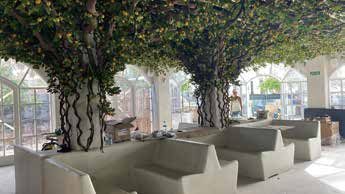
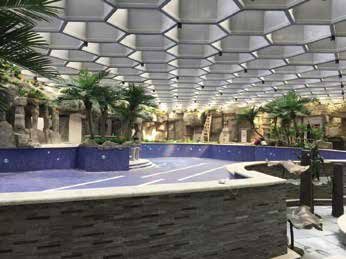
Real installations in this kind of setting — on-site photographs, no mock-ups.
Keeping a planted scheme alive for years?
Tell us the species, heights and exposure of the trees already on site, or the ones you are specifying. We will come back with the leaf type, cleaning method, spare-parts list and lead times — normally within 24 hours on business days.
Sister brand · GardenStone
Pair it with landscaping stone (GardenStone)
From the same supplier group — GardenStone supplies decorative pebbles, gravel and landscape stone that complete the same hotels, resorts, malls and Japanese gardens. One source for the whole landscape.
Explore GardenStone →