How Do I Download an Artificial Plant Catalog PDF?
You request an artificial plant catalog PDF directly from the manufacturer — by email or the contact form — and a factory with stock lines sends it within 24 hours on business days. A useful catalogue states tree heights from 1–15 m, leaf materials (ABS or PU), 1-piece sampling, and separates the 7–15 day standard lead time from 20–45 day custom work.
October 5, 2026 · Buying & Sourcing · 8 min read · By Everflorae Editorial Team
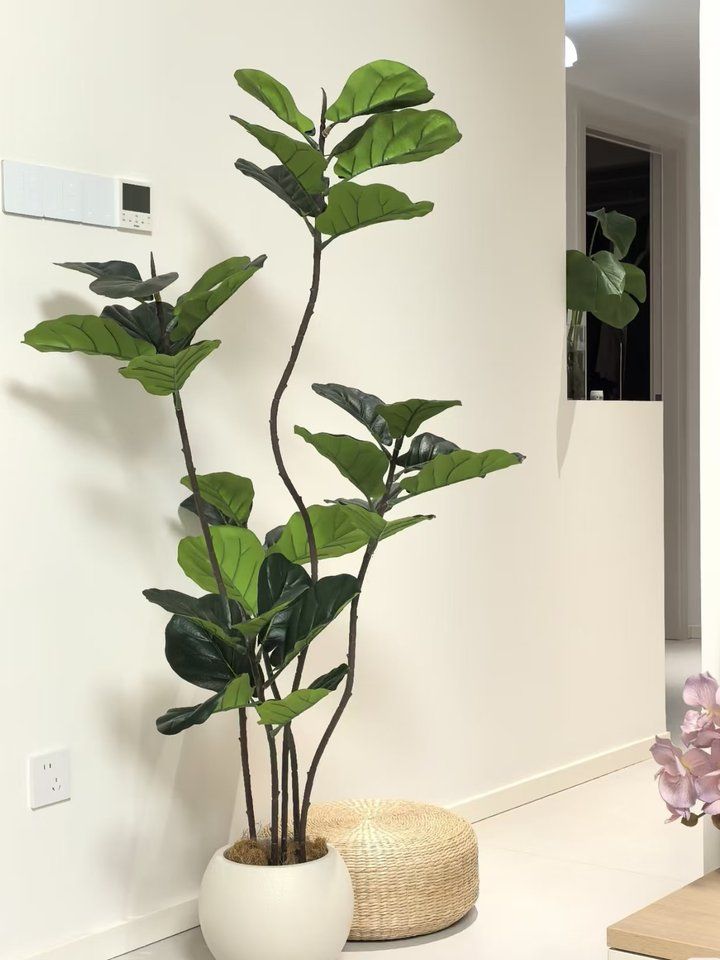
- An artificial plant catalog PDF is requested by email, not downloaded from a public link — commercial greenery is quoted against a specification, so the catalogue travels with a person who can answer questions about it.
- A serious catalogue states, per line: product code, heights or sizes, leaf material (injection-moulded ABS or cast PU), pot or base, fire and UV options, and packing data.
- Read the leaf-material line first — it decides how the plant behaves indoors, outdoors and under fire testing.
- Indoors, foliage keeps its colour for years because UV is not a factor; outdoors, UV-stabilised foliage is rated for 3–5 years of colour-fastness.
- Samples start at 1 piece after you shortlist from the catalogue; standard lead time is 7–15 days, custom work 20–45 days.
What an artificial plant catalog PDF actually contains
A catalogue from a working factory is a specification document with photographs, not a lookbook. Ours covers the full range — potted plants and foliage, trees, palms, green walls, topiary, floral and planters — and for each line it should give you enough to raise an intelligent question, even if it does not give you a price. At minimum, expect these fields per item: a product code, the height or size range (for trees, anything from 1 m to 15 m is standard production), the leaf material, the pot or base type, the fire and UV options available for that line, and the packing data — carton dimensions and packed volume — because freight is often the difference between a workable budget and a broken one.
What a catalogue should not contain is a fixed price list. Unit cost depends on height, canopy or foliage density, trunk structure, materials and destination port, so any catalogue that prints a single universal price is either aimed at retail or guessing. The honest structure — and the one we use — is a catalogue for orientation, then a quotation per model and size against your specification and destination.
How to request the catalogue (and what to send with your enquiry)
Most manufacturers, including us, do not gate a catalogue behind a public download link. Email our contact form or inbox and ask for it, and include four things so the catalogue you receive is the right one: your market or country (it decides which fire standard matters), the project type (hotel, mall, restaurant, retail), whether the plants are for indoor or outdoor use, and the approximate quantity. With those four facts, the reply is a catalogue plus the product pages that actually match your project — usually within 24 hours on business days. Without them, you get the generic version and a second round of emails.
The same logic applies to scope. If you only need floor plants for an office, a 60-page tree catalogue is noise; if you are fitting out a hotel atrium, you want the tree and palm lines with the custom-OEM section, because anything above the standard heights becomes a built-to-drawing order. Telling the factory the project type gets you the shorter, more accurate document.
Read the leaf-material line before anything else
The single most informative line in any artificial plant catalogue is the leaf material. Injection-moulded ABS leaves carry crisp veining from a hard mould and suit most indoor commercial work; cast PU leaves are softer and more flexible, which is why they are used where touch and drape matter. The material also decides how the plant behaves in fire testing — fire-retardant treatment is specified per foliage type, tested to NFPA 701, BS 5867 or EN 13501-1 depending on your market — and it interacts with UV grading, because outdoor foliage needs UV-stabilised polymers, not just a darker pigment.

If a catalogue line does not state the material, ask before you enquire on price. "High-quality plastic" is not a specification; ABS or PU, with the fire and UV options written out, is.
How long is the artificial plant lifespan indoors and outdoors?
The artificial plant lifespan indoors and outdoors is governed by one variable more than any other: ultraviolet light. Indoors, UV is essentially absent, so foliage colour and flexibility hold for many years — the things that age an indoor plant are dust, handling and, at most, strong window-glass sun falling on the same face year after year. Outdoors, the story changes: standard foliage can fade visibly within one to two seasons of full sun, while UV-stabilised polymer foliage is rated for 3–5 years of colour-fastness. That is why the UV grade belongs in the catalogue line and in your purchase order, not in a verbal assurance.
The laboratory basis for UV claims is standardised, which is what makes the numbers on a catalogue comparable between suppliers. The verbatim definitions from ISO and ASTM, with links to the official pages, are collected in the sources section below, and our guide to how outdoor fading actually works explains what the grades do and do not promise.
Catalogue red flags: what a thin catalogue tells you about a supplier
A catalogue is also a screening tool for the supplier itself. Four patterns should make you cautious. First, no leaf material stated anywhere — it usually means the seller does not control production. Second, no size ranges — a factory that builds from 1 m to 15 m says so, because it is a selling point earned by tooling. Third, a universal price list — commercial artificial plants cannot be honestly priced before the specification is known. Fourth, stock photography only: a manufacturer with its own production shows its own workshop, packing and loading photos, because that is the part competitors cannot copy. Our factory page exists for exactly that reason — the 12,000 m² workshop in Guangzhou is the difference between a catalogue and a promise.
Use the catalogue to shortlist, then close the loop the cheap way: order a 1-piece sample of the shortlisted items before committing to volume. Sampling from 1 piece is the lowest-cost risk reduction available in this trade, and it converts the catalogue from a claim into a reference.
Frequently asked questions
How do I get an artificial plant catalog PDF download link?
What is the artificial plant lifespan indoors and outdoors?
Can the catalogue be filtered by fire rating or UV grade?
What happens after I receive the catalogue — what is the minimum order for samples?
Sources & attributed quotations
Named sources behind this guide. The quotations below are verbatim from the issuing bodies, with outbound links to the official pages.
“This document specifies methods for exposing plastic specimens to fluorescent UV lamp radiation, heat and water in apparatus designed to simulate the weathering effects that occur when plastic materials are exposed in actual end-use environments to global solar radiation, or to window-glass filtered solar radiation.”
— ISO (International Organization for Standardization), ISO 4892-3:2024, Plastics — Methods of exposure to laboratory light sources — Part 3: Fluorescent UV lamps, official source
“The use of this apparatus is intended to induce property changes consistent with the end use conditions, including the effects of the UV portion of sunlight, moisture, and heat.”
— ASTM International, ASTM G154-23, Standard Practice for Operating Fluorescent Ultraviolet (UV) Lamp Apparatus for Exposure of Materials, official source
- ISO — ISO 4892-3:2024, fluorescent UV lamp exposure of plastics
- ASTM International — ASTM G154-23, operation of fluorescent UV lamp apparatus
- Everflorae — Fire & UV Compliance Documentation
Related pages
Related project cases
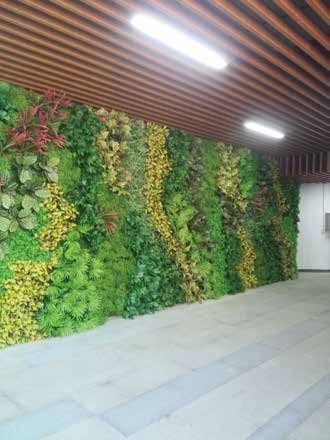
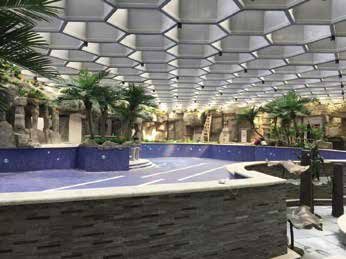
Real projects we have delivered in this kind of setting — on-site photographs, no mock-ups.
Want the catalogue and a quotation?
Tell us your market, project type and indoor or outdoor use, and we will send the relevant catalogue lines with a quotation path and the sampling options — usually within 24 hours on business days.