What Is the Best Artificial Palm Tree for a Restaurant?
The best artificial palm tree for a restaurant is a potted areca or pearl palm at 1.2–2 m for table, banquette and host-desk positions, or a coconut palm at 2.5–4 m where the room has 3.5 m or more of clear height — UV-stabilised ABS or PU fronds on a reinforced fibreglass trunk. Sample 1 piece, bulk from 5 pieces per height, 15–35 days depending on height, with fire performance documented against NFPA 701, BS 5867 or EN 13501-1.
November 16, 2026 · Restaurants & Cafés · 8 min read · By Everflorae Editorial Team

- Use the two ends of the range: potted areca or pearl palms at 1.2–2 m for table, banquette and host-desk positions; coconut palms at 2.5–4 m where the room has 3.5 m or more of clear height.
- The ceiling, the pendant lights and the service aisle set the height — not the reference photograph.
- Grease and steam are the restaurant-specific problem: matte fronds, a pH-neutral degreaser and a ten-minute close-down wipe.
- Fire performance is documented to a named standard (NFPA 701 / BS 5867 / EN 13501-1) and is order-specific.
- Sample 1 piece under the room’s own lighting, bulk from 5 pieces per height, 15–35 days depending on height.
Why does a restaurant read a palm differently from a hotel lobby?
A hotel lobby shows a palm from ten metres away, standing up, on the way to a lift. A restaurant shows it from 1.2 m, sitting down, with a plate in front of you. The change of distance changes the whole specification: the guest sees the base of the trunk, the joint where the trunk meets the planter, the underside of the crown, and every frond within arm’s reach. Detail that reads as texture at ten metres reads as plastic at one.
The second difference is revenue per square metre. A dining room is a seating plan before it is a landscape, and anything standing on the floor has to earn its footprint. A palm earns it in three places: where a table would not fit anyway — column bays, the wedge behind a banquette, the run beside the cloakroom; where it does a job — screening a service door, breaking a long banquette, marking the host desk; or where the room has height that seating cannot use.
The third difference is the air. A working kitchen sends grease vapour and steam into the room, and a fine film settles on every upward-facing surface, fronds included. A lobby never tests a finish that way. In a restaurant the finish and the cleaning routine are part of the specification, and the material has to survive a degreaser and a decade of it.
The fourth is the clock. A restaurant opens at a fixed hour on a fixed date, and the palm has to go in after the floor is finished and before the first service. An artificial palm needs no water, no curing and no grow-in, so the schedule risk sits in the delivery and the lift, not in the plant.
Which palm and which height fit a dining room?
The palm line covers 2–12 m in catalogue, with date palms built to 30 m to drawing, but a restaurant uses two ends of that range: the potted line at 1.2–2 m and coconut palms from 2.5 m up, held to whatever the room can carry. The table maps the five positions a restaurant project usually names to the species and heights that fit them.
| Position | Species / height | What decides it |
|---|---|---|
| Window banquette, bay or host desk | Potted areca or pearl palm, 1.2–2 m | Crown stays below the window head so daylight is not blocked, and the pot moves for a private-hire layout |
| Dining floor under a 2.7–3.5 m ceiling | Coconut palm, 2.5–4 m | The crown must clear pendants, the sprinkler line and the ceiling void; 2.5 m of trunk still leaves useful air under a 3.2 m ceiling |
| Mezzanine void or double-height hall | Coconut palm 5–9 m, or the 9 m king coconut | Only a void can take it; at that height the palm stops being decoration and becomes the room’s vertical axis |
| Terrace, pavement seating or roof bar | Coconut 2.5–9 m outdoor grade, or Washingtonia 5–8 m | Wind and sun decide: internal steel core, bolted base plate, UV-stabilised fronds with a 3–5 year colour benchmark |
| Bar back, shelf or pass screen | Potted palm, 1.2 m, single stem | Back-bar depth; fronds must not sit over glassware or an open pass |
Two rows cover most restaurants. Where the ceiling is a standard 2.7–3.5 m, the real choice is between potted palms at eye level and a coconut palm whose crown is designed to sit below the light fittings — and the second only works if the ceiling has been co-ordinated before the palm is ordered. Where the room is a converted warehouse or a hotel dining room with a void, the palm can go up, and the same budget buys height instead of quantity.

How much floor does a palm take, and what does it cost in covers?
A 1.2–2 m potted palm sits in a planter of roughly 400–600 mm; a 3 m coconut palm needs a base of 800–1000 mm once ballast or a base plate is included. Put that on a seating plan and it is real money: a 900 mm base plus its clearance is about the floor a two-top occupies with the chairs pulled out. That is why palms go where the seating plan already has a gap — column bays, the dead corner beside a cloakroom, the strip behind the last banquette — rather than into the middle of the room.
Anchoring decides the rest. A restaurant floor is usually tile, stone or screed over slab, and a 3 m palm with a crown is a lever: a guest leaning back on it, a chair pushed into it or a cleaning machine nudging it is a load at the base. Either bolt the base plate where the slab allows, or use a weighted planter and state the ballast weight on the drawing so the contractor can handle it. Both decisions belong at order stage, not on site.
Service comes third. Keep at least 900 mm clear on the tray route and check that figure against your local accessibility code before the plan is frozen; a palm that narrows a service aisle gets moved within a month.
Which finish survives grease, steam and a wipe-down?
Matte before gloss. A high-gloss frond reflects a grease film as a haze under warm downlights; a matte surface scatters the same light and still reads as leaf. In a room lit at 2700–3000 K that difference is visible from across the table, so specify matte and check it under the room’s own dimmer level rather than in a showroom.
Heat close to the pass. Fronds on this line are UV-stabilised ABS or PU and are tested for continuous 50 °C+ exposure, which is the relevant number for positions near an open pass, a pizza oven or a display kitchen. Ask for the sample to stand at that position for a week before the order is placed — a metre closer to the heat changes the answer.
ABS or PU is a sample decision, not a datasheet decision. Both are offered on the line. Ask for one frond of each, wipe both with a greasy cloth and a pH-neutral degreaser, then look at them from 1.2 m: whichever still reads as a leaf is the right one for the room.
Fixing is the failure point. Fronds are set around a trunk core in tiers, and the trunk is reinforced fibreglass — hollow or filled — with an internal steel core on the tall sizes. What fails in service is never the trunk: it is a frond clip working loose above a table. Put a monthly clip check into the cleaning contract and that failure never reaches a guest.
Which fire standard will the landlord or insurer ask for?
It follows the jurisdiction. US projects normally name NFPA 701 for textiles and films; UK projects name BS 5867-2 for curtain and drape fabrics; EU projects name EN 13501-1 for the reaction-to-fire classification of construction products. An enclosed dining room with banquettes, curtains and a full house at 20:00 is exactly the space a fire consultant looks at, and a mall food court or a hotel restaurant usually has to satisfy the landlord’s insurer as well as the code.
Acceptance is documentary. The treatment is applied to the fronds actually supplied, so the report has to name the standard, the edition and the material, and it has to travel with the purchase order — “flame retardant” with no standard number will not close out an inspection. The fibreglass trunk and steel core do not burn; the variable is the frond. Our guide to NFPA 701, BS 5867 and EN 13501-1 sets out what each standard actually tests.
How do you clean palms in a live dining room?
Nothing about an artificial palm needs water, and that is the point in a room that cannot be hosed down. The routine that works is short enough to run after close:
- Weekly — dust the crown from the top down with a microfiber sleeve on a pole, working with the frond direction rather than against it.
- Monthly — degrease the fronds nearest the pass and the bar with a pH-neutral degreaser diluted as directed, then wipe dry. No solvent, no steam, no leaf-shine spray, which attracts dust and turns grey.
- Quarterly — check base bolts, the planter joint and the frond clips, and re-tension or replace anything loose.
- Annually — compare the crown with the original colour standard in daylight and log it, so a re-order years later still matches.
Ten to fifteen minutes per palm per week is the realistic budget for a dining room with four or five of them, and it replaces a horticultural contract entirely.
Is the same palm suitable for a shopping mall?
Yes, but a mall is a different brief with a different failure mode. Heights go up: a mall atrium or a food-court void usually wants 6–12 m, which is where the 9 m king coconut earns its place as the wayfinding landmark at the escalator or the centre of the dining terrace, read from three floors away. The base becomes a traffic problem rather than a seating problem — trolleys, scrubbers and delivery carts all find the one palm that is not fixed — and the fire question moves to egress, where nothing may narrow an exit path.
Two practical differences follow. First, cleaning access: a 9 m palm needs a platform or a scissor lift, so it is planned with the mall’s cleaning contractor rather than bought as furniture. Second, refits: retail interiors are re-planned every few years, and a palm on a bolted base can be unbolted, re-potted and moved to the next scheme, which is why the base detail matters more than the species. The artificial palms line covers both the potted sizes a restaurant uses and the atrium heights a mall needs.
How do you order restaurant palms, and how long does it take?
Sampling starts from 1 piece. Approve it under the room’s own lighting, at the dimmed level the room actually runs at, and from a seated position at the nearest table — a palm approved in a bright showroom is regularly rejected in a warm dining room. Bulk production starts from 5 pieces per height, which matches a row of identical palms along a banquette or a terrace.
Lead times run 15–35 days depending on height. Palms ship as the trunk in a crate plus stackable frond cartons, with the crown pre-assembled, so on-site work is a lift and a bolt inside an overnight window. For a multi-site rollout, order every site in one production batch and keep the colour standard on file: two batches produced two years apart will not match under the same lighting.
Send the height, the quantity, the setting (dining floor, terrace or atrium) and the fire specification, and the quotation comes back with the matching specification sheet, unit price and lead time — normally within 24 hours on business days. The artificial trees range and the restaurant and café application notes cover the wider specification when a scheme mixes palms with ficus, olive or green walls.
Frequently asked questions
What is the best artificial palm tree for a restaurant?
How tall should a palm be in a restaurant?
How long does a restaurant palm order take?
Can the same palm be used on a terrace or in a shopping mall?
Related project cases
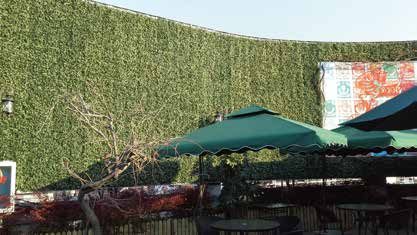
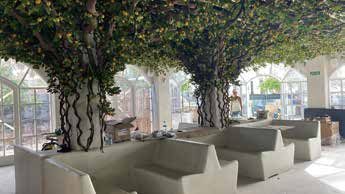
Real projects we have delivered in this category — on-site photographs, no mock-ups.
Specifying palms for a restaurant or a mall?
Send the height, the quantity, the setting and the fire specification. We will come back with the specification sheet, unit price and lead time — normally within 24 hours on business days.
Sources & attributed quotations
Named sources behind this guide; the quotations are verbatim from the issuing bodies, with links to the official pages.
“This standard establishes test methods to assess the propagation of flame of various textiles and films under specified fire test conditions.”
— NFPA (National Fire Protection Association), NFPA 701, Standard Methods of Fire Tests for Flame Propagation of Textiles and Films (2023 edition), official source
“This document provides the reaction to fire classification procedure for all construction products, including products incorporated within building elements with the exception of power, control and communication cables which are covered by EN 13501-6.”
— CEN (European Committee for Standardization), EN 13501-1, Fire classification of construction products and building elements — Part 1: Classification using data from reaction to fire tests, official source
- NFPA — NFPA 701, fire tests for flame propagation of textiles and films
- CEN — EN 13501-1, reaction to fire classification of construction products
- BSI — BS 5867-2:2008, flammability requirements for curtain and blind fabrics
- Everflorae — Fire & UV Compliance Documentation
Sister brand · GardenStone
Pair it with landscaping stone (GardenStone)
From the same supplier group — GardenStone supplies decorative pebbles, gravel and landscape stone that complete the same hotels, resorts, malls and Japanese gardens. One source for the whole landscape.
Explore GardenStone →