What Artificial Palms Suit an Atrium Project?
Four forms carry most atrium work: coconut palms at 2.5–9 m and king coconut palms at 9 m for double-height voids, Washington palms at 5–8 m for wide planters, Canary date palms at 8–10 m for a sculptural trunk, and potted areca palms at 1.2–2 m for under-planting. Trunks are reinforced fibreglass over a steel core, fronds are UV-stabilised ABS or PU, sampling starts at 1 piece, standard lead time is 7–15 days and custom work 20–45 days.
October 6, 2026 · Buying & Sourcing · 9 min read · By Everflorae Editorial Team
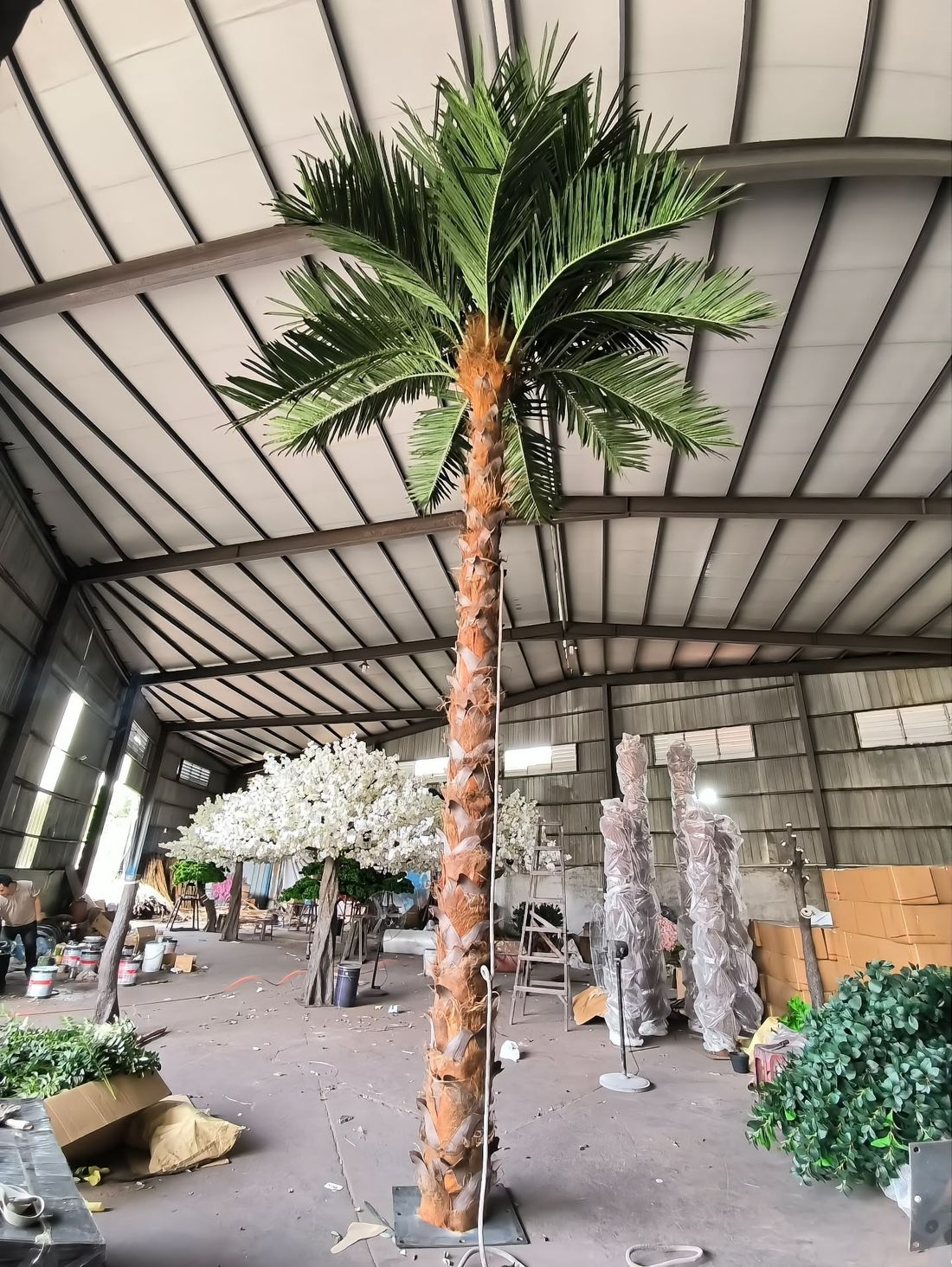
- Match the palm to the void, not to a photograph: coconut 2.5–9 m, king coconut 9 m catalogue standard, Washington 5–8 m, Canary date 8–10 m, potted areca 1.2–2 m.
- Atrium palms live under glass, so specify heat-stable fronds and check that the trunk is heat-resistant; our palm line is tested for continuous 50 °C+ exposure.
- Trunk specification decides stability: reinforced fibreglass, hollow or filled, over an internal steel core with a bolted base plate option.
- Fire treatment is per foliage type. Put NFPA 701, BS 5867-2 Type C or EN 13501-1 on the purchase order and ask for the document at quotation stage.
- Wholesale mechanics: samples from 1 piece, bulk quoted at 5 pieces per height in this line, standard lead time 7–15 days and custom work 20–45 days.
Which artificial palm forms suit an atrium?
An atrium asks a palm to do two jobs at once. From the ground floor, guests read the silhouette — the line of the trunk against glass, the spread of the crown against the soffit. From the mezzanine, the same palm is inspected at three metres, where frond detail, colour consistency and the join between fronds and trunk are all visible. A form that satisfies one view rarely satisfies the other by accident, which is why the artificial palm range is organised by species and height rather than by decorative style.
In practice, four forms cover almost every atrium brief we quote.
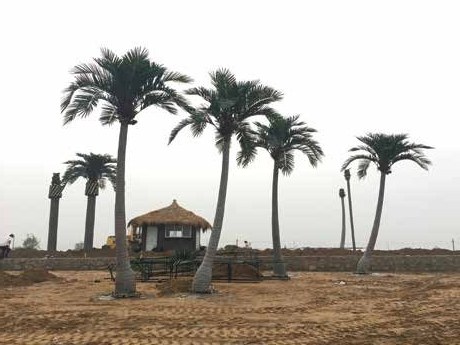
Coconut palm, 2.5–9 m. The straight and curved-trunk versions are the workhorse of tropical atriums and pool courts, because a clean trunk reads clearly against glazing and does not fight the architecture. If the brief says "resort", this is usually the palm.
King coconut palm, 9 m catalogue standard. The taller section, with more built to drawing above that. This is the form for double-height voids where the palm has to reach the upper walkway line and hold a crown at that height.
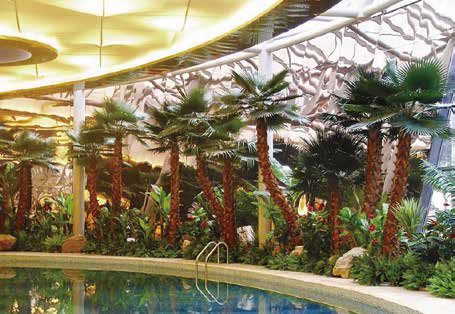
Washington palm, 5–8 m. A fan palm with a heavier, flatter crown. It suits a wide planter or a floor bed better than a narrow column, and it fills horizontal space that a coconut palm leaves open.
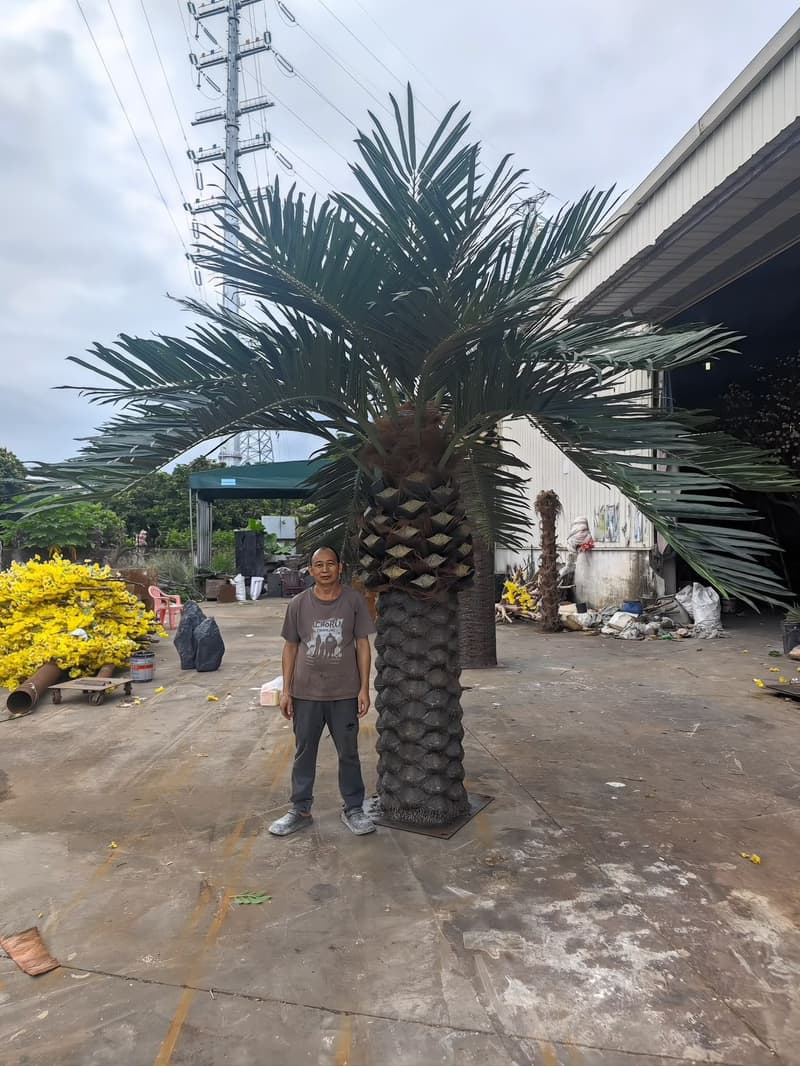
Canary date palm, 8–10 m (fibreglass and silver date variants). The sculptural option: a thick trunk carved with a diamond pattern and painted panel by panel, which is why it is normally chosen when the trunk itself is part of the design. Our wider palm line also builds date palms to drawing well beyond this, including a 30 m specification.
Potted areca and pearl palms, 1.2–2 m. Under-planting. These are what stop a large palm from looking like a sculpture on a bare floor, and they are the easiest part of an atrium package to freight because they are packed as normal potted plants.
Sizing a palm to the void: height, crown spread and sightlines
Atrium heights vary far more than showroom ceilings do, and most sizing mistakes are made from a rendered image rather than a dimension. The workable method is arithmetic, done before anything is quoted. Measure the void from finished floor to the lowest soffit, beam or structural drop that the crown would meet. Subtract the planter or base height. Then choose the tallest catalogue height that still leaves a clear frond tier below that line, so the crown opens in air rather than pressing into the glazing.
In a nine-metre void with an 0.8 m planter, for example, a 6–7 m palm clears a soffit at 9 m with room for the crown to spread; the same palm in a six-metre void would have to be cut down a size. The site-wide production range for artificial trees is 1–15 m, so a specification outside a catalogue list is not a problem in itself — it simply moves the order from stock into custom work.
Crown spread matters as much as height. A three-metre crown in a four-metre light well turns a bright space into a shaded one, and it also changes the lifting plan, because the crown is the widest part of the load. Send the factory the planter footprint, the clear void and the position of any handrail or mechanical grille, and the height recommendation becomes a calculation rather than a guess.
Trunk, frond and fire specification for a public interior
Three specification lines decide whether an atrium palm still looks right in year five, and all three should be written out rather than assumed.
Trunk. Atrium palms are built on reinforced fibreglass trunks, hollow or filled, wrapped around an internal steel core. The core is what carries the load and what resists wind where a palm sits near an open facade or under a ventilation path, and a bolted base plate is the usual way of tying the palm down without drilling into a finished floor. At six metres and above, ask how the trunk is split for shipping — a full-height trunk in one piece changes the crate size and the access route.
Fronds. Foliage in this line is UV-stabilised ABS or PU and is assembled in tiers around the trunk core, shortest fronds at the crown top, longest at the bottom ring, each row checked against the approved reference before fixing. Under glass, the other variable is heat: our palm fronds are tested for continuous 50 °C+ exposure, which matters in a glazed atrium where the air above head height runs far hotter than the floor. The basis for UV and heat claims is laboratory exposure testing, and the standards behind those tests are listed in the sources section below.
Fire. An atrium is a public space, so artificial foliage is almost always inside a fire-regulated envelope. Three standards come up repeatedly: NFPA 701 in the United States, BS 5867-2 Type C in the United Kingdom, and EN 13501-1 in the European Union. Fire-retardant treatment is specified per foliage type — it is not a property of "artificial plants" in general — so the standard belongs on the purchase order, and the certificate you receive should name the foliage in the shipment. Our compliance documentation sets out which options attach to which line; the NFPA 701, BS 5867 and EN 13501-1 guide explains how the three tests differ if you need to argue the point with an authority having jurisdiction.
How wholesale ordering works: samples, quantities and packing
Wholesale in this category does not mean buying from a stock list in the way that a lighting catalogue does. It means a factory order with a named specification, and the sequence is short once the specification is fixed.
Sample first, from 1 piece. Sampling starts at 1 piece, which lets you approve trunk colour and finish, frond tone and crown density before committing to a volume order. For an atrium, sample the tallest palm in the package: it is the one with the most inspection risk, and the crown line is what a client notices.
Quantities per height. In the palm line, bulk is quoted at 5 pieces per height per model. Most atrium schemes mix two or three heights — one or two tall statements plus a run of mid-size palms — so the height mix, not the total count, is what determines the crate plan.
Packing and freight. Palms ship as a trunk crate plus frond cartons, and the cartons are stackable, which is what keeps a mixed container efficient. Freight is quoted on packed volume to your port, so a specification change from a 6 m to an 8 m palm is a freight change as well as a unit-price change. This is also why we quote per model rather than printing a price list: two 8 m palms with different crown densities are not the same shipment.
Lead time. Catalogue heights run 7–15 days after deposit and sample approval. Built-to-drawing work — a taller crown, a custom trunk colour, a bespoke base — runs 20–45 days, because the trunk is wrapped and cured upright and the crown is assembled and checked at full height before crating. The palm line publishes its own height-dependent window on the artificial palms page, and our OEM and custom manufacturing service covers full design work against a drawing.
Access, assembly and base plates: getting a tall palm into the void
The part of an atrium palm project that goes wrong most often is not manufacturing, it is the route from the loading bay to the planter. Three things help.
First, the crown is pre-assembled for fast on-site craning where access allows, so the palm arrives at the void with the crown line already signed off at full height in the workshop. Where the route is too tight for a pre-built crown, fronds travel in cartons and are set on site in order — crown top first, then each row checked against the reference before fixing, with the longest fronds closing the bottom ring last.
Second, tie-down. A bolted base plate inside the planter is the cleanest option: the load goes into the structure under the finished floor instead of into the floor finish. If the palm is going onto a pool deck, a terrace or an exposed walkway, tell the factory at quotation stage, because it affects both the core and the base.
Third, sequence. Atrium planting usually happens late, after floors and balustrades are finished, so lift dates, crane capacity and protection of the finished surface belong in the project programme rather than in a phone call on the day. A short method statement from the factory — crate sizes, weights, the order in which fronds are set, and the base fixing detail — is usually enough for the main contractor to plan around.
The checklist that prevents most atrium palm problems
- Measure the void to the lowest soffit, not to the ceiling rose, and allow a clear frond tier below it.
- Name the species and the height: "coconut palm, 7 m, straight trunk" is a specification; "tropical palm" is not.
- State the fire standard your authority will ask for, and ask for the document at quotation stage rather than after production.
- Confirm hollow or filled trunk, steel core and base plate type in writing.
- Sample at 1 piece, and sample the tallest palm in the package.
- Check the access route before the crate is booked, especially the crown width.
- Fix the height mix early — it drives both the crate plan and the freight cost.
Frequently asked questions
Which artificial palms suit an atrium project?
How is a wholesale price for atrium palms calculated?
How long is the lead time for wholesale atrium palms?
Are artificial palms suitable for a fire-regulated atrium?
Sources & attributed quotations
Named sources behind this guide. The quotations below are verbatim from the issuing bodies, with outbound links to the official pages.
“This standard establishes test methods to assess the propagation of flame of various textiles and films under specified fire test conditions.”
— NFPA (National Fire Protection Association), NFPA 701, Standard Methods of Fire Tests for Flame Propagation of Textiles and Films (2023 edition), official source
“This document provides the reaction to fire classification procedure for all construction products, including products incorporated within building elements with the exception of power, control and communication cables which are covered by EN 13501-6.”
— CEN (European Committee for Standardization), EN 13501-1, Fire classification of construction products and building elements — Part 1: Classification using data from reaction to fire tests, official source
- NFPA — NFPA 701, flame propagation of textiles and films
- CEN — EN 13501-1, reaction-to-fire classification
- Everflorae — Fire & UV Compliance Documentation
Related pages
Related project cases
Real projects we have delivered in this kind of setting — on-site photographs, no mock-ups.
Want atrium palms quoted to your void?
Send the void height, the clear planter footprint and your fire standard, and we will come back with species, heights, packing data and a per-model quotation path — usually within 24 hours on business days.