What Is the Best Artificial Topiary Ball for a Casino?
The best artificial topiary ball for a casino is 90–120 cm at the arrival podium and 60–80 cm along the gaming-floor edge: a matte, UV-stabilised sphere on a welded galvanised steel armature, fire-rated to a named standard (NFPA 701, BS 5867 or EN 13501-1). Minimum order is 1 piece, and standard production runs 7–15 days.
November 2, 2026 · Buying & Sourcing · 9 min read · By Everflorae Editorial Team

- A casino spec is set by artificial light, the fire code and a three-shift cleaning regime — not by how the ball looks in a showroom.
- Matte beats gloss under 24/7 spotlights: gloss PU returns a hotspot that photographs as plastic.
- Diameter is a sightline decision — 90–120 cm at arrival, 60–80 cm at the floor edge, 30–50 cm at F&B counters.
- Ask for the fire standard number and a test report per order; "flame retardant" without a standard is not a specification.
Why is a casino topiary ball specified differently from a hotel lobby one?
A hotel lobby is judged in daylight, photographed for a brochure once, and forgiven a dull corner. A casino is judged at eleven at night, after fourteen hours of traffic, under a mix of 2,700–3,000 K downlights, LED cove lighting and the blue-white glow of a thousand screens. Nothing about that room changes except the crowd, and the planting has to look identical in year eight.
Three differences drive the specification. The light is first: a hotel lobby has shadow to hide in, a gaming floor does not, so glare and colour shift under warm light matter more than leaf realism at 30 cm. The code is second: gaming floors, restaurants and their corridors are public assembly spaces, and the operator's consultant asks for fire documentation against a named standard before handover, not after. Cleaning is third: a casino is cleaned while it is open, in shifts, with chemicals and backpack vacuums, and the planting sits in the path of all of it.
A fourth difference rarely reaches the brief: a property may keep the same scheme for eight to ten years. Ask the supplier to retain a physical colour standard and the original foliage specification, so a re-order in 2031 matches what went in in 2026.
Which diameter belongs where on a gaming floor?
Diameter is not a taste decision in a casino; it is a sightline decision. The table below is the placement logic we work through with operators and their interior contractors before a drawing is issued.
| Position | Typical diameter | What decides it |
|---|---|---|
| Arrival, porte-cochère, podium | 90–120 cm, in pairs | Read from a moving vehicle at 20 m; must survive luggage carts and wind |
| Gaming-floor perimeter | 60–80 cm | Must not cut camera sightlines, aisle width or the dealer's view of the pit |
| High-limit room, corridor ends | 40–60 cm on plinths | Console scale; matched pairs either side of a door or a lift |
| Bars, buffet, F&B counters | 30–50 cm | Sits above table height, clear of heat lamps and pass-through trays |
| Hotel lift lobby, corridor | 60–90 cm, in pairs | Frames the lift bank; must not obstruct the call buttons or the fire door swing |
All of these sit inside a 0.5–5 m build range, so nothing above is a product limit — it is where each size stops working. Final diameter follows the elevation drawing and a walk-through with security and the fire officer.
Which foliage and finish survives 24-hour spotlighting?
Four things separate a ball that still looks right in year three from one that reads as plastic in month two, and none of them is visible in a catalogue render.
Finish. Matte, not gloss. Under a narrow spot at three metres, gloss PU returns a specular highlight that photographs as a hard white spot: the eye reads moulded plastic, not foliage. Matte surface scatters that light, which is why natural and matte finishes are the default for gaming floors and gloss is kept for themed features where the shine is deliberate.
Tone. Two-tone foliage reads as a plant under warm light; a single flat green goes olive or grey under 2,700 K lamps. Ask to see the sample under the project's actual lamp, not a daylight-balanced studio light.
Density at one metre. A hand-set ball should read solid from a metre away, with no armature visible between the pads, and the underside matters as much as the elevation where the ball is seen from below. Request a close-up shot at one metre under the project's lamp; coverage that looks dense from three metres can show steel at eye height.
UV grade. Deep indoors, UV grade is a durability margin rather than a requirement. Where a skylight or glazed façade throws sun onto the ball, specify the outdoor grade: 3–5 year colour retention is the outdoor benchmark, and a west-facing glazed reception can deliver more UV than a shaded exterior.
Foliage is UV-stabilised ABS or PU over a galvanised steel armature welded to the approved shape, and every ball in this line is made to order. The topiary and sculpted forms range lists the current formats, finishes and specifications behind that build.

What fire standard does casino greenery have to meet?
In most jurisdictions the answer is a named standard, and the name depends on where the property is. US projects normally specify NFPA 701 for textiles and films; UK projects specify BS 5867-2; EU projects specify EN 13501-1 for the reaction-to-fire classification of construction products. Hospitality groups with properties in several countries often carry all three so one specification travels.
The detail that decides whether a shipment clears inspection is documentation. Fire performance is order-specific: the treatment is applied to the foliage actually supplied, and the report has to describe those materials. Ask for it with the purchase order rather than after arrival, and check that it names the standard, the edition and the material — "flame retardant" with no standard number attached will not satisfy a consultant.
The steel armature itself does not burn, which is one reason a sculpted ball is easier to document than a fabric drape. The variable is the foliage treatment, plus dust and lint that collect on it. Our guide to NFPA 701, BS 5867 and EN 13501-1 sets out what each standard actually tests.
How do you clean topiary balls in a 24/7 operation?
A casino cannot close the floor to dust a plant. The regime that works is short, frequent and written into the cleaning contract.
Weekly on the floor, monthly back of house. A vacuum with a soft brush head lifts surface dust without pulling at the stems. Dust is what makes artificial foliage read as artificial: under raking light from a cove, a grey film on every pad is more visible than any difference in leaf shape.
Neutral detergent, never solvent. Warm water with a mild neutral detergent and a microfibre cloth handles fingerprints, drink spills and ash. Solvent cleaners attack ABS and dull the finish permanently; silicone furniture polish is worse — it attracts dust and leaves a film on the floor around the base.
Smoking areas need a rinse. Nicotine film builds slowly and shows as a yellow-brown cast on upper surfaces. A quarterly rinse with the same neutral detergent removes it; matte finishes hold less of it than gloss, because there is no sticky clear coat to bond to.
No soil means no pests, no irrigation and no drains. A planter on carpet in a VIP room has no water source to leak and no soil to attract insects.
Check the stems, not just the leaves. Hand contact at the base loosens individual stems. A ten-second tug check per ball during the night shift catches it before a guest does.
What about bases, weight and a raised gaming floor?
Weight is where casino projects diverge from hotel projects, because gaming floors are frequently raised access floors with cable trays underneath and a point-load limit that nobody wants to discover after installation.
Balls in this line run from 0.5 m to 5 m, and a 3 m ball typically weighs 60–120 kg depending on frame and foliage density. Ask for the exact weight and footprint with the drawing, then hand both to the structural or flooring engineer: a plinth spreads the load wider than three bolted feet, and sand or steel ballast inside a planter is often the answer where the floor cannot be drilled at all.
Two site constraints get missed. The route first: a 120 cm sphere has to pass a service lift, a corridor and a door, so measure the smallest opening before the diameter is fixed. Hand contact second — at the arrival the ball meets luggage carts and wet umbrellas, so a plinth lifting the foliage to roughly 60 cm removes the worst of the damage.
How does the same ball spec change in a commercial building?
Office towers, mixed-use podiums and corporate headquarters are the second half of this specification, and the differences are practical rather than stylistic. Daylight comes first: a west-facing reception with full-height glazing puts more UV on foliage than a shaded exterior, so the outdoor UV grade belongs there even though the ball never leaves the building. An atrium is the second: seen from four to six storeys up, a 90 cm ball reads as punctuation, so specify the void separately from the reception.
Continuity is the third. A multi-tenant building usually wants the same ball in every lift lobby on every floor, which means ordering the whole set in one batch so the foliage matches; a re-order two years later will be close, not identical. Landlord design standards are the fourth: matte finish, no branding, a neutral green that does not fight a tenant's palette — or the opposite for a single-tenant headquarters, where the ball may carry a brand colour.
Finally, cleaning. In a commercial building the plants usually fall to the facilities contractor, so agree method and access before handover. The 1-piece minimum makes the pilot easy: a facilities team can live with one ball for a month, under their own lights and their own cleaner, before committing to forty.
How long does a casino topiary order take, and what is the MOQ?
Minimum order is 1 piece — this is a made-to-order line, not a stock line. Catalogued diameters follow the standard 7–15 day production window; custom diameters, matched sets, themed forms and logo shapes run 20–45 days including drawing approval, and a logo form needs at least 20 working days after the drawing is signed off. A 3D render comes before the armature is welded.
Two scheduling notes for casino work. Fit-out happens at night, so packing labelled by floor and zone saves the night crew from opening forty cartons to find four. And freight for a 120 cm sphere is volume, not weight: ask for carton dimensions and cubic metres per ball with the quotation, because the shipping line prices the air inside the carton as readily as the ball.
Send the diameters, the position on the floor, the finish and the fire standard, and the quotation comes back line-itemed against those four variables — normally within 24 hours on business days.
Frequently asked questions
What is the best artificial topiary ball for a casino?
How much does a casino-grade topiary ball cost?
How long do custom topiary balls for a casino take?
Is an artificial topiary ball suitable for a smoking gaming floor?
Sources & attributed quotations
Named sources behind this guide; the quotations are verbatim from the issuing bodies, with links to the official pages.
“This standard establishes test methods to assess the propagation of flame of various textiles and films under specified fire test conditions.”
— NFPA (National Fire Protection Association), NFPA 701, Standard Methods of Fire Tests for Flame Propagation of Textiles and Films (2023 edition), official source
“This document provides the reaction to fire classification procedure for all construction products, including products incorporated within building elements with the exception of power, control and communication cables which are covered by EN 13501-6.”
— CEN (European Committee for Standardization), EN 13501-1, Fire classification of construction products and building elements — Part 1: Classification using data from reaction to fire tests, official source
- NFPA — NFPA 701, fire tests for flame propagation of textiles and films
- CEN — EN 13501-1, reaction to fire classification of construction products
- BSI — BS 5867-2:2008, flammability requirements for curtain and blind fabrics
- Everflorae — Fire & UV Compliance Documentation
Related pages
Related project cases
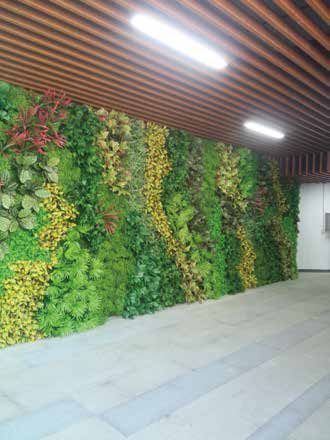
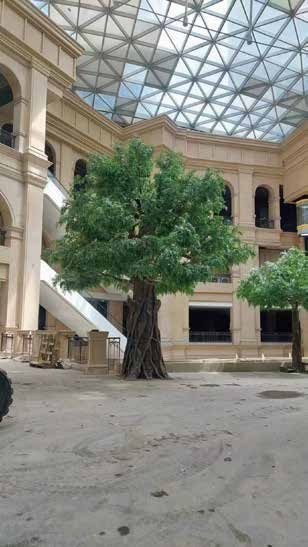
Real projects we have delivered in this category — on-site photographs, no mock-ups.
Specifying topiary for a casino or a commercial lobby?
Send the diameters, the position on the floor, the finish and the fire standard. We will come back with the specification sheet, weight and footprint, unit pricing and lead time — normally within 24 hours on business days.
Sister brand · GardenStone
Pair it with landscaping stone (GardenStone)
From the same supplier group — GardenStone supplies decorative pebbles, gravel and landscape stone that complete the same hotels, resorts, malls and Japanese gardens. One source for the whole landscape.
Explore GardenStone →