What Is the Best Artificial Topiary Spiral for a Wedding Venue?
The best artificial topiary spiral for a wedding venue is a 1.5–3 m sculpted form on a welded galvanised steel trunk, dressed in dense two-tone UV-stabilised ABS or PU foliage and, where the fire permit requires it, certified to NFPA 701, BS 5867 or EN 13501-1. Order a 1-piece sample first; standard spirals ship in 7–15 days, made-to-order forms in 20–45 days.
October 29, 2026 · Buying & Sourcing · 8 min read · By Everflorae Editorial Team

- "Best" at wedding distance is a specification: spiral height, foliage material, density, fire standard and UV grade — not a catalogue photo.
- Most venues take 1.5–3 m spirals in matched pairs at entrance porte-cochères, staircase landings and ceremony archways; 1.5–2 m suits reception desks and sign-in tables.
- Foliage is UV-stabilised ABS (injection-moulded) or PU (cast) on a welded galvanised armature; outdoor UV grade carries a 3–5 year colour-retention expectation.
- Timing: 1-piece sample first; standard spirals ship in 7–15 days, made-to-order forms in 20–45 days.
What does "best" mean for a topiary spiral at a wedding venue?
A wedding venue is the most photographed room a decorative plant will ever sit in, and a spiral is the tallest, most scrutinised form a buyer places there. Guests pass a 2 m spiral at arm's length on the way to the ceremony, the spiral flanks the reception desk in a hundred photographs, and a planner, florist and venue manager inspect it before the couple ever see it. So when a buyer searches for the best artificial topiary spiral for wedding venue projects, the honest answer is a specification, not a product name.
Four things decide whether a spiral survives that inspection:
- Spiral geometry at distance. A smooth, continuous helical curve on a single welded galvanised trunk. A kinked or stepped spiral reads as a wound cone the moment a guest photographs it against the venue's architecture.
- Density. A thin spiral shows the armature through the foliage at the gaps near the trunk. Venue-grade spirals are dressed to full coverage so the steel disappears from any angle — important when the spiral sits at eye level on a landing.
- Foliage material. ABS (injection-moulded, holds its shape, UV-stabilised) or PU (cast, softer hand-feel) — each has its place, and a quotation should name which one you are buying.
- Armature and compliance. A welded galvanised steel trunk sized to the height, and a named fire standard — NFPA 701, BS 5867 or EN 13501-1 — where the venue or local code requires one.
A spiral that cannot be described in those four terms is a catalogue photo, not a specifiable item.
Which foliage works best on a wedding topiary spiral?
Spirals are not one foliage; they are a family, and the right choice depends on what the spiral sits next to and the colour story of the day:
- Boxwood — the dense, small-leaf classic. Reads formal and tidy, and pairs naturally with boxwood hedge panels and topiary balls elsewhere in the scheme — the default for arches and aisle runs.
- Laurel and ivy — larger leaves and a softer silhouette that reads well in daylight-filled courtyards and garden ceremonies.
- Two-tone and mixed greens — depth without looking artificial under downlights and flash photography, which is exactly where a single-tone spiral flattens out.
Whatever the foliage, match it to the greenery already specified in the room. Our green walls & hedges line and the topiary & sculpted forms line are produced in the same Guangzhou workshop, which is what makes matched greens across formats possible.

UV resistance and colour retention for sunlit and outdoor venues
Garden ceremonies, courtyard receptions and marquee weddings put "indoor" spirals under real sunlight. Direct sun through open sides fades single-dye foliage within a season, so a spiral used outdoors or in a sun path should be specified with the same UV-stabilised grade used for permanent outdoor installation. Our outdoor UV grade carries a 3–5 year colour-retention expectation; indoor-grade foliage away from direct sun keeps its colour longer. Write the UV grade into the specification per placement — a spiral under a marquee opening and one inside the banquet hall do not need the same grade, and paying for UV stability where it is not needed is money off the foliage density budget.
Fire safety — flame-retardant topiary and the standards that matter
Banquet halls and hotel ballrooms are strict environments for artificial greenery, and the specification is a standard number, not an adjective. The three most commonly cited frameworks:
- NFPA 701 — the US standard test methods for flame propagation of textiles and films; the usual ask for venue and hotel projects in North America and the Gulf.
- BS 5867 — the British specification for flammability of curtain and blind fabrics, frequently written into UK venue FF&E schedules.
- EN 13501-1 — the European reaction-to-fire classification for construction products, cited across EU venue builds.
Require the named standard and a test report in writing. A supplier claim of "flame retardant" without a standard number is not a specification, and it will not survive a venue's fire officer. Our compliance documentation lists the standards available per product line.
Sizing and placement — matching spiral height to the venue
Size the spiral to the sightline and the furniture, not to the ceiling height. In practice:
- 1.5–2 m — reception desks, sign-in tables and staircase landings. Tall enough to draw the eye upward without blocking conversation across the desk.
- 2–2.5 m — entrance porte-cochère pairs and aisle-end markers; the workhorse range for ceremony flow.
- 2.5–3 m — statement pieces for double-height ceremony backdrops and reception archways, usually on taller planters so the spiral reads at distance.
Planters matter as much as the spiral. Fibreglass planters from 30 cm to 150 cm take the finish the FF&E schedule specifies — RAL-matched where needed — and add the mass that keeps a 2.5 m spiral stable in guest traffic and against an open marquee side. Where a venue wants lower, rounded anchors instead of vertical interest, our topiary balls cover the same sightlines at 0.5–1.2 m.
How do you maintain artificial topiary — spirals and balls?
One of the reasons planners reach for artificial forms is that artificial topiary ball maintenance — and spiral maintenance — is light compared with living centre-pieces. There is no watering, no pruning and no deadheading in the week of the event. The routine that keeps a venue-grade piece looking new:
- Dust monthly. A soft brush or low-pressure air clears the foliage; glossy-leaf buildup wipes off with a damp microfiber cloth.
- Rinse seasonally. Outdoor UV-grade spirals and balls rinse with water each season to remove pollen and film that dulls the colour.
- Inspect the armature annually. Check the welded galvanised trunk and the planter for stability, especially pieces moved between indoor and outdoor placements.
- Store flat-packed where possible. Spirals ship with the foliage zip-tied to the trunk; untying and reshaping takes minutes and avoids crushed branches in storage.
The same four steps apply to topiary balls, so a mixed scheme of spirals and balls is one maintenance routine, not two. For wholesale volumes and mixed shipments with other topiary formats, see our wholesale topiary balls guide.
How much does a wedding topiary spiral cost?
There is no honest fixed list price, because cost scales with four variables a buyer controls:
- Height. Foliage volume grows with the spiral; a 3 m form uses several times the foliage of a 1.5 m one, and the price follows.
- Foliage material. Cast PU costs more than injection-moulded ABS; two-tone and mixed greens sit above single-tone.
- Fire certification. A named standard adds testing and treatment cost — worth it, and unavoidable where the code asks.
- Quantity. Matched-pair and multi-piece orders price better than singles; minimums per design are covered in our topiary MOQ guide.
Send the height, material and standard, and the quotation comes back line-itemed against those four variables — normally within 24 hours on business days. That is the only comparison method that survives a second bidder.
How long does a wedding topiary spiral order take?
Scheduling runs through the approval chain. Sampling comes first — a 1-piece sample of the exact spiral, plus a 3D render for sculpted forms, approved before production. Standard spirals then ship in 7–15 days; made-to-order heights, foliage matches and engineered armatures take 20–45 days including drawing approval. For the engineering detail behind custom forms, see our topiary spiral manufacturer guide, and for wedding-specific placement ideas our wedding venue application guide.
Frequently asked questions
What height artificial topiary spiral works best at a wedding venue?
How much does a commercial artificial topiary spiral cost?
How do you clean and maintain an artificial topiary spiral?
Is a flame-retardant topiary spiral required for wedding venues?
Sources & attributed quotations
Named sources behind this guide; the quotations are verbatim from the issuing bodies, with links to the official pages.
“This standard establishes test methods to assess the propagation of flame of various textiles and films under specified fire test conditions.”
— NFPA (National Fire Protection Association), NFPA 701, Standard Methods of Fire Tests for Flame Propagation of Textiles and Films (2023 edition), official source
“This document provides the reaction to fire classification procedure for all construction products, including products incorporated within building elements with the exception of power, control and communication cables which are covered by EN 13501-6.”
— CEN (European Committee for Standardization), EN 13501-1, Fire classification of construction products and building elements — Part 1: Classification using data from reaction to fire tests, official source
- NFPA — NFPA 701, fire tests for flame propagation of textiles and films
- CEN — EN 13501-1, reaction to fire classification of construction products
- BSI — BS 5867-2:2008, flammability requirements for curtain and blind fabrics
- Everflorae — Fire & UV Compliance Documentation
Related pages
Related project cases
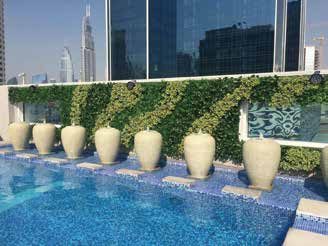
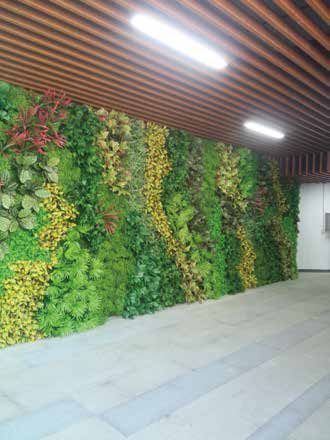
Real projects we have delivered in this category — on-site photographs, no mock-ups.
Specifying a topiary spiral for a wedding venue?
Send the height, the placement (indoor, sunlit glazing or marquee), and the fire and UV specification. We will come back with the specification sheet, unit pricing and lead time — normally within 24 hours on business days.
Sister brand · GardenStone
Pair it with landscaping stone (GardenStone)
From the same supplier group — GardenStone supplies decorative pebbles, gravel and landscape stone that complete the same hotels, resorts, malls and Japanese gardens. One source for the whole landscape.
Explore GardenStone →