What Is the Best Way to Buy Wholesale Artificial Palm Trees?
Buy wholesale artificial palm trees from a manufacturer rather than a trader: sample first at 1 piece, choose heights of 2.5–9 m for coconut palms or 8–10 m for date palms, specify fire treatment (NFPA 701, BS 5867-2 or EN 13501-1) and UV grade, and plan for 7–15 days for catalogue stock or 20–45 days for custom work.
October 31, 2026 · Buying & Sourcing · 9 min read · By Everflorae Editorial Team

- Source from a manufacturer, not a trader: you get the named species, the trunk spec and the fire certificate, not a resold photograph.
- Sample at 1 piece first, then buy heights of 2.5–9 m (coconut), 9 m (king coconut), 5–8 m (Washington) or 8–10 m (Canary date).
- Price is per palm by model and height — not per foot — because height, canopy density, trunk fill and fire/UV grade each change the cost.
- Put the fire standard (NFPA 701, BS 5867-2 or EN 13501-1) and UV grade on the purchase order and ask for the document at quotation stage.
- Lead time is 7–15 days for catalogue stock, 20–45 days for custom work; sampling at 1 piece does not extend production lead time.
Why source wholesale artificial palm trees from a manufacturer?
The biggest difference between a trader and a manufacturer is who owns the specification. A trader resells a photograph and a price; a manufacturer owns the trunk, the frond and the fire document. For a wholesale palm order — dozens of palms, mixed heights, a project deadline — that distinction is what keeps the crown line consistent across every carton and what lets you change one detail (a trunk colour, a base plate) without renegotiating the whole quote. Our artificial palm range is built and finished in Guangzhou, so the same workshop that quotes the order also signs off the crown at full height before crating.
Sourcing from a manufacturer also changes the economics. There is no resale margin stacked on top of the build cost, and the freight is quoted on the packed volume you actually ship rather than on a trader's carton estimate. For a wholesale artificial palm tree programme, that margin difference is usually larger than any single line-item saving.
Choosing palm species and height for a wholesale order
Wholesale palm programmes are almost always a height mix, not a single model repeated. Four forms cover most commercial briefs.
Coconut palm, 2.5–9 m. The workhorse of tropical lobbies, pool courts and resorts: a clean trunk reads clearly against glazing and does not fight the architecture. Straight and curved-trunk versions are both built to drawing.
King coconut palm, 9 m catalogue standard. The form for double-height voids where the palm has to reach an upper walkway line and hold a crown at that height, with more built above the catalogue height on request.
Washington palm, 5–8 m. A fan palm with a heavier, flatter crown that fills horizontal space a coconut palm leaves open — better for a wide planter or a floor bed.
Canary date palm, 8–10 m (fibreglass and silver date variants). The sculptural option, with a thick trunk carved in a diamond pattern and painted panel by panel, usually chosen when the trunk itself is part of the design. The wider palm line builds date palms well beyond this, including a 30 m specification.
The site-wide production range for artificial trees is 1–15 m, so a height outside a catalogue list simply moves the palm from stock into custom work — it is a lead-time change, not a feasibility problem.
How wholesale palm pricing works — and why not per foot
The question buyers most often type is "artificial plant price per foot", and the honest answer is that artificial palm trees are not priced per linear foot. They are quoted per palm by species and finished height. Height drives trunk material and length, the number of frond tiers, and the crate count; canopy density, hollow or filled trunk, a bolted base plate, fire treatment and UV grade each add cost on top. Freight is then quoted by packed volume to your port.
That is why two 8 m palms with different crown densities are not the same shipment, and why we send a per-model quotation against your specification instead of printing a price list. If a supplier quotes you a flat "per foot" rate, read it as a marketing number rather than a build cost: the trunk, the fronds and the crate are what the price is actually made of. Our OEM and custom manufacturing service quotes each model against the drawing, so the number you receive maps to the palm you receive.

Fire safety and UV grade for wholesale palms
A commercial palm almost always sits inside a fire-regulated envelope, so the fire treatment is specified per foliage type, not assumed for "artificial plants" in general. Three standards come up repeatedly: NFPA 701 in the United States, BS 5867-2 Type C in the United Kingdom, and EN 13501-1 in the European Union. Put the standard on the purchase order and ask for the certificate at quotation stage, because the document should name the foliage you actually receive, not a generic line.
For outdoor or glazed-atrium placement, UV grade is the second half of the specification. Outdoor foliage is built from UV-stabilised ABS or PU and is tested for colour retention of 3–5 years under weathering; under glass, where the air above head height runs far hotter than the floor, the fronds are tested for continuous 50 °C+ exposure. The standards behind these tests are listed in the sources section below, and our compliance documentation sets out which option attaches to which line.
Samples, minimum order and lead time
Wholesale in this category means a factory order with a named specification, and the sequence is short once that specification is fixed.
Sample first, from 1 piece. Sampling starts at 1 piece, so you can approve trunk colour and finish, frond tone and crown density before committing to volume. For a programme, sample the tallest palm in the package: it carries the most inspection risk and is the one a client notices.
Minimum order. There is no minimum that blocks a project; bulk is quoted per model and height, and most programmes mix two or three heights — one or two tall statements plus a run of mid-size palms — so the height mix, not a threshold count, drives the crate plan.
Lead time. Catalogue heights run 7–15 days after deposit and sample approval. Built-to-drawing work — a taller crown, a custom trunk colour, a bespoke base — runs 20–45 days, because the trunk is wrapped and cured upright and the crown is assembled and checked at full height before crating. The palm lead-time guide walks through the same window in more detail.
Packing, freight and customs for a wholesale palm order
Palms ship as a trunk crate plus frond cartons, and the cartons are stackable, which keeps a mixed container efficient. Freight is quoted on packed volume to your port, so a specification change from a 6 m to an 8 m palm is a freight change as well as a unit-price change — another reason we quote per model rather than per foot.
Two practical points reduce surprises at the border. First, tell the factory the destination port and Incoterm (FOB, CIF, DDP) at quotation stage, because it changes both the crate plan and the documentation. Second, confirm the access route to the final site before the crate is booked — the crown width, not just the trunk height, decides whether a pre-built crown can travel or whether fronds ship in cartons and are set on site. Our factory overview covers how orders are crated and loaded.
A wholesale buyer's checklist
- Name the species and height: "coconut palm, 7 m, straight trunk" is a specification; "tropical palm" is not.
- State the fire standard your authority will ask for, and ask for the certificate at quotation stage rather than after production.
- Confirm hollow or filled trunk, steel core and base plate type in writing.
- Sample at 1 piece, and sample the tallest palm in the package.
- Fix the height mix early — it drives both the crate plan and the freight cost.
- Quote per model and height against your drawing, not per linear foot.
- Confirm the Incoterm and the on-site access route before the crate is booked.
Frequently asked questions
What is the best way to buy wholesale artificial palm trees?
How much do wholesale artificial palm trees cost per foot?
How long is the lead time for wholesale artificial palm trees?
Are wholesale artificial palm trees fire-rated for commercial use?
Sources & attributed quotations
Named sources behind this guide. The quotations below are verbatim from the issuing bodies, with outbound links to the official pages.
“This standard establishes test methods to assess the propagation of flame of various textiles and films under specified fire test conditions.”
— NFPA (National Fire Protection Association), NFPA 701, Standard Methods of Fire Tests for Flame Propagation of Textiles and Films (2023 edition), official source
“This document provides the reaction to fire classification procedure for all construction products, including products incorporated within building elements with the exception of power, control and communication cables which are covered by EN 13501-6.”
— CEN (European Committee for Standardization), EN 13501-1, Fire classification of construction products and building elements — Part 1: Classification using data from reaction to fire tests, official source
- NFPA — NFPA 701, flame propagation of textiles and films
- CEN — EN 13501-1, reaction-to-fire classification
- Everflorae — Fire & UV Compliance Documentation
Related pages
Related project cases
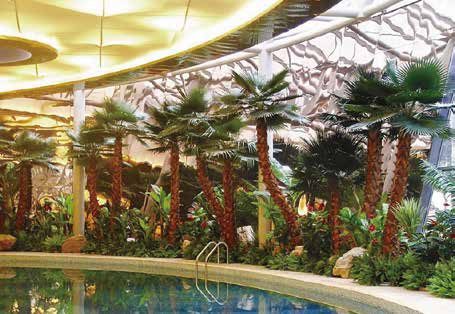
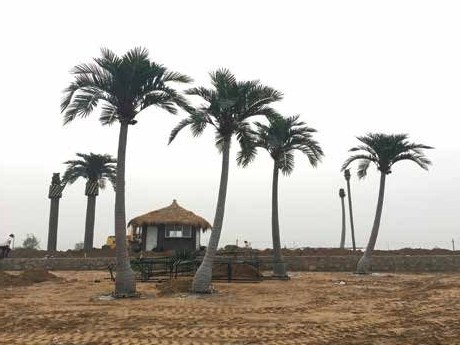
Real projects we have delivered in this kind of setting — on-site photographs, no mock-ups.
Want wholesale palms quoted to your project?
Send the species, the height mix and your fire standard, and we will come back with packing data and a per-model quotation path — usually within 24 hours on business days.
Sister brand · GardenStone
Pair it with landscaping stone (GardenStone)
From the same supplier group — GardenStone supplies decorative pebbles, gravel and landscape stone that complete the same hotels, resorts, malls and Japanese gardens. One source for the whole landscape.
Explore GardenStone →