What Is the Best Large Artificial Tree for an Airport Terminal?
The best large artificial tree for an airport terminal is a UV-stabilised, fire-rated specimen on a bolt-together trunk — a ficus, olive or palm built to clear 3–6 m ceilings, survive 24/7 concourses and meet aviation fit-out codes. Sampling starts at 1 piece, standard production lead time is 7–15 days, custom runs take 20–45 days, and UV-stable foliage holds colour for 3–5 years outdoors.
November 1, 2026 · Buying & Sourcing · 9 min read · By Everflorae Editorial Team

- The best large artificial tree for an airport terminal is a commercially graded ficus, olive or palm on a bolt-together (segmented) trunk with UV-stabilised ABS or PU foliage — not a single-piece decorative prop that cracks under 24/7 handling.
- Sampling starts at 1 piece, so a procurement or fit-out team can inspect the trunk, canopy and planter before committing to a terminal-wide run.
- Standard lead time is 7–15 days after deposit and sample approval; fully custom runs take 20–45 days.
- UV-stable foliage keeps colour for 3–5 years under skylights; fire rating (NFPA 701 / BS 5867 / EN 13501-1) is a separate option airports frequently require.
- Large trees install as bolted trunk segments with a lift or crane, scheduled into the terminal's fit-out window — not lifted as one rigid piece.
What is the best large artificial tree for an airport terminal?
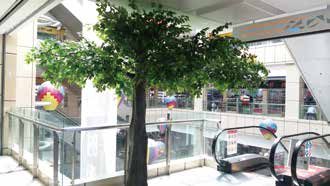
The honest answer is that the best large artificial tree for an airport terminal is defined by how the tree must survive the space, not by which catalogue photo looks biggest. A terminal concourse runs 24/7, moves millions of passengers a year, sits under vast skylights, and answers to strict fire and aviation fit-out codes. A single-piece decorative tree that looks fine in a showroom will fade, crack at the trunk joint, or fail a fire check inside a season of that environment. So the three things that separate a commercial large tree from a decorator one are the trunk construction, the foliage grade, and the fire behaviour.
The trunk is the first tell. A real tree of 4–6 m cannot be shipped or lifted as one rigid piece, so a commercial copy uses a bolt-together (segmented) trunk — steel or fibreglass core with bark-skin sections — so the tree assembles on site, holds its form through constant cleaning and redeployment, and can be partially replaced if a section is damaged. The foliage grade is the second: any tree near a skylight or glass curtain wall gets direct sun, so it needs UV-stabilised polymer or it fades within a season. The third is fire behaviour — enclosed public concourses and many aviation authorities' fit-out rules call for a fire-retardant treatment on decorative planting.
None of that is visible in a product photo, which is exactly why sampling starts at 1 piece. You want the physical trunk and canopy in hand to check the bark mould, the foliage rigidity and the planter finish before a few dozen copies are made. For the wider range these trees belong to, the artificial trees page lists the species and forms we produce.
Which species — ficus, olive or palm?
For terminal-scale planting, three species carry most of the brief, and they are not interchangeable:
- Artificial ficus (rubber plant / weeping fig). Dense, rounded canopy, 3–6 m. Best for concourses and arrival halls where the tree reads as a single calm mass from a distance.
- Artificial olive tree. Open, airy branching with silver-green leaves, 3–5 m. Best for a Mediterranean or premium-retail feel in duty-free and lounge zones.
- Artificial palm (royal / areca / traveller's). Tall, slender trunk with a crown of fronds, 4–7 m. Best for atriums and double-height volumes where vertical drama matters more than canopy spread.
The species should follow the ceiling and the sightline. A ficus fills a concourse with mass; an olive softens a lounge; a palm draws the eye up an atrium. Saying "a big tree" without saying which species is how a terminal ends up with the wrong object in the wrong volume — and the wrong lead time, because the three come off different tooling and trunk jigs.
Trunk, canopy and base: what "large" really means
"Large" for an airport is mostly about the trunk and the base, not the leaf count. A 4 m ficus needs a trunk that will not bow under its own canopy and a base heavy or anchored enough that a luggage trolley bump will not tip it. We build the trunk as bolt-together segments over a steel or fibreglass core, so the height is set in the workshop and the canopy spread is matched to the planter. The planter and the base do a lot of the visual and safety work — which is why specifying the pot finish, the ballast weight and the fixing method matters as much as the foliage, especially where trees sit in high-traffic walkways.
Canopy spread matters for clearance: a 5 m tree with a 3 m spread needs different siting than the same height with a 1.8 m spread. Because the trunk is segmented, a single species can serve a 3 m gate lounge and a 6 m atrium by changing the number of trunk sections and the canopy form — one tooling, two very different installations.
UV stability and fire rating for terminal installs
Airports are dominated by skylights and glass, so UV stability is not optional — it is the default. Standard indoor foliage is fine only for a sealed, windowless back-of-house area; anything in a concourse, an arrivals hall or near a curtain wall needs UV-stabilised foliage. Commercial UV grade holds colour for roughly 3 years, with a premium outdoor grade reaching 5 years before noticeable fade.
Fire behaviour is a separate, and often mandatory, specification. Enclosed public concourses, and the fit-out rules of many airport authorities, call for a fire-retardant treatment on decorative planting. We offer treatment tested to NFPA 701 (US), BS 5867 (UK curtains and drapes standard, often referenced for soft decorative foliage) or EN 13501-1 (EU reaction-to-fire classification). UV grade and fire rating are independent: you can have one without the other, and you should state both on the order rather than assume. Our compliance page explains which test document is issued against which foliage specification.
Placement and sizing across concourses, atriums and gate lounges
Large trees are structure, not detail, so placement drives the whole order. A 3–4 m ficus anchors a check-in island or a gate-lounge vista; a 5–6 m palm or ficus becomes the hero of an atrium. Because the visible tree is large, the planter, the base weight and the sightline do most of the design work — which is why the pot finish and the fixing method are specified as part of the tree, not as an afterthought.
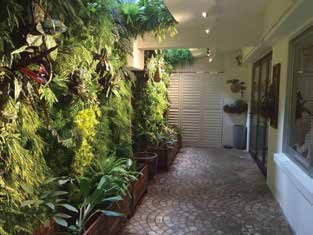
Placement also drives the UV and fire call. Anything within a metre of a skylight or a glass wall should be UV-stabilised; anything in a public, enclosed concourse should carry a fire rating where the authority requires it. An airport terminal & concourse planting scheme usually mixes these large trees with green walls and smaller specimens, so the trees are the structure and the consistency of their colour and form across a long terminal is what reads as quality.

Sampling, MOQ and lead time
Sampling is deliberately low-friction: 1 piece is enough to judge the trunk rigidity, the bark mould and the canopy. Standard catalogue trees — existing trunk jig, standard foliage grade, standard planter — ship in 7–15 days after deposit and sample approval. A custom run changes that: a new trunk mould, a bespoke colour match to a terminal's brand, a branded or custom planter, or a fire-rating, means the tooling or colour batch is made first, which puts the run at 20–45 days.
The date that matters is the sample-approval date, not the deposit date — production timing starts when the approved sample is recorded. Airport fit-outs run to a fixed programme (a terminal closes a zone on a set night), so state the installation date at quotation stage so capacity can be reserved. Where trees are part of a larger planting order, ask for the mixed-order minimum explicitly, because a container shared with planters or green walls often reaches a full load on better terms than trees bought alone.
Installation: delivery, access and on-site assembly
Artificial tree installation service is where a large specimen stops being a product and becomes part of the building. Because the trunk ships in bolt-together segments, delivery is by standard freight rather than a single oversized load, and on-site assembly uses a scissor lift or crane slotted into the terminal's fit-out window. A qualified access provider handles the lift; we supply the trunk sections, the canopy, the planter and the ballast, and confirm the base is secure before the tree is dressed.
For trees above about 3 m, plan access points and sectional disassembly for any future repair — a segmented trunk means a damaged section is swapped rather than the whole tree scrapped. Our tree cleaning & maintenance guide covers the access and care side in detail, and our hotel-lobby spec guide works through the same trunk and canopy choices for a hospitality volume.
How to compare terminal tree quotations
Two quotations for "large artificial trees" are rarely for the same object. Before comparing prices, ask each supplier for the same seven things: the species and trunk construction (single-piece or bolt-together), the foliage grade and whether it is UV-stabilised, the fire-rating standard if specified, the planter or mount and its ballast, the packing volume per carton, the installation scope, and a test document for the exact foliage ordered. A quote that cannot answer those is not cheaper — it is unspecified, and the gap shows up on site as a bowed trunk, fade under a skylight, or a fire document that does not match the product.
For the wider planting scheme these trees sit within, our shopping mall project guide works through green-wall and specimen choices, and our hotel-lobby spec guide covers the same selection logic for an atrium volume. Both use the same commercial-grade standard.
Frequently asked questions
What is the best large artificial tree for an airport terminal?
How tall should an airport terminal artificial tree be?
How long does it take to produce and install a large artificial tree for an airport?
Does an airport artificial tree need a fire rating?
Sources & attributed quotations
Named sources behind this guide. The quotations below are verbatim from the issuing bodies, with outbound links to the official pages.
"This standard establishes test methods to assess the propagation of flame of various textiles and films under specified fire test conditions."
— National Fire Protection Association, NFPA 701, Standard Methods of Fire Tests for Flame Propagation of Textiles and Films, official source
"This practice is intended to reproduce the weathering effects that occur when materials are exposed to sunlight (either direct or through window glass) and moisture as rain or dew in actual usage."
— ASTM International, ASTM G154-23, Standard Practice for Operating Fluorescent Ultraviolet (UV) Lamp Apparatus for Exposure of Materials, official source
Related pages
Related project cases
Real projects we have delivered in this kind of setting — on-site photographs, no mock-ups.
Need a large-tree specification for your airport terminal?
Send the species (ficus, olive or palm), the ceiling height and canopy spread, the foliage grade, the fire-rating standard if required, and your destination port, and we will reply with sampling options, installation plan, lead time and a quotation — usually within 24 hours on business days.
Sister brand · GardenStone
Pair it with landscaping stone (GardenStone)
From the same supplier group — GardenStone supplies decorative pebbles, gravel and landscape stone that complete the same hotels, resorts, malls and airports. One source for the whole landscape.
Explore GardenStone →