What Is the Best Artificial Olive Tree for a Restaurant?
The best artificial olive tree for a restaurant is a 2.8–3.8 m multi-trunk tree on a natural-bark or fibreglass core with a 2–3.5 m canopy of matte, two-tone ABS/PU foliage — tall enough to read above booth screens, but clear of pendant lights and ductwork. Sample 1 piece first; standard heights ship in 7–15 days, custom builds in 20–45 days, with fire performance documented against NFPA 701, BS 5867 or EN 13501-1.
November 14, 2026 · Restaurants & Cafés · 8 min read · By Everflorae Editorial Team

- A restaurant tree is read from two metres at table height, under 3,000 K lamps — matte two-tone foliage survives that test; gloss does not.
- 2.8–3.8 m with a 2–3.5 m canopy covers most dining rooms; the ceiling, not the catalogue, decides the final number.
- Kitchen air means grease film: foliage must tolerate weekly wipe-downs with warm water and neutral detergent.
- Sample 1 piece, standard heights in 7–15 days, custom in 20–45 days, fire reports named standard by named standard.
What makes a restaurant a different brief from a hotel lobby?
A hotel lobby gives a tree distance: guests read it from the entrance, across a void, usually under high ceilings. A restaurant gives it intimacy. Diners sit one to two metres away for ninety minutes, at roughly the height of the tree’s first branches, and they look at it repeatedly. At that distance, every moulding seam, every repeating leaf pattern and every glossy hotspot is visible — so the specification starts with foliage quality at close range, not with height.
Operating conditions are the second difference. A dining room fills with warm, oil-laden air from the kitchen every service; leaves near the pass or the open-kitchen line collect a film that a hotel lobby never sees. Anything specified for a restaurant has to survive a weekly wipe-down with warm water and a mild neutral detergent, and it has to keep its matte finish after dozens of cleaning cycles.
Timing is the third. Restaurants open on a date, and greenery is usually the last item installed — often in the three or four days before the soft launch. A supplier who can confirm a design on a 3D render, sample one tree and hold a written lead time is worth more than one with a longer catalogue.
Which size and canopy shape fit a dining room?
Height is decided by the ceiling before it is decided by taste. A tree must clear pendant lights, ductwork, speakers and any overhead track lighting, and it should leave visible air above the canopy — a canopy that touches the ceiling reads as artificial from across the room. The catalogue range for this line runs 2–4.5 m tall with 1.5–4 m canopies, and heights of 1–15 m are built to drawing, so the table below describes where each size stops working, not a product limit.
| Position | Typical height / canopy | What decides it |
|---|---|---|
| Entrance, host station | 2.8–3.8 m / 2.8–3.8 m | The first impression from the street; pairs frame the door without blocking the host’s sightlines |
| Central dining feature | 3.8–4.5 m / 3.5–4 m | Read from every table; canopy must clear pendant lights, density checked from below |
| Booth and banquette ends | 1.2–2.8 m / 1.9–2.8 m | The 1.2 m / 1.9 m canopy tree works as a repeating divider at seat height |
| Bar and open-kitchen line | 2.8–3.8 m | Heaviest grease exposure; foliage must tolerate weekly wipe-downs |
| Terrace or sidewalk line | 2.8–3.8 m, outdoor grade | UV-stabilised foliage with 3–5 year colour retention and a drainage-designed base |
Reference builds from the current catalogue: HXDGLS007 at 1.2 m tall with a 1.9 m canopy for booth repeats, HXDGLS004 at 2.8 m / 2.8 m for entrances, HXDGLS010 at 3.8 m / 3.8 m for central features and HXDGLS011 at 4.5 m / 4 m for double-height dining spaces. Custom heights and canopy shapes follow the same range, built to drawing.

Which foliage finish survives kitchen air and daily cleaning?
Matte, not gloss. Restaurant lighting is warm and close — pendant lamps at 2,700–3,000 K hung at exactly the height where a gloss surface reflects them. Gloss PU returns a white highlight that reads as moulded plastic from the next table; matte scatters that light and keeps reading as foliage. If the scheme mixes finishes, keep gloss for themed props and matte for anything a guest can see at close range.
Two-tone leaves. Real olive foliage carries a silver-grey underside against a deeper green top. A single flat green goes muddy under warm lamps; a two-tone mix keeps the leaf reading alive at one to two metres, which is precisely the distance a dining room gives you. Ask to see the sample under a warm lamp, not a daylight-balanced studio light.
Wipe-tolerant materials. Foliage on this line is UV-stabilised ABS or PU. Both tolerate warm water with a mild neutral detergent — the realistic cleaning regime for a tree near an open kitchen. Solvent cleaners are the one thing to keep away, because they dull ABS permanently. Dust lifts with a soft brush vacuum head weekly; grease film wipes off with a damp cloth during the same pass.
What does not happen. There is no soil, no irrigation, no falling leaves and no pollen near food. That last point matters more in a restaurant than anywhere else: nothing drops onto plates, and nothing attracts insects to the dining room. The artificial olive tree line lists the current heights, canopies and finishes behind these specifications.
Which fire standard does restaurant greenery need?
In most jurisdictions the answer is a named standard, chosen by the country and the authority having jurisdiction. US projects normally specify NFPA 701 for textiles and films; UK projects specify BS 5867-2 for curtain and drape fabrics; EU projects specify EN 13501-1 for the reaction-to-fire classification of construction products. A restaurant group with sites in several countries usually carries all three, so one specification travels across the portfolio.
Documentation decides acceptance. Fire performance is order-specific: the treatment is applied to the foliage actually supplied, and the report must name the standard, the edition and the material. Ask for the report with the purchase order — “flame retardant” with no standard number attached will not satisfy a fire officer during the pre-opening inspection. The steel or fibreglass core does not burn; the variable is the foliage treatment. Our guide to NFPA 701, BS 5867 and EN 13501-1 sets out what each standard actually tests.
How do you base and anchor a tree in a dining room?
A restaurant floor sees more traffic than it looks like it does: service staff moving at speed, chairs pushed back every evening, night-shift deep cleans. Where the floor can be fixed, the base plate bolts down discreetly; where it cannot — heritage floors, granite, raised access floors — the planter takes internal ballast sized against the tree’s stated weight and footprint, both supplied with the drawing. A leaning tree in a dining room is a service interruption; a falling one is an insurance claim.
Position the tree where the cleaning contractor’s equipment can pass, not where it has to be lifted over. And measure the delivery route before the height is fixed: a 4.5 m tree ships in sections, but every section still has to pass the service door, a corridor and a stair turn.
How does a restaurant olive tree order work?
Sampling starts from 1 piece — a restaurant can buy one tree, live with it under its own lamps for a fortnight, and only then order the set. Volume orders run from 10 units per height, which suits a multi-site group fitting out several rooms at once. The canopy shape is confirmed on a 3D render before production starts, so nothing physical is committed until the silhouette is approved.
Standard catalogued heights ship in 7–15 days; custom heights, canopy shapes and matched sets run 20–45 days including drawing approval. For a restaurant opening on a fixed date, work backwards from the soft launch and add installation: greenery is fast to install because it needs no wiring, no water and no curing, but it does need the floor to be finished first.
Send the height, canopy, finish, fire standard and base type, and the quotation comes back line-itemed against those five variables — normally within 24 hours on business days.
Do the same trees work in a shopping mall food hall?
The best artificial olive tree for a shopping mall follows the same trunk and foliage specification but answers to a different viewer. A mall food hall reads the tree from three heights at once — diner eye level, escalator mid-flight and the balconies above — so the canopy must be dressed and density-checked from below as well as from the elevation. Traffic adds the second constraint: trolleys, delivery cages and ride-on floor scrubbers all pass within a metre, which pushes foliage higher on a plinth and makes the base a facilities decision rather than a styling one.
Enclosed malls also lean harder on fire documentation: the consultant usually asks for the named-standard report before handover, not after. And for a food hall, order every tree in one production batch so the foliage matches across the space, keeping the manufacturer’s colour standard on file for re-orders five years out. The artificial trees range covers the species and heights behind both the restaurant and mall schemes.
Frequently asked questions
What is the best artificial olive tree for a restaurant?
How much does a restaurant artificial olive tree cost?
How long does a custom artificial olive tree take?
Is an artificial olive tree suitable for a restaurant terrace?
Related pages
Related project cases
Real projects we have delivered in this category — on-site photographs, no mock-ups.
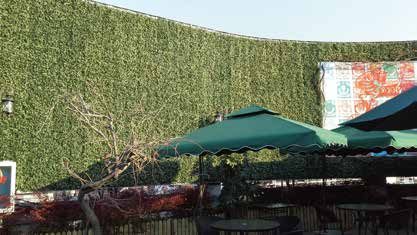
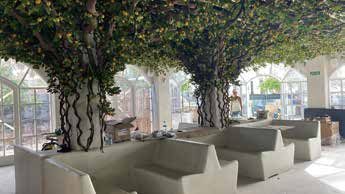
Specifying olive trees for a restaurant or food hall?
Send the height, canopy, finish, fire standard and base type. We will come back with the specification sheet, weight and footprint, unit pricing and lead time — normally within 24 hours on business days.
Sources & attributed quotations
Named sources behind this guide; the quotations are verbatim from the issuing bodies, with links to the official pages.
“This standard establishes test methods to assess the propagation of flame of various textiles and films under specified fire test conditions.”
— NFPA (National Fire Protection Association), NFPA 701, Standard Methods of Fire Tests for Flame Propagation of Textiles and Films (2023 edition), official source
“This document provides the reaction to fire classification procedure for all construction products, including products incorporated within building elements with the exception of power, control and communication cables which are covered by EN 13501-6.”
— CEN (European Committee for Standardization), EN 13501-1, Fire classification of construction products and building elements — Part 1: Classification using data from reaction to fire tests, official source
- NFPA — NFPA 701, fire tests for flame propagation of textiles and films
- CEN — EN 13501-1, reaction to fire classification of construction products
- BSI — BS 5867-2:2008, flammability requirements for curtain and blind fabrics
- Everflorae — Fire & UV Compliance Documentation
Sister brand · GardenStone
Pair it with landscaping stone (GardenStone)
From the same supplier group — GardenStone supplies decorative pebbles, gravel and landscape stone that complete the same hotels, resorts, malls and Japanese gardens. One source for the whole landscape.
Explore GardenStone →