What Is the Best Artificial Olive Tree for a Casino?
The best artificial olive tree for a casino is a 2.8–4.5 m gnarled multi-trunk build on a fibreglass or steel core — reference models HXDGLS010 (3.8 m tall / 3.8 m canopy) and HXDGLS011 (4.5 m / 4 m) — in matte, fruit-free ABS and PU foliage. Fire reports come per order to NFPA 701, BS 5867 or EN 13501-1; samples start from one unit and standard builds take 7–15 days.
November 11, 2026 · Casino Resorts & Gaming Floors · 8 min read · By Everflorae Editorial Team

- Olive is the signature species for casino entrances, high-limit lounges and buffet restaurants — it reads premium at close range and needs no daylight, water or soil.
- Reference builds: HXDGLS004 (2.8 m tall / 2.8 m canopy), HXDGLS010 (3.8 m / 3.8 m) and HXDGLS011 (4.5 m / 4 m); any height is engineered to drawing across a 1–15 m range.
- Matte two-tone ABS and PU foliage: no glossy flash under pit and table spotlights, nothing drops onto the carpet, nothing stains.
- Fire paperwork is the sign-off gate: NFPA 701, BS 5867 or EN 13501-1, report issued per order and naming the material tested.
- Sample from one unit, volume from ten; standard builds 7–15 days, custom 20–45 days.
Why an olive tree works on a casino floor
A casino floor is the most hostile room in hospitality for a live tree, and the olive is the species operators most often ask for by name. A live olive (Olea europaea) needs six or more hours of direct sun per day; a gaming floor is a windowless, 24-hour environment running on low ambient light and high-intensity table spotlights. Within weeks a real olive responds by thinning its canopy and dropping leaves — and olives drop something worse: fruit. Oil-rich olives falling onto carpet, gaming tables or a buffet line stain on contact and create a slip hazard that a housekeeping team cannot chase around the clock.
An artificial olive removes every one of those failure modes. The canopy holds its density permanently, so the tree that photographed well on opening night looks the same three years later. There is no soil and no standing water in the planter — a real constraint on a gaming floor, where floor boxes, surveillance cabling and cash-handling routes compete for the same square metres. There is no irrigation line to leak near electrical infrastructure. And there is no pollen: a live olive is a documented allergen source, which matters in a closed-air building where guests stay for hours. The cleanup problem shrinks to dusting and wiping on the night-shift cycle the casino already runs.
What is the best artificial olive tree for a casino?
Catalogue builds run 2–4.5 m tall with canopies of 1.5–4 m, on fibreglass or steel cores with hand-finished gnarled bark; heights outside the catalogue are engineered to drawing across a 1–15 m range. The best artificial olive tree for a casino is therefore a form specified to the position, not a specimen picked from a photo. Five positions cover most gaming-floor briefs:
| Position | Tree height | Canopy | Reference build |
|---|---|---|---|
| Main entrance / porte-cochère pair | 4.5 m | 4 m | HXDGLS011, outdoor-grade UV foliage where exposed |
| Gaming floor feature | 3.8 m | 3.8 m | HXDGLS010, matte foliage |
| High-limit lounge or buffet accent | 2.8 m | 2.8 m | HXDGLS004, close-range detail grade |
| VIP suite or restaurant table scale | 1.2 m | 1.9 m | HXDGLS007, compact planter footprint |
| Any soffit height, to drawing | 1–15 m | Built to drawing | Engineered form with approval drawing and 3D render |
Two clearances decide whether the tree works on the floor. The vertical one: keep roughly half a metre between canopy top and ceiling so the foliage can be dusted without dismantling — a 3.8 m tree wants a finished ceiling of about 4.3 m. The horizontal one: the canopy must stay clear of the sightlines pit managers and surveillance cameras rely on, and the planter footprint must sit outside chip-runner and guest circulation — if a cart can clip the trunk, the planter is in the wrong place. State ceiling height, the position on the floor plan and the fire standard in the enquiry, and the form and size are settled before a production drawing is issued.
Which construction details matter under casino lighting?
The trunk is a fibreglass core — steel where canopy load demands it — moulded and hand-finished with the gnarled, fluted bark texture that makes an olive read as an olive from two metres away. It is built in bolt-together segments. On a casino floor that detail is about installation, not structure: the segments pass through the service corridor and the service elevator, and the tree assembles in place inside the overnight window, with the joint lines hidden under the foliage. A one-piece tree needs a crane and a closed floor; a segmented one needs two fitters and a night.
Foliage is injection-moulded ABS and cast PU, specified matte and two-tone — darker silvery-green on top, paler underneath. The matte finish is the detail that earns its place here: casino lighting combines low ambient levels with high-intensity spots directly over tables and gaming positions, and glossy leaves flash hard highlights on every surveillance camera and marketing photo. The matte surface reads consistent under both. The leaf surface also wipes clean without disassembly; decorative olive fruit, where the design calls for it, is fixed to the branch — nothing drops, nothing rolls under a slot machine. If part of the tree stands in a glazed entrance or the porte-cochère, UV-stabilised foliage grades hold colour 3–5 years in outdoor-equivalent exposure, so the entrance pair does not fade ahead of the floor trees.

The base follows the floor. A cement-filled base keeps a freestanding tree stable against trolley and cart knocks on the gaming floor; a steel-plate base disappears inside a decorative planter matched to the FF&E schedule; a bolted plate fixes the tree where the operator requires it. One planning rule protects both the tree and the building: keep the planter footprint off floor boxes and cable routes, because every gaming-floor position is wired, and a planter that covers an access point will be moved whether you approve it or not.
What fire documentation does a casino need?
Gaming floors are high-occupancy assembly spaces served by defined escape routes, and greenery on those routes normally falls under local fire code — the one item where an undocumented product stops a casino sign-off. Name the standard, not the adjective: NFPA 701 for US-referenced projects, BS 5867 Part 2 for UK curtain-grade fabric, EN 13501-1 for EU reaction-to-fire classification. The report survives review when it is issued per order and names the standard, the edition and the material actually tested — a certificate that says only “flame retardant” documents nothing.
Because fire treatment is a production step on the goods, the report arrives with the order, and one complete file answers the fire engineer, the regulator and the insurer. One positioning note belongs in the same conversation: keep the canopy out of the sprinkler envelope, and let the project fire engineer set the clearance below heads before the tree is placed — on a gaming floor that clearance is checked, not assumed.
How does the specification change for a commercial building?
The best artificial olive tree for a commercial building follows the same species logic at lobby scale: 3.8–4.5 m multi-trunk builds at the entrance or over the reception backdrop, and a 2.8 m form in the lift lobby where the ceiling sits lower. Three things change compared with a casino. Design review is formal — the landlord or property manager expects the production drawing and a 3D render, and often a sample, before approving. The fire file is set by the building, not the tenant: facility management specifies which standard common-area greenery must document, and the per-order report is written to it. And installation routes through the service elevator in bolt-together segments with foliage packed and numbered — a written installation sequence keeps the crew inside the building’s night window.
Maintenance is the same night-shift logic at building hours: weekly dry-dusting and a monthly damp-cloth wipe, no plant-care contract, no irrigation. See the artificial olive tree specifications for the full size range, models and fire options.
How does ordering and lead time work?
Sampling starts from one unit: send a render, a CAD drawing or a dimensioned photo and the engineers return a production drawing and a 3D render; production starts only after approval. Volume orders run from ten units per height. Standard catalogue trees take 7–15 days to produce; custom builds — a specific height, canopy spread or bark character — take 20–45 days including drawing approval, plus freight. The trunk ships in bolt-together segments with foliage packed and numbered, so even a 4.5 m build arrives in ordinary cartons and assembles in place.
The quotation comes back with the spec sheet, unit price and lead time — usually within 24 hours on business days — when the enquiry states four things: ceiling height, quantity, installation environment and the fire standard the project references. For the cost drivers behind those numbers, see the artificial olive tree price guide.
Frequently asked questions
What is the best artificial olive tree for a casino?
How much ceiling height does a casino olive tree need?
How do you clean an artificial olive tree on a gaming floor?
Is the same olive tree suitable for a commercial building lobby?
Sources & attributed quotations
Quotations are verbatim from the issuing bodies, with links to the official pages.
“This standard establishes test methods to assess the propagation of flame of various textiles and films under specified fire test conditions.”
— NFPA (National Fire Protection Association), NFPA 701, Standard Methods of Fire Tests for Flame Propagation of Textiles and Films (2023 edition), official source
“This document provides the reaction to fire classification procedure for all construction products, including products incorporated within building elements with the exception of power, control and communication cables which are covered by EN 13501-6.”
— CEN (European Committee for Standardization), EN 13501-1, Fire classification of construction products and building elements — Part 1: Classification using data from reaction to fire tests, official source
- NFPA — NFPA 701, fire tests for flame propagation of textiles and films
- CEN — EN 13501-1, reaction to fire classification of construction products
- BSI — BS 5867-2:2008, flammability requirements for curtain and blind fabrics
- Everflorae — Fire & UV Compliance Documentation
Related pages
- Artificial Olive Trees — Manufacturer & Wholesale Supplier
- Casino Resorts & Gaming Floors — Application Guide
- Commercial Building Lobbies — Application Guide
- Artificial Olive Tree Price Guide — What Actually Drives the Cost
- How Do You Maintain an Artificial Olive Tree?
- What Is the Best Artificial Topiary Ball for a Casino?
Related project cases
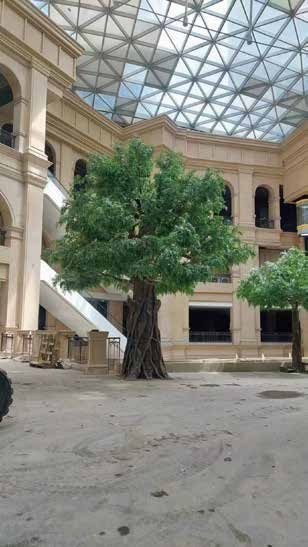
Real projects we have delivered in this category — on-site photographs, no mock-ups.
Specifying an olive tree for a casino or a commercial lobby?
Send the ceiling height, the position on the floor plan, the fire standard and the opening date. We will come back with a form, a model, a base detail and a lead time — normally within 24 hours on business days.