- Flame retardant, flame resistant and fire retardant are used interchangeably in briefs; the word that matters in a specification is the test standard.
- NFPA 701 is the usual requirement in the US, BS 5867 in the UK, EN 13501-1 across the EU — set by where the wall is installed.
- The rating lives in the foliage material, not the backing or the fixings — ask exactly which component was tested.
- Certificates are issued per order; a line in a catalogue is not a document.
- Fire grading is built into the foliage at production — it is not a spray-on treatment added afterwards.
Flame retardant, flame resistant, fire retardant: which word matters?
Buying briefs use the three phrases interchangeably, and so do suppliers. In practice they all describe the same outcome: the foliage should not sustain flame propagation in the test the venue's fire strategy names. The useful word in a specification is none of the adjectives — it is the standard. "Flame retardant to NFPA 701" or "flame resistant foliage walls, BS 5867" tells the supplier exactly what to build and the inspector exactly what to check. A quotation that says only "fire retardant artificial plants" with no standard named is the line to question before you sign it.
Which standard applies to your foliage wall
NFPA 701 is the Standard Methods of Fire Tests for Flame Propagation of Textiles and Films — the test most US architects and venue inspectors name. BS 5867 is the British standard for fabrics used in curtains and drapery, which UK specifiers apply to foliage, with Type B and Type C classes and Type C the more demanding. EN 13501-1 is the EU reaction-to-fire classification for construction products, cited on mainland-European fit-outs. Which standard applies is set by where the wall is installed, not by the supplier's preference — our guide to fire-rated artificial green walls walks through all three in detail.
Where the rating lives: foliage, backing and plants
The rating attaches to the foliage material itself — leaves, blossom and hedging greens — not to the panel backing, the frame or the fixings. That has two practical consequences. A "fire rated green wall" claim may rest on the backing fabric while the foliage is untreated, so ask which component was tested. And freestanding fire retardant artificial plants — lobby trees, potted arrangements — carry the rating on their foliage in the same way, so one per-order document set should cover the whole planting scheme, not only the wall.
The specification checklist
Four lines cover most commercial projects. First, name the standard and class in the enquiry — NFPA 701, BS 5867 Type B or C, or the EN 13501-1 class your specifier lists. Second, require per-order test documents issued against your order number, not a certificate photocopied into a catalogue. Third, confirm the panel system: green wall and hedge panels are priced per square metre, and the flame-retardant grade is built into the foliage before assembly, so the quotation should state the grade component by component. Fourth, keep the documents with the operation and maintenance file — the inspector asks the contractor, and the contractor asks you.
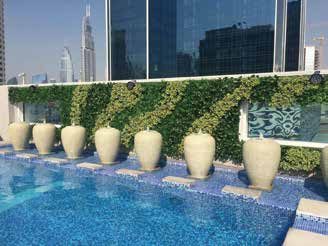
Our certifications page sets out the document set per market, and our delivered Dubai hotel flame-retardant green wall shows what a specified and documented installation looks like in practice.
Keeping the rating meaningful over the wall's life
A flame-retardant grade does not remove the cleaning question — venues still expect foliage free of dust and kitchen grease. The routine is the same as for any installed hedge: dust-and-rinse cycles, mild detergent and fixing checks after storms, set out in our artificial hedge maintenance guide. Keep the test documents with the O&M file so the rating stays verifiable for the life of the installation, and when panels are replaced during a refit, order the replacement foliage to the same named standard.
Frequently asked questions
Is a flame retardant foliage wall the same as a fire rated green wall?
Which fire certificate do fire retardant artificial plants need for a hotel?
What is the difference between flame retardant and flame resistant foliage walls?
Can an existing foliage wall be made flame retardant?
Sources & attributed quotations
Named sources behind this guide. The quotations below are verbatim from the issuing bodies, with outbound links to the official pages.
“This standard establishes test methods to assess the propagation of flame of various textiles and films under specified fire test conditions.”
— NFPA (National Fire Protection Association), NFPA 701, Standard Methods of Fire Tests for Flame Propagation of Textiles and Films (2023 edition), official source
“This part of BS 5867 specifies flammability requirements for fabrics and fabric assemblies for use in the production of non-domestic curtains, drapes and window blinds and for finished articles including combinations of curtains and linings when tested by the methods specified in BS EN ISO 6941 and BS EN ISO 15025.”
— BSI (British Standards Institution), BS 5867, Fabrics for curtains, drapes and window blinds — Flammability requirements — Specification, official source
- NFPA — NFPA 701, Standard Methods of Fire Tests for Flame Propagation of Textiles and Films
- BSI — BS 5867, Fabrics for curtains, drapes and window blinds — Flammability requirements
- Everflorae — Fire & UV Compliance Documentation