What Should You Ask a Ficus Tree Supplier?
Ask an artificial ficus tree supplier for four things before you pay: a production drawing and 3D render to approve, the leaf material (ABS moulded or PU cast), a pack list that matches the numbered QC tags on the tree, and the lead time in writing. Ficus builds run 3–8 m with canopies to 12 m, samples start at 1 piece, and standard lead time is 7–15 days.
October 21, 2026 · Buying & Sourcing · 8 min read · By Everflorae Editorial Team

- The four questions that matter: drawing approval, leaf material, numbered packing list, written lead time. Everything else is secondary.
- Our ficus and banyan line runs 3–8 m high with old-growth canopies up to 12 m wide; the wider tree range is 1–15 m built to drawing.
- Foliage is ABS or PU on a fibreglass, steel or natural-bark trunk; aerial roots are shaped by hand, root by root. MOQ is 1 piece for a sample and 10 for volume; lead time is 7–15 days standard.
What does an artificial ficus tree supplier actually build?
A ficus that survives a lobby is four decisions stacked on each other, and knowing them turns a supplier chat into a specification:
- The skeleton. Fibreglass trunk, steel-core structure or natural bark finish. It carries the canopy load and the anchoring load — the part you never see but always pay for.
- The leaf layer. ABS leaves are injection moulded: crisper edges, tighter repeatability, better for dense uniform canopies. PU leaves are cast: softer, slightly translucent, more like a living leaf at close range. Two-tone foliage — darker face, lighter reverse — is what stops a big canopy looking flat.
- The form. Multi-trunk, umbrella and aerial-root versions are built to drawing; aerial roots are shaped by hand, one at a time, and joined into the trunk. That is the most labour-heavy detail on a banyan-style tree.
- The base. Steel plate, cement-filled or planter-ready — which decides whether the tree bolts down, is ballasted, or drops into a container the architect already specified.
If a supplier cannot say which of those four they control in-house and which they buy in, you are talking to a trading desk rather than a maker. Our artificial trees line is built in our own Guangzhou workshop, and the ficus heights, canopy spreads and trunk options are published on the ficus and banyan tree page.
Which questions separate a maker from a reseller?
Ask these in the first email, before anyone quotes a price. A real manufacturer answers without hesitating, and usually sends photographs as evidence.
- “Can you send the production drawing and a 3D render for approval before you build?” The answer should be yes, and nothing is cut until you approve. A reseller offers a catalogue photo instead.
- “Does every trunk carry a numbered inspection tag?” Ours do, and every branch fork is labelled, so drawing, tree and packing list match at any stage. Ask for a photo of a tagged tree from a comparable order.
- “Who shapes the aerial roots?” If they “come pre-made”, expect a regular banyan. Hand-shaped roots are why two trees of the same height differ by weeks of labour.
- “Can you show me the tree I am buying?” A photograph of your actual tree at full height, against a person or a tape, is the only honest size proof at this scale — and ask how the canopy is packed and re-shaped on site.
The sequence behind those answers tells you where a cheap quote cut corners: see how artificial trees are made in a factory.
How do you verify size and canopy before you pay?
Height is the easiest thing to mis-buy: a “6 m tree” can mean 6 m of trunk, 6 m to the top leaf, or 6 m of canopy spread. Fix the convention in writing and state which number you are buying:
- Finished height — base plate to the highest leaf. Our ficus formats run 3–8 m; the wider tree range covers 1–15 m to drawing.
- Canopy spread — the widest point across the crown. Old-growth banyan builds reach 12 m, a different freight and rigging problem from a 3 m spread.
- Clear trunk — base to the first branch, which decides whether the tree reads correctly above a reception desk.
- Base footprint — the steel plate or planter dimension, which must match your fixing detail.
A one-piece sample closes the gap between drawing and reality: samples start at 1 unit, so you approve leaf texture, colour and gloss in your own daylight before ordering cartons.

What should the quote state about lead time, MOQ and freight?
A quote that only lists a unit price is a starting position. Four commercial numbers have to appear:
- MOQ. 1 piece for a sample, 10 pieces for bulk production. Below that it is a sample transaction, not a wholesale order.
- Lead time. Standard builds ship in 7–15 days; custom trees take 20–45 days, with drawing approval and the 3D render sitting inside that window rather than in front of it.
- Carton count. This is where freight surprises come from: a 10 m tree typically ships in 2–4 packages, because the trunk travels in bolt-together segments and the canopy is packed in numbered bags.
- Who assembles what. Segmented trunks mean on-site assembly: ask for the written sequence and a video call with your crew, which we do as standard on oversized orders.
Ask for carton dimensions and weights at quote stage. Volumetric weight on a 4 m canopy can outweigh the tree itself, and it moves landed cost more than a small gap in unit price.
Which documents should come with an artificial ficus tree wholesale order?
For an artificial ficus tree wholesale shipment going into a commercial building, three document groups matter, and each is issued per order rather than as a generic PDF:
- Fire documentation. Inside an occupied building, specify fire-retardant foliage and ask which standard the parts were tested to — NFPA 701 in the US, BS 5867 in the UK and EU, or EN 13501-1 in the EU. The report should carry the order, not just the product family.
- UV grade declaration. Outdoor positions need outdoor-grade UV stabilisation, rated 3–5 years of colour depending on exposure. Get the grade written on the invoice: indoor and outdoor foliage look identical on arrival.
- Packing list tied to QC tags. Numbered bags and trunk tags should reconcile with the packing list, so a missing branch is a phone call rather than a rebuild.
Our factory evidence page shows what those documents look like in practice, including how test paperwork is issued against a specific order.
How do you compare two artificial ficus tree wholesale quotes fairly?
Two numbers on two emails are not comparable. Line them up on four points, and the cheaper quote usually stops looking cheaper:
- Leaf material and density — ABS versus PU, and how many leaf layers fill the canopy. A sparse canopy at 4 m reads as wire from the mezzanine.
- Trunk construction — fibreglass, steel core or natural bark, and whether the finish is hand-textured. After height, this is the largest cost driver.
- Fire, UV and base type — all three are options, and all three are frequently left off a first quote to make the number look better.
- Carton volume and the render — the freight line nobody compares until the invoice arrives, and a drawing or render charged as an extra.
The structure behind those lines is set out in our comparison of artificial tree trunk materials, and the volume mechanics in how MOQ works on banyan and ficus orders.
Frequently asked questions
What should you ask an artificial ficus tree supplier first?
How much does an artificial ficus tree cost?
How long does an artificial ficus tree wholesale order take?
Is a wholesale artificial ficus tree suitable for a hotel lobby?
Sources & attributed quotations
Named sources behind this guide; the quotations are verbatim from the issuing bodies, with links to the official pages.
“This document specifies methods for exposing plastic specimens to fluorescent UV lamp radiation, heat and water in apparatus designed to simulate the weathering effects that occur when plastic materials are exposed in actual end-use environments to global solar radiation, or to window-glass filtered solar radiation.”
— ISO (International Organization for Standardization), ISO 4892-3:2024, Plastics — Methods of exposure to laboratory light sources — Part 3: Fluorescent UV lamps, official source
“This standard establishes test methods to assess the propagation of flame of various textiles and films under specified fire test conditions.”
— NFPA (National Fire Protection Association), NFPA 701, Standard Methods of Fire Tests for Flame Propagation of Textiles and Films, official source
- ISO — ISO 4892-3:2024, methods of exposure to laboratory light sources, fluorescent UV lamps
- NFPA — NFPA 701, Standard Methods of Fire Tests for Flame Propagation of Textiles and Films
- ASTM International — ASTM G154-23, operating fluorescent UV lamp apparatus for exposure of materials
- Everflorae — Artificial Ficus / Banyan Trees: heights, canopy spreads and trunk options
Related pages
Related project cases
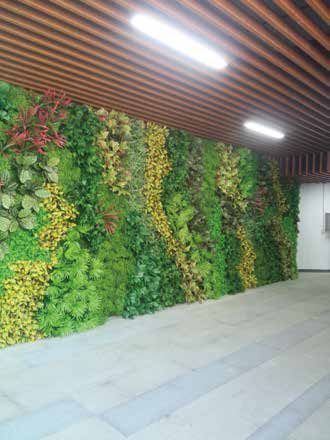
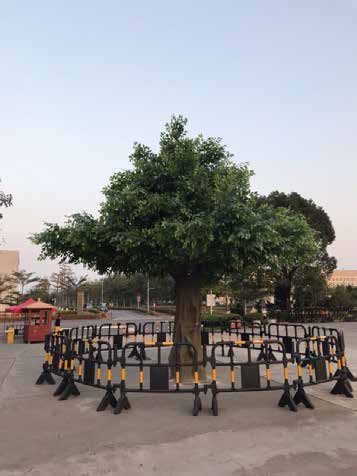
Real installations in this kind of setting — on-site photographs, no mock-ups.
Checking a ficus supplier for a live project?
Send the height, canopy spread, installation setting (interior, atrium, outdoor) and the fire or UV grade your client requires. We will reply with the production drawing route, carton counts and lead time — normally within 24 hours on business days.
Sister brand · GardenStone
Pair it with landscaping stone (GardenStone)
From the same supplier group — GardenStone supplies decorative pebbles, gravel and landscape stone that complete the same hotels, resorts, malls and Japanese gardens. One source for the whole landscape.
Explore GardenStone →