What Should You Ask an Artificial Green Wall Manufacturer?
Ask an artificial green wall manufacturer five questions: what stem density the panels carry (a working benchmark is 90–120 stems per m²), which backing system suits your site, which fire standard the foliage is tested to and whether the report is issued per order, how batch-to-batch colour consistency is controlled, and how the MOQ works — panel orders start at 50 m² and standard production runs 7–15 days.
November 3, 2026 · Buying & Sourcing · 9 min read · By Everflorae Editorial Team

- Density and weight are checkable numbers: ask for 90–120 stems per m² and 4–6 kg per m², then verify both on a sample.
- Backing decides where the wall can go — indoor foam, outdoor iron mesh or UV-grade plastic mesh, not one mesh for everything.
- Fire performance must arrive as a per-order test report against a named standard: NFPA 701, BS 5867 or EN 13501-1.
- Panel MOQ starts at 50 m², mixable across foliage styles on the same grid; engineered walls are quoted from drawings.
What does an artificial green wall manufacturer actually build?
The first thing to establish is that "green wall manufacturer" covers two different products, and a supplier that only makes one will quote the other badly.
The first is the modular panel: a square or rectangle of pre-planted foliage on a backing grid, produced in standard formats. Ours run 1 × 1 m as the standard tile, 85 × 85 cm and 100 × 100 cm squares, 50 × 100 cm rectangles and round mats of Ø50 and Ø75 cm. Panels interlock on the same mounting grid, so a buyer can mix foliage styles freely within one wall. This is the line distributors buy by the pallet and the line most "artificial green wall" search results actually refer to.
The second is the engineered wall: a floor-to-ceiling build on a frame designed for the specific wall, often with concealed irrigation provision, quoted from an elevation drawing. Framing, access and height change this build far more than the greenery does, which is why a serious manufacturer asks for your drawing and site photos before quoting rather than reciting a per-square-metre number. Ask any supplier which of the two they are quoting — the answer tells you whether the figure that follows means anything.
How do you verify a density claim like 90–120 stems per m²?
Density is the number that separates a wall that reads as planting from one that reads as a printed mat, and it is also the number most easily inflated in a catalogue. Our benchmark is roughly 90–120 stems per m² depending on species, and a panel of that density weighs about 4–6 kg per m². The weight is the buyer's leverage: stems and leaves are physical material, so a panel claimed at the same density but weighing half as much is telling you something.
Three checks settle it. Ask for a head-on photograph at working distance, not a three-quarter render — the panel edge and any visible backing show immediately. Ask for the weight per m² in writing on the quotation. And order one sample panel before the full area, weigh it, and look at it from the distance your visitors actually see the wall. A lobby read from four metres tolerates a lower grade than a restaurant read from one metre, and knowing which you have bought is worth more than any catalogue adjective.
Which backing system should the manufacturer quote for your site?
The backing is the part of a panel the visitor never sees and the specifier should never ignore, because it decides whether the wall survives its location. A manufacturer offering a single all-purpose backing is cutting the range down to what is cheapest to stock.
Three backings cover commercial work. An EPE foam layer bonded to iron mesh suits indoor walls: the foam deadens sound slightly, holds stems firmly and presents a clean panel edge where people get close. Galvanised iron mesh is the outdoor and fire-rated option — it carries FR-treated foliage, drains freely and survives facade exposure. UV-resistant plastic mesh with snap-fit connectors is the UV outdoor grade for facade and open-air projects, lighter to handle and corrosion-free where the mesh itself would weather. Indoor spec, ask for the EPE and iron mesh build; outdoor or FR spec, ask for galvanised mesh; exposed facades, ask for the UV plastic mesh. If a quotation does not state which backing is included, that is the first question back.

What fire documentation should come with the order?
In commercial interiors the planting is part of the fit-out, and the fit-out is documented. A manufacturer selling into hotels, malls and offices should be able to treat the foliage against a named standard and issue a test report per order — not per catalogue.
The standards to ask about depend on the project's jurisdiction. US projects normally specify NFPA 701, the flame-propagation test for textiles and films. UK projects specify BS 5867, the flammability specification for curtain and blind fabrics, commonly at Part 2 grade. EU projects specify EN 13501-1, the reaction-to-fire classification for construction products. Operators with properties in several regions often ask for all three so one specification travels between countries.
Two details decide whether the paperwork survives a consultant's review. The report must name the standard, the edition and the material actually tested — a certificate that says only "flame retardant" documents nothing. And it must be issued against the foliage supplied with your order, because fire treatment is a production step on the goods, not a property of the product family. Ask for the report with the purchase order, not after arrival.
How does artificial green wall MOQ work?
MOQ is where buying a green wall differs from buying most other artificial planting, and it is worth understanding the mechanics before comparing quotations.
For modular panels, the MOQ is 50 m². That figure is not per style: because every panel interlocks on the same mounting grid, the 50 m² can mix foliage styles freely — a moss band at the base, a fern mix through the middle, a flowering panel as an accent — which is exactly how a designed wall is composed anyway. Fifty square metres is a workable pilot for most commercial projects: a reception feature wall of about 7 × 7 m fits inside it with room for a corridor section, so the buyer tests the manufacturer's density, colour and packing on real square metres before committing a larger area.
Engineered floor-to-ceiling walls are quoted project by project instead of against a fixed MOQ, because the frame is built to the drawing: a 3 m wall behind a reception desk and a 12 m atrium face share no bill of materials. Ask the manufacturer to state the MOQ logic in the quotation itself — panels by the square metre, walls by the drawing — and treat any supplier quoting a single per-m² price for both as one who has not read your wall.
Freight completes the MOQ picture. Panels at 4–6 kg per m² are weight-light but volume-heavy: ask for carton dimensions and cubic metres per panel with the quotation, because the shipping line prices the air in the carton as readily as the foliage.
How do you check batch-to-batch consistency before a large order?
A 300 m² rollout rarely ships in one batch, and the failure mode is not quality — it is tone: a wall where the second batch reads half a shade greener than the first, visible along the seam where the two meet.
Four controls prevent it. Ask the manufacturer to retain a physical colour standard for your foliage style, so a re-order in two years is checked against the same reference your first order was. Order the full area in as few production batches as the schedule allows, and sequence the installation so batch boundaries fall on architectural breaks — column lines, door heads, frame joints — not in the middle of a sightline. Ask how panels are labelled and packed per carton, so the installer hangs panels from one batch in one zone. And for engineered walls, ask for the panel layout drawing early: a numbered layout converts a colour question into a placement instruction.
What lead time and logistics should you expect?
Standard modular panels take 7–15 days to produce. Engineered walls take 20–40 days, because the framing is fabricated to the site drawing and the drawing has to be approved before fabrication starts. Both figures are production windows — add sea or air freight on top, and confirm the incoterm before comparing quotations.
Two logistics items belong in the purchase order rather than in a late email. Packing: panels should be cartoned flat with the foliage protected, and carton quantity per m² stated, because the installer's first day is decided by whether cartons arrive zoned by area. Installation support: a manufacturer should supply a starter kit and a written fixing guide, and distributors should receive installation material they can forward to their own customers — if a supplier cannot produce the guide, they are trading the product rather than making it.
Send the wall area, the site type, the fire standard and the target delivery window, and a manufacturer's quotation should come back line-itemed against exactly those four variables — normally within 24 hours on business days.
Frequently asked questions
What should you ask an artificial green wall manufacturer?
What is the MOQ for artificial green wall panels?
How long does a green wall manufacturer take to deliver?
Can a manufacturer document fire performance for indoor commercial use?
Sources & attributed quotations
Named sources behind this guide; the quotations are verbatim from the issuing bodies, with links to the official pages.
“This standard establishes test methods to assess the propagation of flame of various textiles and films under specified fire test conditions.”
— NFPA (National Fire Protection Association), NFPA 701, Standard Methods of Fire Tests for Flame Propagation of Textiles and Films (2023 edition), official source
“This document provides the reaction to fire classification procedure for all construction products, including products incorporated within building elements with the exception of power, control and communication cables which are covered by EN 13501-6.”
— CEN (European Committee for Standardization), EN 13501-1, Fire classification of construction products and building elements — Part 1: Classification using data from reaction to fire tests, official source
- NFPA — NFPA 701, fire tests for flame propagation of textiles and films
- CEN — EN 13501-1, reaction to fire classification of construction products
- BSI — BS 5867-2:2008, flammability requirements for curtain and blind fabrics
- Everflorae — Fire & UV Compliance Documentation
Related pages
Related project cases
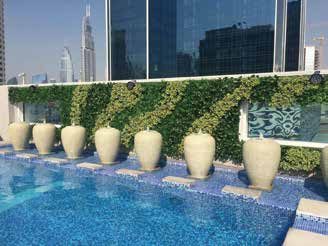
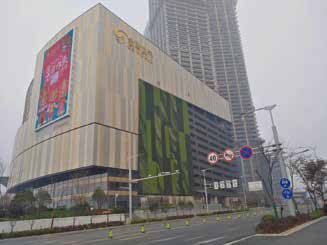
Real projects we have delivered in this category — on-site photographs, no mock-ups.
Sourcing green walls from a manufacturer?
Send the wall area, the site type, the fire standard and the delivery window. We will come back with density, backing, panel formats, MOQ and lead time — normally within 24 hours on business days.
Sister brand · GardenStone
Pair it with landscaping stone (GardenStone)
From the same supplier group — GardenStone supplies decorative pebbles, gravel and landscape stone that complete the same hotels, resorts, malls and Japanese gardens. One source for the whole landscape.
Explore GardenStone →