What Is the Best Artificial Green Wall for a Commercial Building?
The best artificial green wall for a commercial building is a modular panel system built from UV-stabilised ABS or PU foliage on a rigid backing grid, fire-rated to NFPA 701, BS 5867 or EN 13501-1 where the code requires it. Order a 1-piece sample first; standard panels ship in 7-15 days, made-to-order walls in 20-45 days.
October 27, 2026 · Buying & Sourcing · 8 min read · By Everflorae Editorial Team

- "Best" for a commercial building is a specification: panel format, foliage material, fire standard and UV grade — not a product photo.
- Most office and lobby walls use 50 × 100 cm or 100 × 100 cm modules at 90-120 stems/m², mounted on a shared grid; heights run from 1 m feature panels to full floor-to-ceiling runs.
- Foliage is UV-stabilised ABS (injection-moulded) or PU (cast) on a rigid backing; outdoor UV grade carries a 3-5 year colour-retention expectation.
- Timing: 1-piece sample first; standard panels ship in 7-15 days, made-to-order engineered walls in 20-45 days.
What makes a green wall the best fit for a commercial building?
A commercial building lobby, atrium or corridor is a high-traffic, highly photographed space, and the green wall there is inspected by a facilities manager, a designer and often a fire officer before anyone enjoys it. So when a buyer searches for the best artificial green wall for commercial building projects, the honest answer is a specification, not a product name.
Four things decide whether a wall survives that scrutiny:
- Panel format and coverage. A dense module hides the backing grid from any angle. Commercial-grade panels run 90-120 stems/m², and thin, gappy panels read as fake the moment someone stands at arm's length.
- Foliage material. ABS (injection-moulded, holds its shape, UV-stabilised) or PU (cast, softer hand-feel) — each has its place, and a quotation should name which one you are buying.
- Fire standard. A named number — NFPA 701, BS 5867 or EN 13501-1 — where the building code or the landlord requires one.
- UV grade. Sunlit atriums and glazed concourses fade single-dye foliage within a season; the wall should specify the UV-stabilised grade used for permanent outdoor install.
A wall that cannot be described in those four terms is a catalogue photo, not a specifiable item.
Panel formats and how they map to the building
Modular panels are not one size; the right format depends on the wall's height and the join pattern you want:
- 50 × 100 cm — the workhorse for tall, narrow runs and column wraps; two modules stack to a 2 m bay with a near-invisible seam.
- 100 × 100 cm — faster coverage for broad lobby feature walls; fewer joins per square metre.
- Mixed and blended panels — combining two or three foliage mixes breaks up repetition so a large wall does not read as a repeating tile under downlights.
Whatever the format, it should mount on a shared backing grid with the same workshop tolerances as the rest of the range. Our green walls & hedges line is produced in the same Guangzhou workshop as our trees and topiary, which is what lets a building mix formats without a colour or density mismatch.

UV stability and colour retention in sunlit atriums
Glazed atriums, concourse windows and lobby entrances put "indoor" walls under real sunlight. Direct sun through glass fades single-dye foliage within a season, so a wall in a sun path should be specified with the same UV-stabilised grade used for permanent outdoor installation. Our outdoor UV grade carries a 3-5 year colour-retention expectation; indoor-grade foliage away from direct sun keeps its colour longer. Write the UV grade into the specification per placement — a wall behind a reception desk and one in a south-facing atrium do not need the same grade, and paying for UV stability where it is not needed is money off the density budget.
Fire safety — flame-retardant green walls and the standards that matter
Commercial buildings are strict environments for artificial greenery, and the specification is a standard number, not an adjective. The three most commonly cited frameworks:
- NFPA 701 — the US standard test methods for flame propagation of textiles and films; the usual ask for commercial and hotel projects in North America and the Gulf.
- BS 5867 — the British specification for flammability of curtain and blind fabrics, frequently written into UK FF&E schedules.
- EN 13501-1 — the European reaction-to-fire classification for construction products, cited across EU commercial builds.
Require the named standard and a test report in writing. A supplier claim of "flame retardant" without a standard number is not a specification, and it will not survive a building's fire officer. Our compliance documentation lists the standards available per product line, and our fire-certificate guide explains how each one is tested.
The best artificial green wall for a hotel lobby — and how it differs
The best artificial green wall for hotel lobby spaces follows the same four-part spec as an office building, with two extra pressures: a lobby is the most photographed room in the property, and it often carries a hospitality fire code on top of the building code. Practically that means a denser mix at eye level (guests stand beside it), a blended foliage pattern so a 6-10 m feature wall does not repeat, and a named fire standard written into the FF&E schedule. Height matters less than seam-hiding — lobbies want a continuous green surface, so 100 × 100 cm panels with near-invisible joins are usually the better call than 50 × 100 cm. Where a lobby also takes full-size trees (our range runs 1-15 m), the wall anchors the lower level and connects the canopy to the human scale of the room.
How much does a commercial green wall cost?
There is no honest fixed list price, because cost scales with four variables a buyer controls:
- Panel format and area. Foliage volume and module count grow with the wall's square metres; a 2 m column wrap costs far less than a 40 m² feature wall.
- Foliage material. Cast PU costs more than injection-moulded ABS; blended multi-mix walls sit above single-mix.
- Fire certification. A named standard adds testing and treatment cost — worth it, and unavoidable where the code asks.
- Quantity. Project volumes price better than a single feature panel; minimums per design are covered in our green wall vs live wall cost guide.
Send the wall dimensions, the foliage mix and the fire and UV specification, and the quotation comes back line-itemed against those variables — normally within 24 hours on business days. That is the only comparison method that survives a second bidder.
How long does a commercial green wall order take?
Scheduling runs through the approval chain. Sampling comes first — a 1-piece sample panel of the exact mix, approved before production. Standard modular panels then ship in 7-15 days; made-to-order engineered walls, blended mixes and fire-treated runs take 20-45 days including drawing approval. For project volumes and mixed shipments with other formats, see our green wall lead-time guide.
Frequently asked questions
What is the best artificial green wall format for a commercial building?
How much does a commercial artificial green wall cost?
How long does a UV-stabilised green wall keep its colour?
Is a flame-retardant green wall required for commercial buildings?
Sources & attributed quotations
Named sources behind this guide; the quotations are verbatim from the issuing bodies, with links to the official pages.
"This standard establishes test methods to assess the propagation of flame of various textiles and films under specified fire test conditions."
— NFPA (National Fire Protection Association), NFPA 701, Standard Methods of Fire Tests for Flame Propagation of Textiles and Films (2023 edition), official source
"This document provides the reaction to fire classification procedure for all construction products, including products incorporated within building elements with the exception of power, control and communication cables which are covered by EN 13501-6."
— CEN (European Committee for Standardization), EN 13501-1, Fire classification of construction products and building elements — Part 1: Classification using data from reaction to fire tests, official source
- NFPA — NFPA 701, fire tests for flame propagation of textiles and films
- CEN — EN 13501-1, reaction to fire classification of construction products
- BSI — BS 5867-2:2008, flammability requirements for curtain and blind fabrics
- Everflorae — Fire & UV Compliance Documentation
Related pages
Related project cases
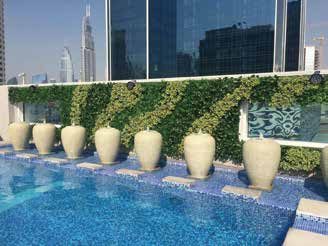
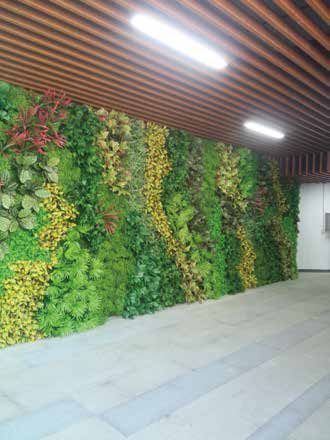
Real projects we have delivered in this category — on-site photographs, no mock-ups.
Specifying a green wall for a commercial building?
Send the wall dimensions, the foliage mix, and the fire and UV specification. We will come back with the specification sheet, panel pricing and lead time — normally within 24 hours on business days.
Sister brand · GardenStone
Pair it with landscaping stone (GardenStone)
From the same supplier group — GardenStone supplies decorative pebbles, gravel and landscape stone that complete the same hotels, resorts, malls and Japanese gardens. One source for the whole landscape.
Explore GardenStone →